
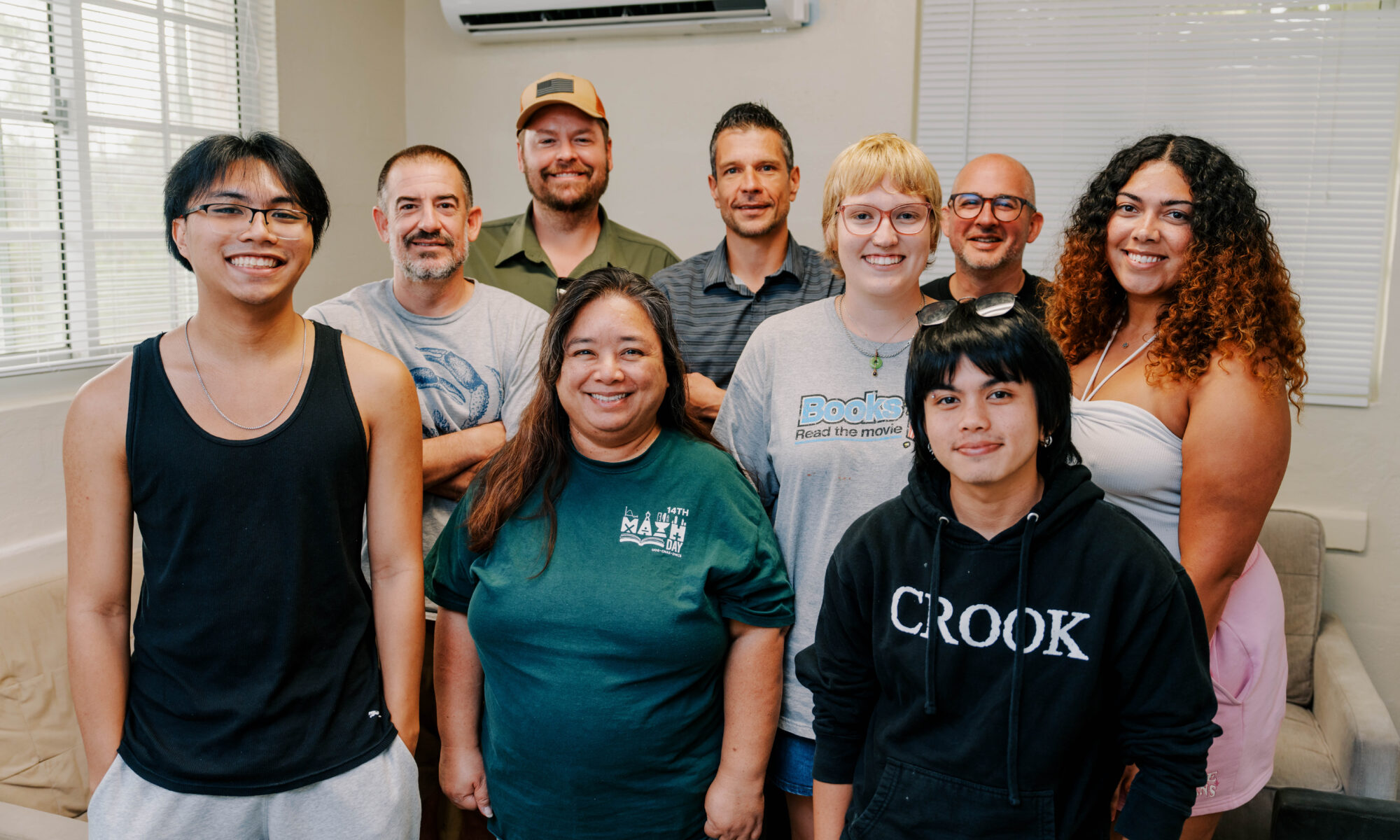
The Guam National Science Foundation Established Program to Stimulate Competitive Research (Guam NSF EPSCoR) E-RISE and E-CORE programs welcome five University of Guam graduate students as Graduate Research Assistants (GRA) for the 2026-2027 school year.
The GRA program provides UOG-enrolled graduate students with support for three years in their pursuit of a master’s degree. The E-RISE (Research Incubators for STEM Excellence) project specifically aims to support students interested in marine biology and ecosystem research, while the E-CORE (Optimizing Research Infrastructure on Guam [ORIG]) project aims to develop higher education STEM pathways through collaborations between academic and primary partners.
This GRA cohort consists of:
- Robert “Trey” Ward (E-RISE) – Master’s in Science Education, Bachelor’s in Biology, assisting Tom Schills, Ph.D.
- Sydney Payne (E-RISE) – Bachelor’s in Biology, assisting Tom Schills, Ph.D.
- Jade Peairson (E-RISE) – Bachelor’s in Marine Biology, assisting Rob Lasley, Ph.D.
- Kai Chaco (E-RISE) – Bachelor’s in Biology, assisting Michalis Mihalitsis, Ph.D.
- Johndeo Bulatao (E-CORE) – Bachelor’s in Mathematics, assisting Leslie Aquino, Ph.D.
Under the guidance of Tom Schills, Ph.D., Ward and Payne will be focusing on research towards the rejuvenation of Guam’s coral reefs. Both GRAs will be utilizing different methods and instruments to study calcifying organisms around our reefs, in efforts to understand what organisms may be able to assist in the growth and health of our coral. Ward will be working with reef habitat observation cubes, while Payne will be working with structured promotion photogrammetry.
Regarding the work his GRAs will be getting into, Schills describes it as “an ecosystem approach of how our reefs doing, what’s the health of our reefs, and what can we expect in the future because we see these transitions taking place underneath.”
Peairson will be assisting Rob Lasley, Ph.D., in the collection and categorization of organisms to document Guam’s biodiversity. As Curator of Crustacea, Dr. Lasley and his team at the Guam Center for Biodiversity Research (GCBR) work on providing baseline data and surveys of Guam’s biodiversity to be accessed freely by any interested parties. While Lasley focuses specifically on crabs, the GCBR team collects and houses diatoms, the herbarium, ichthyology, invertebrate zoology, macroalgae, and tissues.
“Guam’s a really strategic place to do biodiversity research,” Lasley stated. “We have the most diverse coral reefs of any US state or territory, and so the idea is… combining all those collections into one digital roof so that we can disseminate all the data that we collect.”
Chaco will be assisting Michalis Mihalitsis, Ph.D., in the study of fish morphology. Chaco heard about the opportunity to work under Mihalitsis from Kate Moot, Ph.D., Associate Professor of Biology at the UOG College of Natural Sciences. Chaco will be working under Mihalitsis alongside GRA Joe Elper, who was brought on as an E-RISE graduate research assistant in March of this year.
Leslie Aquino, Ph.D., will be mentoring Bulatao in data science and modeling, alongside Hyunju Oh, Ph.D., and Joo-Chul (JC) Yoon, Ph.D. Bulatao has worked with the three professors as part of the EPSCoR Summer Math Research Program, once as a participant through GECCO (Guam Ecosystems Collaboratorium for Corals and Oceans) and again just this past summer as a Research Assistant through E-RISE. Under the three-professor team, Bulatao will be working on data science and machine learning, often utilizing and analyzing research provided by fellow EPSCoR faculty mentors and researchers.
These five latest GRAs will share lab time under their faculty mentors with undergraduate Student Researchers – fellows under the EPSCoR E-CORE Student Research Experience (SRE). Students from both research programs will often be working on the same projects, with many SREs continuing their work after graduation into the GRA program. In addition to time in the lab, GRAs and SREs alike will get many opportunities to network outside of the classroom through local and national science conferences.
This GRA cohort will receive constant guidance from Christina Mantanona, Research Mentoring Lead for Guam NSF EPSCoR E-RISE. Throughout the program, Mantanona will be keeping in close contact with the cohort to receive updates and assuring everything is on track.
“We want to build the community within this cohort, you’ll be joining with those who are already in the program, and then you all are new to the program, we want to get you involved,” Mantanona described. “We know that there’s incredible research being done here, and that you all are very much a part of. You have a voice at academia, and we want to help you or support you in that.”
The Guam NSF EPSCoR GRA program support includes a tuition waiver for up to 12 credits, research training, faculty mentorship, possible travel opportunities, and a monthly stipend. Availability varies year to year, and applications and more information about the program can be found at guamepscor.uog.edu.