
2022 GRA: Meet our new graduate research assistants!  

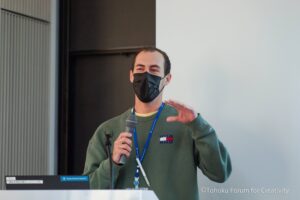
Xavier De Ramos

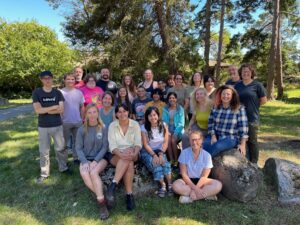
This year, Guam NSF EPSCoR welcomed six new members of its Graduate Research Assistantship program. Over the next three years, these graduate students will receive mentorship, training, and fieldwork experience as they pursue their master’s degree.   

Grace Jackson 

Having grown up in a small beach town in Southern California, Grace Jackson has lived her life surrounded by water.  

“This instilled in me the love for the ocean and later my scientific curiosity,” said Jackson. “I applied to this program to increase my scientific proficiency where I could learn about a different ecosystem and culture that I have not experienced before. I am so glad to be a part of this program.”  

Under the guidance of Tom Schils, Ph.D., Jackson will study crustose coralline red algae, specifically of the genus Lithophyllum.  

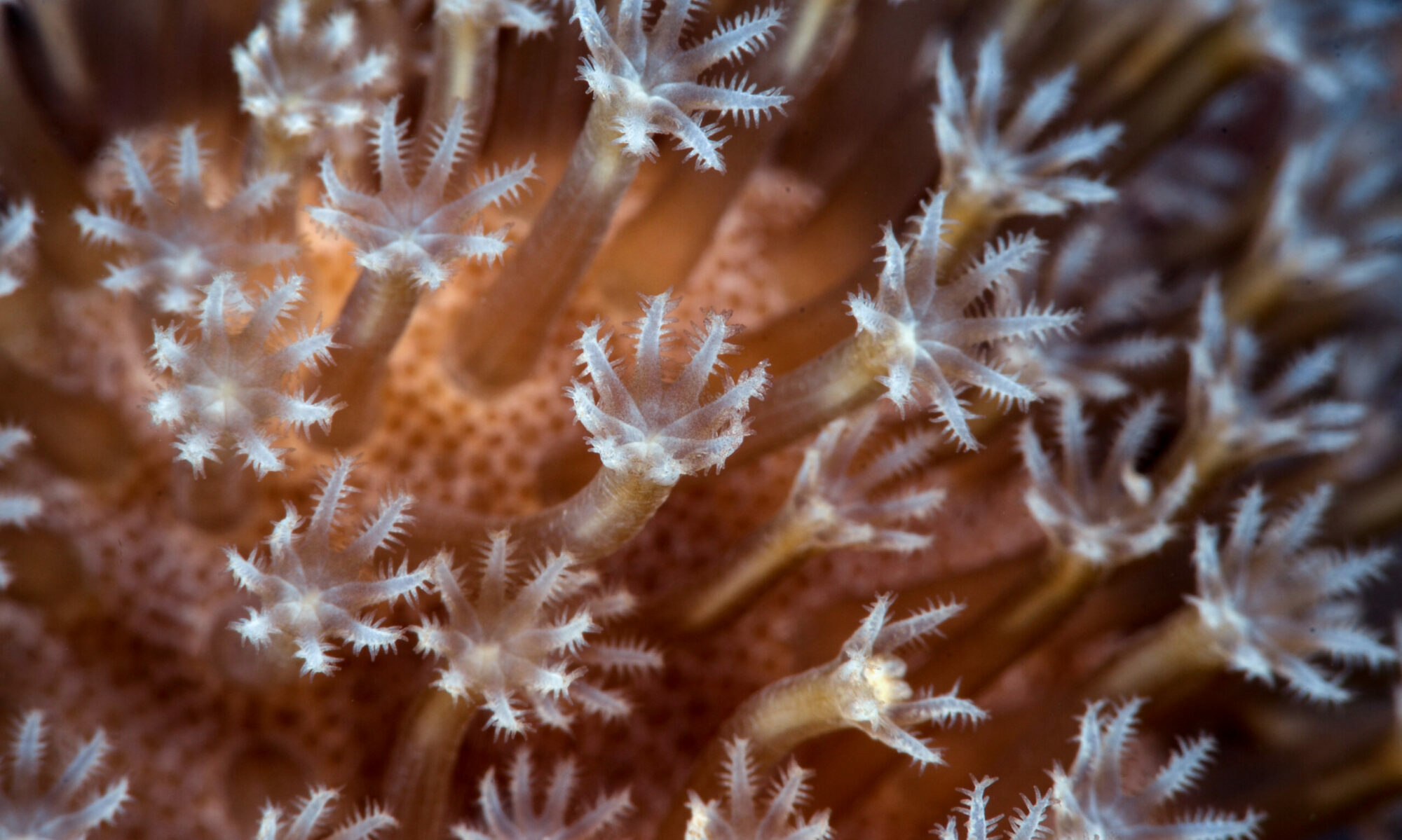
CCRA is a group of marine seaweeds that deposits limestone like stony corals. They serve several important ecological functions on reefs, such as building and cementing reefs together or serving as the preferred settlement substrates for coral larvae, which then further develop into adult colonies. 

Lauren Kallen  

Lauren Kallen applied to the Guam NSF EPSCoR GRA program due to the benefits and support that the program provides to its students. Kallen was born and raised in Illinois and earned her bachelor’s degree in marine biology at the University of California, Santa Cruz.  

Kallen’s advisor is Sarah Lemer, Ph.D., whose work focuses on the study of marine invertebrates. Over the course of the program, Kallen will conduct research on Drupella snails, carnivorous marine snails that feed on coral. Her research will focus on outbreaks of these snails on coral reefs because in high densities, these snails can quickly decimate a reef.  

I am very excited and grateful to be in this program, it is an amazing opportunity. I am very interested in outreach and giving back to the beautiful community in Guam,” said Kallen.   

Garret O’Donnell  

While looking for potential graduate programs, Garret O’Donnell found out about the Guam NSF EPSCoR program through his mentors from the University of Florida. 

Under the guidance of David Combosch, Ph.D., O’Donnell will study Leptoria, a genus of brain coral. O’Donnell said that he is interested in Leptoria’s population genetics, spawning behavior, and abiotic stress responses to factors such as heat and low oxygen.  

Since coming to Guam, O’Donnell said that he appreciates the UOG Marine Laboratory community.  

“I think everyone there has been super welcoming and super cohesive as a unit and that’s been really cool to see,” said O’Donnell. “Everyone seems to know what everybody else is doing and that’s not something you always see in science. A lot of the time, labs are kind of isolated from each other. I like to see that there’s a lot of camaraderie amongst the students and the faculty.”   

Andrew O’Neill  

Throughout his life, Andrew O’Neill found a love for the ocean. As he pursued his undergraduate degree at the University of California, Santa Cruz, he wanted to specialize in ecology and conservation. Once he learned about the Guam NSF EPSCoR GRA program, he saw it as a unique opportunity to do research and help the environment.  

During the program, O’Neill will be advised by Atsushi Fujimura, Ph.D., and plans to focus on research the effects of sedimentation on Guam’s reef fish assemblages.  

“In my first semester here, I did some instructing with some of the undergraduate biology sections and through that, I learned the Guam has a huge sedimentation problem,” said O’Neill. “Lots of silt gets washed away from all the rains and the rivers and flows down to the coastal waters. I want to figure out what would be the worst-case scenario if we don’t fix this problem.”  

Xavier De Ramos  

Knowing that he wanted to find ways to help the island, De Ramos earned a bachelor’s degree in marine biology at the University of Hawai’i, Manoa. 

“Towards the halfway point of my time in college, I started thinking about Guam – my home,” said De Ramos. “I remember having a lasting impression after I went snorkeling and I was just blown away about what I saw down there. That got me thinking about what kind of issues Guam is facing or if there was anything I could do to contribute to research regarding its coral reefs.”  

De Ramos will be advised by Ciemon Caballes, Ph.D., whose research focuses on ecophysiology as well as coral and echinoderm ecology.  

“I feel very excited about learning more through this program and my graduate courses because I want to give back to the island,” said De Ramos. “At the end of the day, giving back to the island is all that matters to me.”  

Graduate biology student attends University of Washington summer research program 

Therese Miller Photo 2

University of Guam graduate biology student and Guam NSF EPSCoR graduate research assistant Therese Miller gained research experience this summer through a course held by the University of Washington. The class was called Biodiversity and Integrative Taxonomy of Invertebrates and was held at the university’s field station in Friday Harbor Laboratories on San Juan Island from July 18 to August 18, 2022.  

The course focused on methods for documenting and describing the species-level diversity of invertebrate animals through activities such as field trips to collect samples, dissecting, photography, and genetics work.  

The class was taught by two instructors: Gustav Paulay, Ph.D., a curator and professor at the University of Florida who served as the director of the UOG Marine Laboratory from 1991 to 2000 and has extensive experience in studying marine invertebrate zoology.  

Kevin Kocot, Ph.D., a curator and professor at the University of Alabama, hosted workshops on bioinformatics and studying meiofauna. Bioinformatics is an interdisciplinary field that develops software and tools to understand biological data. Meiofauna are small invertebrates that live on or near the bottom of bodies of water.  

“Together, they not only encouraged our passions for studying marine biodiversity but also equipped us with the tools to further our careers,” said Miller.  

Over the course of the program, Miller worked on a research project that involved describing species of blood stars (Henricia), a sea star found along the Pacific Coast which is typically red-orange in color but can vary from tan to almost purple. 

“Historically, what appear to be several different species are all called the same name in the literature or are left undescribed,” said Miller. “My project entailed collecting about 50 specimens of these sea stars and taking DNA from them to see how closely they were genetically related.”  

During the course, she found two specimens of a species that were the first to be sampled in the Juan de Fuca Island strait. This species had previously been found along California and Oregon.  

Throughout her time in Washington, Miller was able to see cultural aspects of San Juan Island such as various small farms throughout the island as well as a fishing vessel that belonged to the indigenous Native American tribes of the Pacific Northwest.   

“It was fascinating to learn about some of the native tribes that have lived in the area for several centuries,” said Miller. “I also relearned the importance of characterizing biodiversity in the anthropogenic age, particularly for marine species, which are largely understudied compared to terrestrial fauna. This is especially important to me living on Guam since marine biodiversity here is so rich and there is so much to research and explore. I felt this course really inspired me to open my eyes more to the world around me and consider what species here have yet to be identified.” 


Groundbreaking delegation of UOG students set to present at largest diversity in science conference in the country

Alyssa Calalo 1

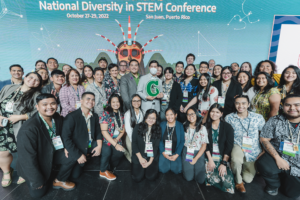
Over 30 Tritons will represent the University of Guam at the largest multidisciplinary and multicultural STEM diversity event in the country next week as the Society for the Advancement of Chicanos/Hispanics and Native Americans in Science (SACNAS) presents the National Diversity in STEM conference in San Juan, Puerto Rico.

Student researchers funded under the National Science Foundation Guam Established Programs to Stimulate Competitive Research (EPSCoR) and the Inclusion across the Nation of Communities of Learners of Underrepresented Discoverers in Engineering and Science Supporting Emerging and Aquatic Sciences (INCLUDES SEAS) programs will take the stage to present the findings of their recent research projects.

“UOG is taking big steps to make STEM careers more accessible to our local students,” explained principal investigator Austin Shelton, Ph.D. “Supported by grants, our students will present their research at the national level and get exposure to hundreds of new career and scholarship opportunities.”

A total of five students from EPSCoR and four students from INCLUDES SEAS were selected from student submissions from all over the country to present their research, which is the largest number of student researchers ever accepted from UOG.

Through the grant-funded trip, students like Antoni Badowski, an undergraduate biology major at UOG and a Guam NSF EPSCoR student researcher, will have the opportunity to meet with students, mentors and teachers from around the world.

“I am very excited to go to SACNAS and present my research,” said Badowski. “This will be my first off-island conference and I look forward to gaining experience and networking with others in my field of interest.”

Badowski will present his research regarding the genetic barcoding of amphidromous shrimp species native to Guam. Amphidromous shrimps migrate between freshwater and saltwater. Once the barcoding is complete, photo documentation along with preserved specimens, tissue biopsies, and genomic DNA extracts will be entered into the UOG Biorepository. This study will allow more extensive genetic analyses to be conducted in the future and serve as a guide for effective conservation efforts. He is under the mentorship of Daniel Lindstrom, Ph.D.

Along with grant-provided funding and local scholarships from the Research Corporation of the University of Guam, about half of the student researchers were awarded travel scholarships by the SACNAS organization.

The SACNAS conference will be held from October 27 through October 29 and will be held in-person for the first time since 2019. The conference was held virtually in 2020 and 2021 due to pandemic restrictions.

Six new graduate research assistants join Guam NSF EPSCoR

2022 GRA Orientation Photo 2

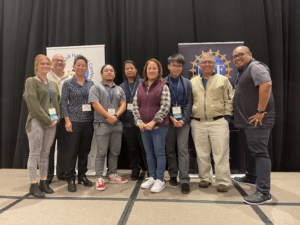
Guam NSF EPSCoR welcomed six new members to its Graduate Research Assistantship program during an orientation held on Friday, August 26, 2022.  
 
Over the course of the three-year program, these six graduate research assistants will receive tuition coverage, a salary, as well as mentorship and support over the course of their graduate program as they conduct research regarding coral reefs, coastal systems, genetics and genomics, or identifying patterns of regional biodiversity.  
 
These new GRAs include Grace Jackson, Lauren Kallen, Andrew O’Neill, Xavier De Ramos, Zoe Trumphour, and Garret O’Donnell.  
 
“I would like to welcome our new students to the program,” said Terry Donaldson, the principal investigator and director of the Guam NSF EPSCoR program. “You will get to utilize equipment, instruments, and various assets to conduct your research that people used to dream about. When I was a student, a lot of this stuff had not been invented yet. You’ve earned your place here. We’re behind you and we want you to succeed.”  

The GRA program is part of Guam NSF EPSCoR’s goal to develop a research program to help ensure the sustainability of coral reef ecosystems in the face of environmental change. In total, Guam NSF EPSCoR now has 20 graduate research assistants.  
 
Each of the graduate research assistants were given free memberships to the Guam Green Growth Makerspace and Innovation Hub. Guam NSF EPSCoR helps support Guam Green Growth.  

“This is like a whole other fancy lab,” said Austin Shelton, Guam NSF EPSCoR’s co-principal investigator and the director of the University of Guam Center for Island Sustainability and Sea Grant. “Outside of campus, you can go down to the CHamoru Village in Hagatña and use 3D printers, CNC routers, and laser cutters as well as brand new terracotta printers. If anybody wants to use that to build tiles to start growing stuff on, you can plug in the 3D designs and start building there.”  

For three years, these students will be a part of a project that covers a diverse range of research areas.  

“For this grant, the research crux here involves understanding why some corals are more resilient than others, climate change and temperature increases, and watershed degradation and sedimentation,” said Bastian Bentlage, co-principal investigator of the Guam NSF EPSCoR. “We have a lot of associated research projects, as well. Some of you will focus on coralline algae, crustaceans, diatoms, as well as fish that spend part of their life in freshwater systems and then another in the ocean. There’s a broad variety of research areas, but the overarching theme is how our reefs will fare in a changing climate.”  

The new graduate research assistants will also be able to access near-peer mentorship opportunities in which they can learn from their peers and postdoctoral students as well as teach undergraduate and high school teachers over the course of their term. 

“This program is such a great opportunity, especially for master’s students,” said Garret O’Donnell, a new graduate research assistant. “It’s very well-funded compared to a lot of master’s programs. When it comes to other universities, sometimes students would have to pay for their positions, so it’s helpful to have a salary on top of my tuition coverage that allows me to do this.”  

Five students gain valuable experience through summer research program  

2022 PSU Photo 1

Over the course of eight weeks, five undergraduate students gained valuable scientific experience, discovered more about themselves, and explored different research areas through the NSF INCLUDES: SEAS Bridge to Ph.D. Program held at Pennsylvania State University.  

These student researchers include Louise Pascua, Gabriella Prelosky, Anela Duenas, Anna Aguirre, and Merry Remetira.  

For these student researchers, it was their first time participating in an off-island research program. The program was held from June to August 2022.  

“My experience during the summer was so much fun! I was able to do research on something I had zero experience in which was terrifying but also very enjoyable,” said Louise Pascua, a biology major and a 2022 Guam NSF EPSCoR student researcher. “It’s a little cliche to say, however I do believe that my love for science has been re-ignited. I made many life-long friends and built many professional relationships, while also finding myself.”  

During the program, Pascua was placed under the mentorship of Jason Rasgon, an entomology professor at PSU. For her independent research project, she focused on genetically modifying eye color in Culex tarsalis mosquitoes using ReMOT Control. ReMOT Control is similar to CRISPR technology however ReMOT Control injects the adults to send the gene cutting complex to the embryos rather than injecting the embryos directly, according to Pascua.  

Anela Duenas, a biology major and 2021 NSF SEAS research fellow, experienced some culture shock when it came to conducting research in a new environment.  

“This program made me realize that I am more interested in the ecological aspects of research after working with more hands-on activities in the greenhouse for my project,” said Duenas. “I also experienced a culture shock when first arriving to the United States as it was my first time. A culture shock not only because of a new location but also in science. It was incredible to witness the laboratories and equipment available to students at Pennsylvania State University. Overall, it was very eye opening and made me excited to be in this field.”  
 
Under the mentorship of Francesco Di Gioia, an assistant professor at PSU, Duenas studied alternative growing media for the production of microgreens.  

Over the course of the program, the student researchers faced challenges and research areas they were not familiar with all while gaining the skills and knowledge to become confident in their ability to adapt and persevere.  

“There was definitely a learning curve with certain aspects of my research just because there were procedures or techniques that I haven’t done beforehand,” said Anna Aguirre, a biology student and a 2021 NSF SEAS research fellow. “However, I did my part with taking notes and trying to be as proactive in learning as I can be and suddenly the learning curve was not so intimidating.”  

Aguirre studied plant pathology and environmental microbiology under Sharifa Crandall, an assistant professor at PSU. For her project, she looked at how soil steaming and later final beneficial and pathogenic amendments might affect plant growth.  

For one student, this experience helped them learn how to speak up when they need help. 

“My main challenge is that I have insecurities when it comes to what I know and what I can offer,” said Merry Remetira, a civil engineering student and a 2021 NSF SEAS research fellow. “This in turn can make me fear reaching out to a mentor and explaining what I really feel. I tend to just accept what is instructed of me and try not to question anything. I was also advised to stop apologizing so much, that to only apologize when responsibility is due. That was a truly enlightening experience and I will work on that challenge.”   

Remetira was mentored by Margaret Byron, an assistant professor of mechanical engineering at PSU. For her project, she studied how oil-particle aggregates formed using a roller tank to simulate how particles would interact in the environment.  

For Gabriella Prelosky, a biology student and a 2021 NSF SEAS research fellow, being in the program helped renew her excitement for science and her future. 
  
Prelosky studied under Natalie Boyle, an assistant research professor at PSU. Her research project involved calculating the lethal dose curve of 50% of alfalfa leaf cutting bees using an insecticide compound known as acetamiprid in varying doses.  

“This experience most definitely has affected my goals. Before participating in the bridge program, I was almost certain I did not want to pursue a master’s degree after graduating next spring due to extreme burnout, but this program showed me both the highs and lows in a positive light. I now know that after a break, I am definitely going for a master’s,” said Prelosky. “My advice for this program, but also others, be confident in yourself. Things may not go how you want it the first time, but the more you fall, the more you learn!” 
 

Multi-agency ocean cleanup removes blue green algae 

DSC00570

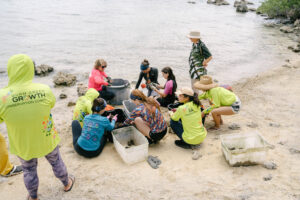
The University of Guam Marine Laboratory led a multi-agency volunteer effort on July 7 to successfully remove blue green algae at the USO Beach in Piti.  

That day, volunteer divers and snorkelers from the National Oceanic and Atmospheric Administration (NOAA), National Park Services (NPS) joined the team from the Marine Lab in manually removing the algal blooms from the coral colonies in the area. 

Meanwhile, Guam Green Growth Conservation Corps and UOG Sea Grant and Center for Island Sustainability interns provided onshore assistance by sorting and sifting through the material collected from the ocean. 

Laurie Raymundo, director of the UOG Marine Laboratory and biology professor, said environmental conditions encourage the excessive growth of these long, hair-like algal blooms, “We’ve noticed years ago that seasonally, we got these blooms of blue-green algae of the genus Lyngbya and it tends to come into the water as soon as it gets warmer. Most blue green algae respond to high nutrient waters, which is most of Guam.” She added that the algae blooms smother the corals and cause tissue loss. 

The G3 Conservation Corps and CIS/SG interns separated fish and other marine creatures from the piles and squeezed seawater from the algae. The team collected the piles in buckets and then taken back to UOG to be used as plant and tree mulch. In total, the cleanup team collected and processed three 27-gallon buckets of algae. 

While hard at work, G3 Conservation Corps member Dulce Imbo described the task assigned to the onshore volunteers, “We are trying to remove the algae from channel under the water so that we can have the corals breathe a little easier because these algae are the ones that suffocate the corals. For the Guam Green Growth Conservation Corps, there’s about nine of us here today, accompanied by our interns in our work.” 

G3, is a public-private partnership created to achieve a sustainable future. Aligned with the 17 United Nations Sustainable Development Goals, G3’s efforts are designed to cultivate an ecosystem for transformative action to achieve a sustainable, prosperous, and equitable future for Guam. 

Bridge to Bachelor’s interns cap summer experience with poster presentation   

DSC04279
DSC04279

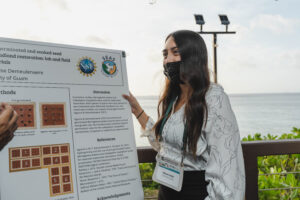
The Micronesia Summer Bridge to Bachelor’s Program culminated its 2022 cycle with a poster presentation by its summer interns in July at the University of Guam Microscopy Teaching & Research Laboratory. The presentations highlighted new species found in the Micronesia region.  

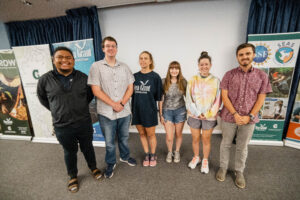
The four students were the first batch of program interns to participate on-campus as the University eases its COVID-19 restrictions. Yuji Chibana and Rhiden Moreno from Palau Community College presented a poster on “Palau Mangrove and Coral Reef Diatoms with Emphasis on Gyrosigma Regional Diversity.” Meanwhile, Jemalynn Iguel and Angel Santos from the Northern Marianas College presented on “Saipan Diatoms with Emphasis on Plagiotropis Regional Diversity.”  

Diatoms are single-celled algae found in oceans, lakes, and rivers. These microorganisms thrive in marine and freshwater habitats and produce 20 percent of the breathable oxygen on earth each year.  

Chibana and Moreno worked on several samples taken from mangrove and coastal areas in Palau and Yap.  Moreno said, “We found three species, two of which are new. This extends Palau’s library of Gyrosigmas from eight to ten.” The two species identified were the Gyrosigma variistriatum v2 and Gyrosigma bowtie. 

Meanwhile, the Saipan team found 12 Plagiotropis species from specimens collected in Saipan and 17 species collected from Palau. According to Iguel, samples extracted from the same site revealed diatom species that share similar characteristics, which supported the theory of regional endemicity.  

The students started their internship in June by gathering diatom and algae samples in several mangrove and coastal sites on Guam. The collected samples contributed to an ongoing diatom research supported by the National Science Foundation’s Established Program to Stimulate Competitive Research (EPSCoR).

Professor Emeritus of Biology Dr. Christopher Lobban and his team of EPSCoR and NSF INCLUDES SEAS Islands Alliance supported student researchers/mentors worked closely with the interns in analyzing the samples at the EPSCoR-funded lab. NSF EPSCoR Student Research Experience and NSF INCLUDES: SEAS Islands Alliance undergraduate student researchers Khazmyne Kawamoto and Monita Paul served as student mentors to the Saipan and Palau teams, respectively. 

The overall research project seeks to determine and document the native diatom species in the region, especially on Guam, CNMI, Palau, FSM, and the Marshall Islands. “Basically, what we are trying to look for is to look for a signal for regional endemicity. So, we are looking at species that occur here but not in other places,” Dr. Lobban said in an earlier interview about the overall project. 

The Micronesia Summer Bridge to Bachelor’s program offers opportunities to students from the Micronesian region who are interested in Science Technology Engineering and Mathematics (STEM) research. Participants of the program receive a $3,000 stipend; comprehensive research training; faculty and near-peer mentorship; and travel, lodging, and food accommodations for those traveling to Guam.   

The UOG Center for Island Sustainability and UOG Sea Grant in partnership with the UOG School of Education oversees the program. It is funded by a grant from the National Science Foundation through UOG’s Inclusion Across the Nation of Communities of Learners of Underrepresented Discoverers in Engineering and Science (INCLUDES) Supporting Emerging Aquatic Scientists (SEAS) Islands Alliance Guam Hub.   


Musicians connect with community at G3 Makerspace  

G3 Workshop 2

Two Guam-grown musicians talked story about their roots and culture as part of the second installment of the Guam Green Growth Makerspace’s “Seed Talk Sessions,” a series of developmental opportunities offered by the facility in which industry professionals engage island community members to stimulate creativity and encourage local entrepreneurship. The event took place at the facility’s innovation hub in the CHamoru Village on July 1, 2022.  

Born and raised in Guam, Peter “Håle’” Cruz grew up listening to classic rock and eventually transitioned into creating reggae music. For five years, he played with local island band Table for Five. Upon moving stateside, Cruz joined Tribal Theory, a reggae group, and toured the United States, Guam, and Hawai’i. After departing Tribal Theory in 2019, he formed Håle, which focuses on Marianas reggae music and draws inspiration from the CHamoru culture and Guam.  

Shiabe “Bok” Pangelinan grew up in Yigo in a musically talented family. The son of the late Frank “Bokonggo” Pangelinan, a traditional CHamoru musician, Pangelinan played the local music scene with D.U.B. and Soul Vibes. Much of his music is inspired by his CHamoru heritage and culture.  

During their presentation at the G3 innovation hub, Cruz and Pangelinan shared guidance on how to be a successful musician on Guam. They discussed earning royalties, distribution, and general tips about the music industry.  

“I wanted to talk about the life and the struggle of being someone who left Guam and trying to make it happen for themselves,” said Cruz. “I think that’s really important. If it wasn’t for that part of my life and being with the CHamoru community here, I don’t think I would be here.”  

When asked about what advice they would give to aspiring musicians, Cruz and Pangelinan said to be driven and take risks when you can.  

“Whenever you play, keep in mind that you don’t know who’s going to be in that crowd,” said Pangelinan. “It can be the worst gig, but you shouldn’t dismiss them. I’d play in random bars and people would ask me for my number and I’d have a better gig set up. A lot of the times people are scared, but when you push yourself to a point where you know what’s going to happen, it’s going to happen. You can’t second guess yourself.”  

Math students present research on coral reef dynamics

2022 SMRP Photo 1

Six students presented their research about the effects of coral bleaching, coral diseases, rising temperatures, and controlling crown-of-thorns (COTS) starfish populations using mathematical modeling this summer as part of the 2022 Summer Joint Math Research Program showcase held on July 15. The students – five undergraduate students and one high school student – were part of the 2022 Summer Math Research Experience held from May 23 to July 16 at the University of Guam.  

The program was part of the Guam Ecosystems Collaboratorium for Corals & Oceans (GECCO) project, funded by the university’s Guam NSF EPSCoR grant. 

“You’ve inspired research by what I have seen from the titles of your projects,” said Austin Shelton, the director of the UOG Center for Island Sustainability and Sea Grant, during the showcase’s opening remarks. “These are the kinds of things the community needs to understand our coastal and terrestrial resources.”  

The Summer Math Research Experience was held in conjunction with two other research programs: the Young Research Experience in Mathematics and the National Research Experience for Undergraduates Program.  

Using data collected from researchers at the UOG Marine Laboratory, the models were developed to use as a tool to forecast changes in the island’s coral reefs.  

“Creating these mathematical models is important so that we can see and predict the changes from these environmental situations,” said UOG Assistant Professor Mathematics Jaeyong Choi, one of the program’s mentors. ”Using the mathematical models, we can use them to simulate situations based on the data collected from the researchers at the marine laboratory.”  

During the program, the students were split into two teams to focus on two projects.  

The first group looked at whether rising sea surface temperatures were a bigger threat to Acropora pulchra and Porites populations than crown-of-thorns starfish, which prey on stony coral. Outbreaks of these starfish can cause severe damage to coral reefs over just a few weeks.  

 “Applying math to science feels like you’re exploring,” said Siwen “Lulu” Shao, a high school student at St. John’s Catholic School. “You never encounter the same problem. When we built this complex mathematical model, all you have to do is change numbers and parameters and this model would be able to apply to any COTS and any coral relationship in the world.” 

The second group focused on how two different coral species – Acropora pulchra and Porites massive – react in situations of bleaching and disease along with how the presence of seaweed inhibits their ability to recover. 

“Being in this program has been pretty amazing and eye-opening,” said Ernie Samelo, an undergraduate mathematics major at the University of Guam. “I’ve learned a lot of stuff about math and applying it in real life and coral. Corals are something I never thought would have so many layers to it. I’ve loved every moment of this program.” 

Student researchers from Palau and CNMI explore mangrove sites

DSC06979

In June, participants of the Micronesia Summer Bridge to Bachelor’s Program from the Commonwealth of the Northern Mariana Islands and Palau started their internship experience on island by gathering diatom and algae samples in several mangrove and coastal sites on Guam. The program contributes to an ongoing diatom research supported by the National Science Foundation’s Established Program to Stimulate Competitive Research (EPSCoR). 


The Micronesia Summer Bridge to Bachelor’s program offers opportunities to students from the Micronesian region who are interested in Science Technology Engineering and Mathematics (STEM) research. Participants are enrolled at the Northern Marianas College, Palau Community College, the College of Micronesia-FSM, or the College of the Marshall Islands.  


The students who were selected to participate in the summer program come from diverse academic backgrounds. Prior to their trip to Guam, the student interns collected marine and coastal data in their respective areas.  


On Guam, Professor Emeritus of Biology Dr. Christopher Lobban and his team of EPSCoR and NSF INCLUDES SEAS Islands Alliance supported student researchers/mentors are working closely with the students in analyzing the samples at the UOG Microscopy Teaching & Research Laboratory 


“The idea of this research experience is to give the students a chance to see what it’s like to do scientific research,” said Dr. Lobban. At the EPSCoR funded lab, the students have access to a scanning electron microscope (SEM) and other innovative equipment to study detailed images of the samples. 


According to Dr. Lobban, the overall research project seeks to determine and document the native diatom species in the region, especially on Guam, CNMI, Palau, FSM, and the Marshall Islands. Diatoms are single-celled algae found in oceans, lakes, and rivers. These microorganisms produce 20 percent of the breathable oxygen on earth each year.  


Basically, what we are trying to look for is to look for a signal for regional endemicity. So, we are looking at species that occur here but not in other places,” Dr. Lobban said. Samples collected in the previous year’s program resulted in student researchers discovering and naming several previously undocumented types of algae and diatoms. 


Yuji Chibana, one of the student interns from Palau said the program spurred his interest in Scientific research. “I’m a liberal arts major and I am trying to transition more into a Science-based major like Environmental Marine Science.


The experience catapulted me into that area of learning. This program is really helping me. I’ve never really been exposed into these kinds of things before. So, it is a good start.  


Participants of the program receive a $3,000 stipend; comprehensive research training; faculty and near-peer mentorship; and travel, lodging, and food accommodations for those traveling to Guam.