
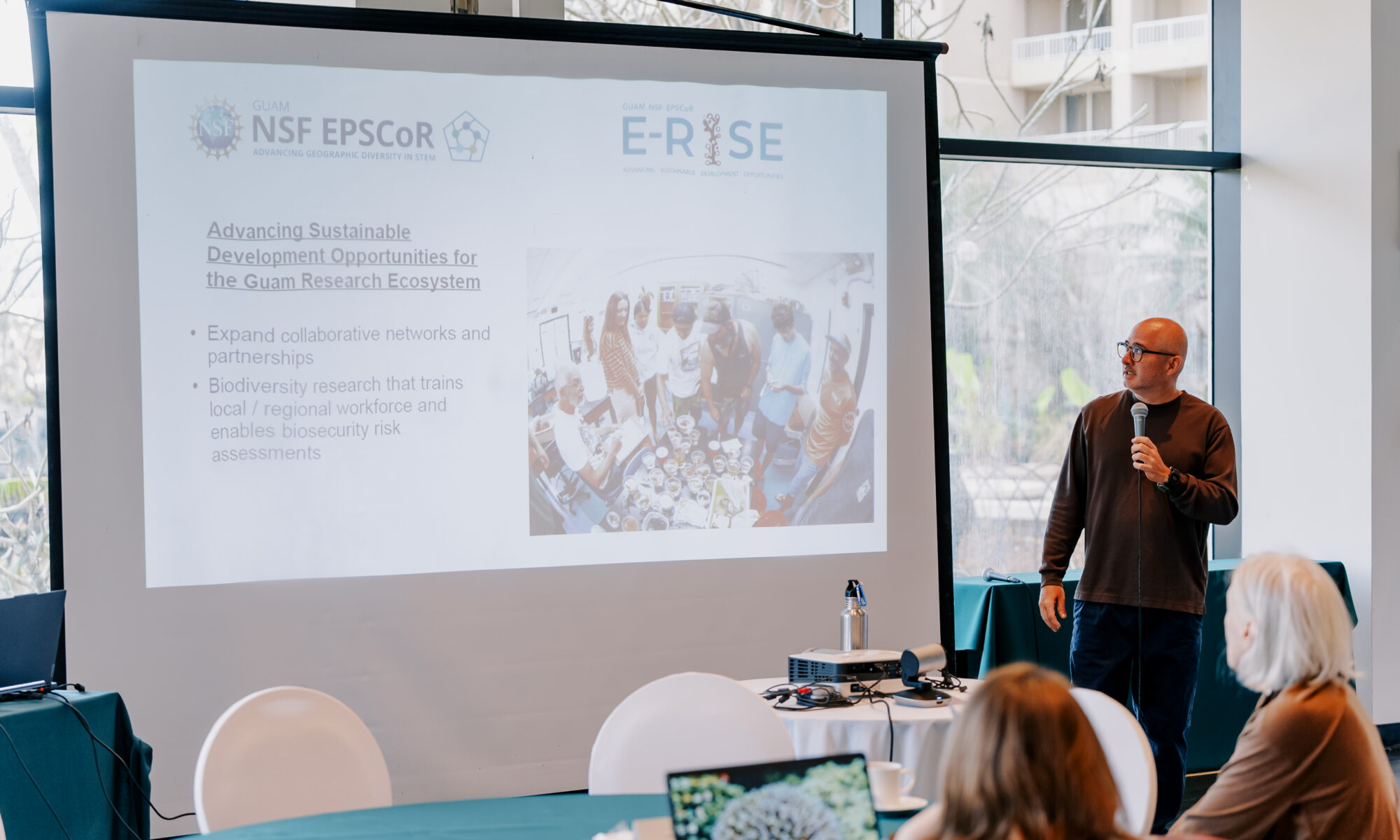
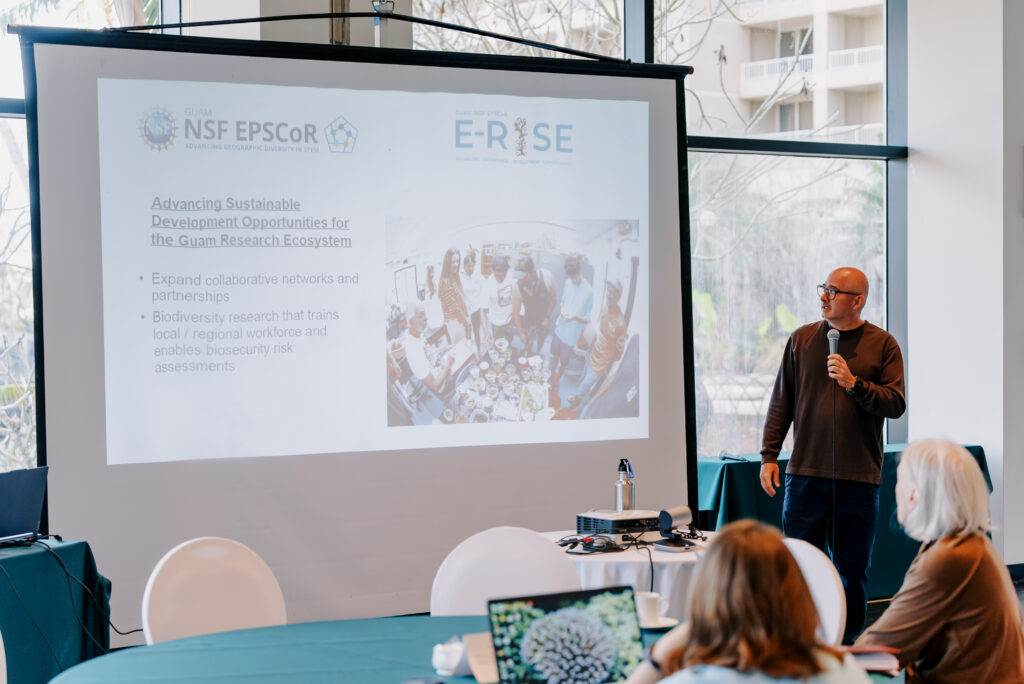
UOG Associate Professor of Bioinformatics and E-RISE principal investigator Bastian Bentlage, Ph.D., set the tone for collaboration on Tuesday at the 17th University of Guam Conference on Island Sustainability as he opened the Guam NSF EPSCoR ECORE Research Grant Workshop, highlighting its discussion-driven format and calling on participants to actively exchange ideas, explore project concepts, and learn from one another.
He highlighted the goal of understanding attendees’ research interests and proposal needs in order to better connect them with resources and support systems, including the University of Guam’s research offices and partners, stating: “I also want to not just talk to you, but also learn from you what you’re actually interested in working on, what kinds of proposals or projects you’re trying to develop, so we get a better idea of how we may support you.”
He provided an overview of the NSF EPSCoR program, explaining that it was established to build research capacity in underfunded states and territories like Guam. Since 2015, EPSCoR investments have supported major initiatives, including a $6 million initial grant followed by a $20 million project focused on coral reef ecosystems, environmental resilience, and workforce development. Current efforts under the E-RISE program continue this work through research incubators, biodiversity studies, and training opportunities that extend beyond academia into local and regional agencies, while also enabling broader impacts such as biosecurity risk assessment.
The workshop includes presentations and technical sessions designed to strengthen research capacity, featuring:
- UOG Vice Provost Pamela Peralta Taitano, Ed.D. on “The Principal Investigator’s (PI) Guide to Research;”
- Dean of the UOG College of Natural and Applied Sciences (CNAS) Rachel Leon Guerrero, Ph.D. on “Start with the Win: Crafting Specific Aims for Success;”
- Associate Professor of Mathematics Leslie Aquino, Ph.D., on the Guam NASA EPSCoR and its Seed Grant Program.
Additional sessions cover federal grant writing norms, characteristics of fundable proposals, and steps for turning ideas into competitive grant applications.
Bentlage also outlined the goals of the ECORE program, which aims to strengthen Guam’s research ecosystem by fostering connections among institutions, improving facilities, and creating pathways for student development and careers in science.
He stressed that projects should be designed with broader impact in mind, noting: “I would like to encourage everyone to think about your projects more broadly, in addition to the research you’re doing, how does that impact our community, our workforce, and what’s the long-term impact?”
He emphasized that the program is intended to support researchers by filling gaps, assisting with grant development, and leveraging established networks. Bentlage also expressed hope that the grant workshop would be the first in a continuing series designed to strengthen collaboration and build a more connected research community.