
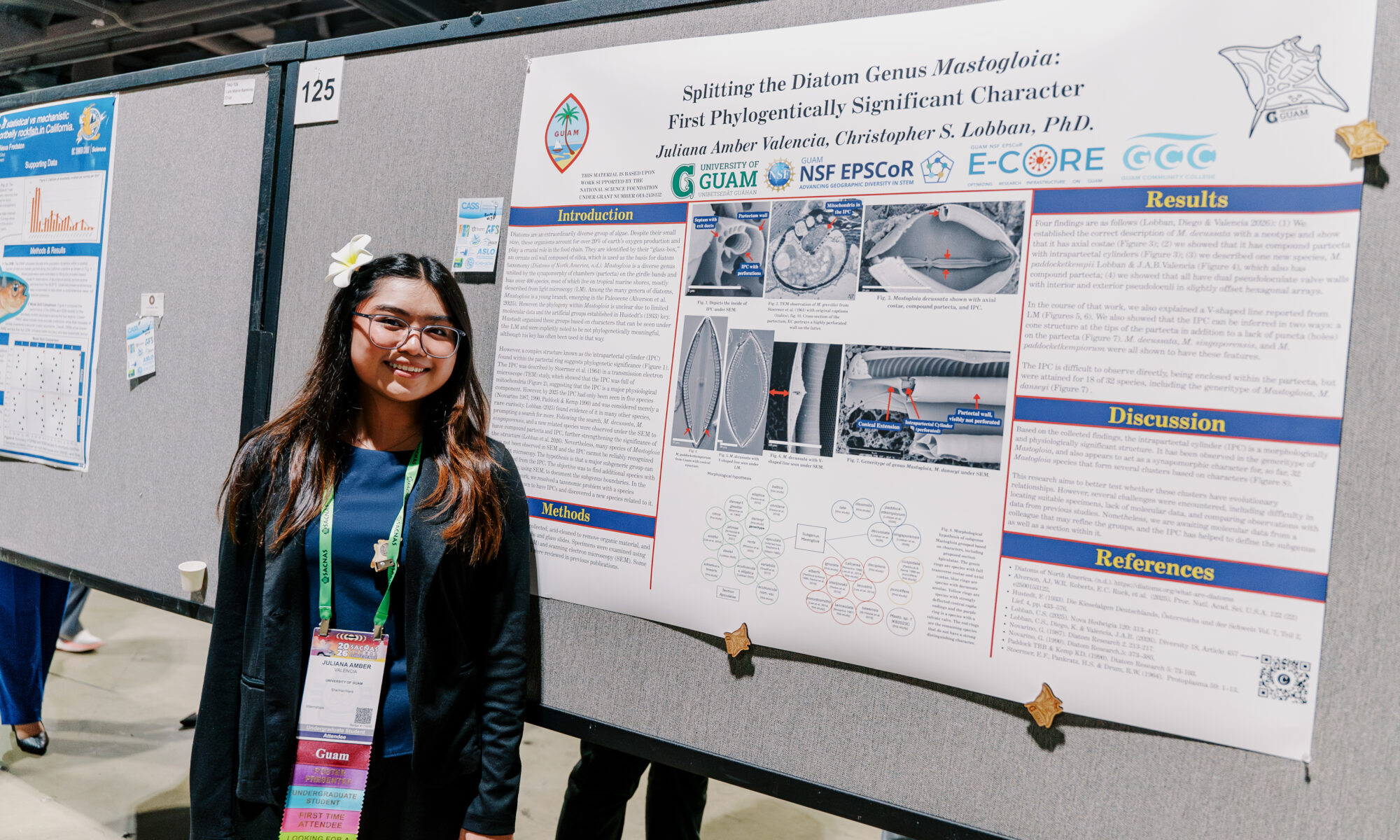
University of Guam student Juliana Amber Valencia helped describe a new diatom species and presented the findings at the 2026 SACNAS Annual Conference in Long Beach, California.
Her mentor, UOG Professor Emeritus of Biology Christopher S. Lobban, Ph.D., and their poster, “Splitting the Diatom Genus Mastogloia: First Phylogenetically Significant Character,” also suggest that a tiny, overlooked structure shared by the new species could help scientists reorganize one of the largest groups of marine diatoms.
Diatoms are algae with glass-like cell walls made of silica. Despite their size, they produce over 20% of the Earth’s oxygen and are an important part of the food chain. The genus Mastogloia, which has over 400 species and lives mostly on tropical marine shores, is defined by small chambers called partecta. Valencia and Lobban focused on a structure inside those chambers, the intrapartectal cylinder (IPC), which had been seen in only five species before 2025.
Valencia added: “Further investigation allowed us to discover that the IPC is present in many Mastogloia species, including those that looked similar to our new species, but it is not present in all of them. Thus, we hypothesize that the IPC is a major physiological structure that may be used to describe a major subgeneric group.”
According to the poster, Lobban described the new species in a 2026 paper co-authored with Valencia and Kendrick Diego. Like its close relatives, it has compound partecta, the IPC, and a double-layered cell wall. The team also corrected the description of a related species, M. decussata, by designating a neotype, a new reference specimen.
Using scanning electron microscopy, the team found evidence of the IPC in 18 of 32 species studied, including the type species of Mastogloia.
Valencia said the research started with her interest in the microscope itself. “I was inspired to pursue this research topic specifically because of the Scanning Electron Microscope. However, upon entering Dr. Lobban’s lab, I realized that diatoms are a niche and unexplored area, especially on Guam, and I was ecstatic to be able to contribute even just a sliver of knowledge.”
Her message for others is that small projects matter. “One key takeaway that I hope people will learn is that any contribution to research is a major win for Guam, even for microscopic things like diatoms! There is no research that is trivial, no matter how small it seems. Not only does our knowledge expand science as a whole, but we islander researchers can proudly say that our work was done right here on our beautiful island of Guam.”
At the conference, Valencia said she was most looking forward to “meeting other student researchers with niche topics.” She said, “Diatoms are quite an overlooked area, so I find myself leaning towards keeping an eye out for projects that cover something from a very specific nook of science.”
The research was supported by the Guam NSF EPSCoR E-CORE program.
AT A GLANCE
- The big idea: The study looked at a tiny internal structure that may offer a better way to divide diatoms in the genus Mastogloia, and led to the description of a new species.
- What’s a diatom? A microscopic alga that lives inside a “glass box,” a cell wall made of silica. Diatoms produce over 20% of the Earth’s oxygen and are a key part of the food chain.
- What’s the IPC? The intrapartectal cylinder is a structure inside the chambers (partecta) that define Mastogloia.
- What they did: The team collected marine samples, cleaned them with acid, and examined the specimens under light and scanning electron microscopes
What they found:
- A new species related to M. decussata
- A corrected description of M. decussata, including its IPCs.
- Signs of the IPC in 18 of 32 species, including the type species of Mastogloia.
- Two clues that point to an IPC: a cone structure at the tips of the partecta, and a lack of holes on the partecta
What it means: The IPC appears to be an important feature for defining a major subgroup of Mastogloia. Challenges remain, including finding suitable specimens and a lack of molecular data, but the team is awaiting molecular data from a colleague that may refine the groups.
Acknowledgments
The material for the poster is based on work supported by the National Science Foundation under grant number OIA-2438132.