
UOG grad student explores the small world of meiofauna

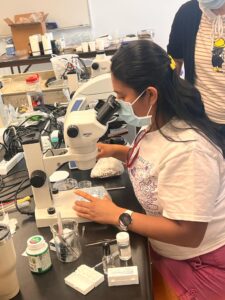
Meiofauna Workshop Photo 3

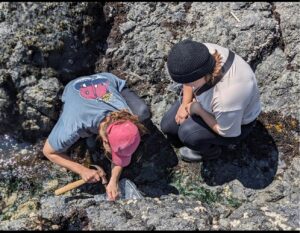
Sarai Vega, a biology graduate student from the University of Guam was one of 13 participants selected worldwide to attend the 2023 Dauphin Island Sea Lab Meiofauna Diversity and Taxonomy Workshop in Alabama from May 10 to May 19, 2023.  

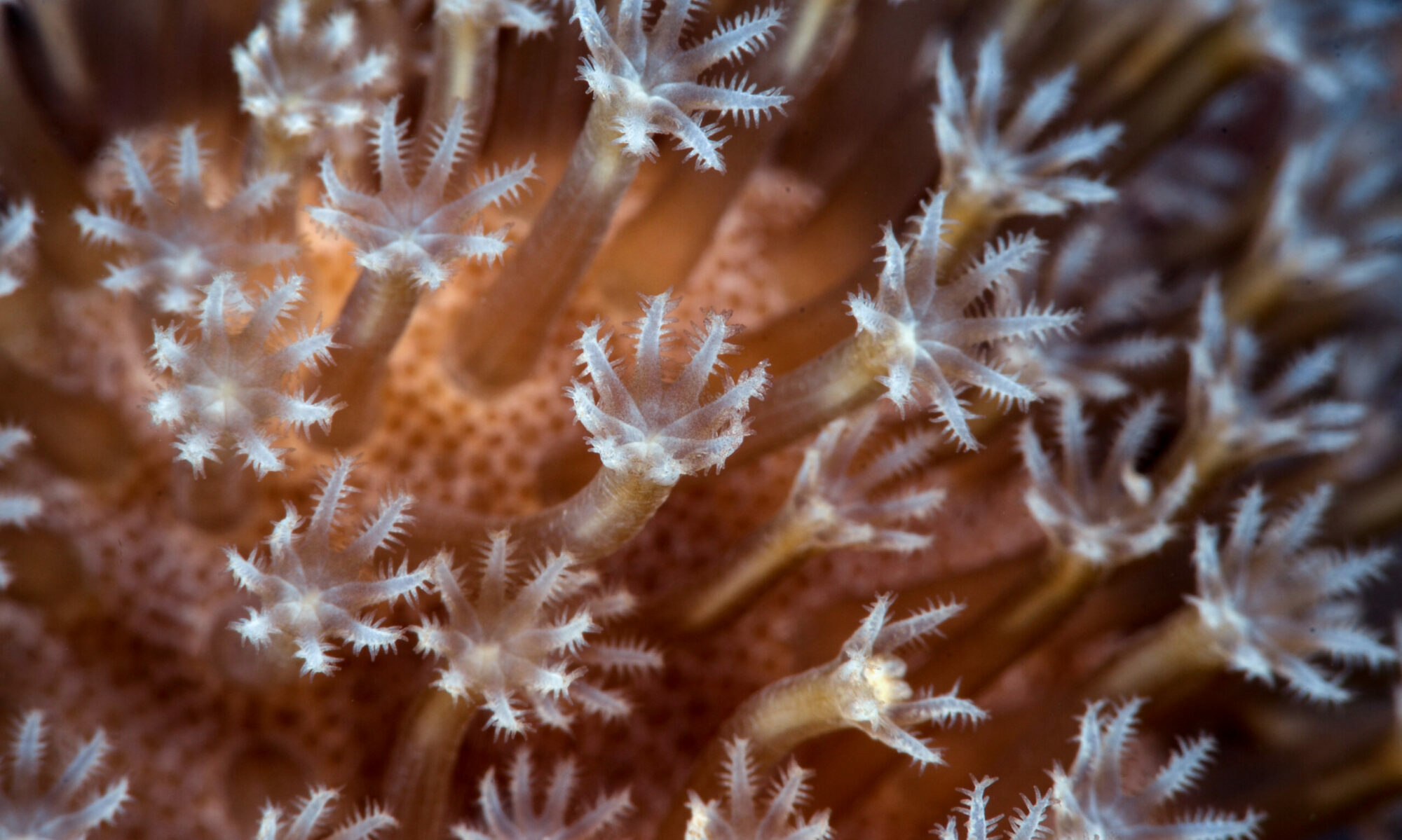
Meiofauna are invertebrates that live in both marine and freshwater environments that are small enough to pass through a 0.45 micrometer mesh. They live in between the grains of sand and mud on the seafloor and riverbeds. Copepods, flatworms, and nematodes fall under meiofauna.  

Because the meiofauna group is broad, the field remains understudied despite its ecological importance.  
 
“Meiofauna have a high turnover, so they reproduce very fast and they don’t live very long,” said Vega. “Because of this, they are a food source to bigger animals like crabs and sea cucumbers. In turn, those bigger animals are food for other animals. If this group didn’t exist, it would affect that chain.”  

Over the course of the workshop, Vega was able to connect with meiofauna experts from around the world as well as learn different collection and sampling techniques for DNA metabarcoding of meiofauna communities around Dauphin Island.  

As a Guam NSF EPSCoR Graduate Research Assistant, Vega became interested in researching meiofauna to incorporate it into her thesis project, which focuses on studying the formation of sediment plumes in the Pago Watershed in central Guam and how they affect the island’s environment.  

Sediment from soil erosion due to fires and invasive species such as wild pigs and deer can wash into rivers, streams, and bays during rainfall. Once in the water, these plumes of sediment can pollute bodies of water and smother coral reef systems.   

“These sediment plumes consist of very fine sediment,” said Vega. “I want to understand what’s happening and how they affect meiofauna.”  

Vega said that her experience attending the workshop has benefited her development as a scientist.  

“Being in the workshop was very hard in the beginning, but I got to learn a lot by asking other people how they’d process their samples so by the end of the workshop, I was faster,” said Vega. “As a scientist, I feel like if there’s any new skill I would like to have, I’ll just have to practice and I’ll get better. Learning is infinite and it’s exciting to know that.”  

Tramonte defends master’s thesis  

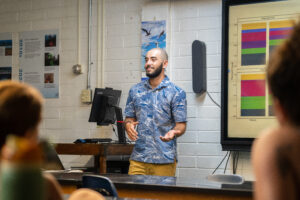
Carlos Tramonte Thesis Defense Photo 1

On June 13, 2023, Guam NSF EPSCoR Graduate Research Assistant Carlos Tramonte defended his Master of Science in Biology thesis at the University of Guam Marine Laboratory.  

Tramonte’s thesis was titled, “Coral Species Replacements on Guam’s Reef Flats: Investigating the Role of Symbiodiniaceae Dynamics and Environmental Stressors.” 

His chairperson was Dr. Bastian Bentlage. Along with Bentlage, Tramonte’s committee consisted of UOG Marine Laboratory Director Dr. Laurie Raymundo, and Dr. Sarah Davies from Boston University.   

Following the completion of his graduate program, Tramonte will pursue doctoral work at University of Hawaiʻi at Mānoa with the support of the Graduate Research Fellowship Program from the National Science Foundation.   

Tramonte will be working on mesophotic reef systems in American Samoa and will be looking into coral physiology and environmental DNA (eDNA). 

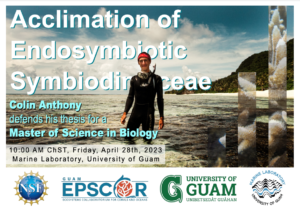
Anthony defends his Master of Science in Biology

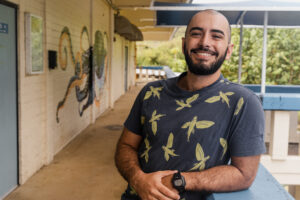
Collin

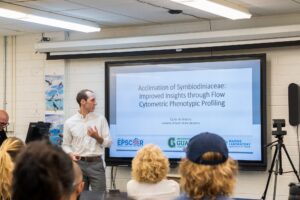
Guam NSF EPSCoR Graduate Research Assistant Colin Anthony defended his thesis in front of his mentors, classmates and teachers at the University of Guam Marine Lab in Mangilao.

His thesis was titled, “Acclimation of Endosymbiotic Symbiodiniaceae: Improved Insights through Flow Cytometric Phenotypic Profiling.”
 
His chairperson was Dr. Bastian Bentlage. Colin’s committee consisted of Dr. Brett Taylor from the University of Guam and Dr. Cheryl Ames from Tohoku University.

UOG graduate student earns NSF Graduate Research Fellowship  

Carlos Tramonte Photo 1 1
Guam NSF EPSCoR Graduate Research Assistant (GRA) Carlos Tramonte will pursue doctoral work at the University of Hawaiʻi at Mānoa with the support of the Graduate Research Fellowship Program from the National Science Foundation (NSF).

Guam NSF EPSCoR Graduate Research Assistant (GRA) Carlos Tramonte will pursue doctoral work at the University of Hawaiʻi at Mānoa with the support of the Graduate Research Fellowship Program from the National Science Foundation (NSF).  

The NSF Graduate Research Fellowship Program supports the most promising graduate students in STEM by providing fellows with a three-year annual stipend of $37,000 along with a $12,000 cost of education allowance for tuition and fees as well as access to opportunities for international research and professional development.  

The fellowship program is highly competitive with annual acceptance rates of about 16 percent among more than 12,000 applicants.  

“I’ve been told that the program can be really hard to get into,” said Tramonte. “When I got my acceptance letter, I had to reread it a few times before I went downstairs and told Bastian that I got it.”  

Tramonte, who is under the mentorship of UOG Associate Professor of Bioinformatics Bastian Bentlage, Ph.D., originally wasn’t planning to pursue a doctorate degree. 
 
However, he is excited that his acceptance to the fellowship program has given him an opportunity to seek higher education. At the University of Hawaiʻi at Mānoa, Tramonte will be working on mesophotic reef systems in American Samoa and will be looking into coral physiology and environmental DNA (eDNA).  

With support from his mentor along with other members of the UOG Marine Laboratory community, Tramonte is fast-tracking his term as a GRA to complete it within two years instead of three so that he can start his time in the NSF fellowship program this summer. 

His master’s thesis focuses on highlighting potential mechanisms behind observed species replacements on Guam’s reef flats.   

“I’ve been thinking about how in just a few months, I’ll be out of here,” said Tramonte. “I’ve really fallen in love with this island – the people, the culture. It’s such a beautiful treasure of a place. Guam has a hold on my heart that I didn’t think would happen when I moved out here. I love this place so much and the university and the Marine Laboratory and the flexibility EPSCoR has given me to pursue whatever I want has been amazing.” 

JOIN US: Colin J Anthony to defend his Master of Science: Biology thesis!

Colinpromo
Colinpromo

Join us on Friday, April 28th, 2023 at 10:00 AM ChST as we cheer on our student researcher Colin J Anthony as he defends his Master of Science: Biology thesis!

Thesis Title: Acclimation of Endosymbiotic Symbiodiniaceae: Improved Insights through Flow Cytometric Phenotypic Profiling

Chairperson: Dr. Bastian Bentlage (Committee: Dr. Brett Taylor & Dr. Cheryl Ames (Tohoku University)

Location: Marine Laboratory Classroom Room 205

Zoom link: http://ow.ly/6XxQ50NQ4zP

NSF Guam EPSCoR graduate research assistantship now accepting applicants

Epscor GRA 1
Epscor GRA 1

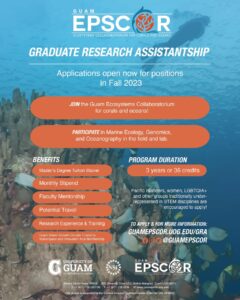
Are you a prospective graduate student interested in ensuring the sustainability of coral reefs and the marine environment? If you’re self-motivated, well-organized, and have a Bachelor of Science in Biology, Environmental Science, or related field, NSF Guam EPSCOR has a valuable graduate student research experience for you — and it’s paid!

The Graduate Research Assistantship is a three-year long program designed to train graduates in scientific research. Selected students will benefit from a tuition waiver of up to 3 years or 36 credits for the pursuit of a master’s degree, research training, faculty mentorship, potential travel opportunities, a Guam Green Growth Circular Economy Makerspace and Innovation Hub membership and an $18,000 annual stipend ($1,500 per month).

Selected applicants will participate in Marine ecology, genomics, and oceanography in the field and lab. Depending on chosen specialization, students may learn about DNA extraction and sequencing and/or how to read and analyze data to characterize marine environments. The program may involve hands-on fieldwork to investigate coral reefs or to deploy and retrieve oceanographic instruments while working at the UOG Marine Laboratory or biorepository. Graduate students will also receive support for their individual thesis defenses.

The program seeks to increase the number and diversity of students who choose careers in STEM (Science, Technology, Engineering, and Mathematics). All qualified students are encouraged to apply, in particular Pacific islanders, LGBTQIA+, women, minorities, and students with disabilities.

The deadline to apply is 12 a.m. CHST on February 10, 2023. Late applications may be considered until the UOG Masters Application Deadline, pending availability of positions. For more information and to apply, visit https://guamepscor.uog.edu/gra/

About NSF Guam EPSCOR

The NSF Guam EPSCoR program at the University of Guam is funded by a five-year, $20 million grant from the National Science Foundation’s Established Program for the Stimulation of Competitive Research (EPSCoR). The program aims to broaden the participation of underrepresented students in STEM fields through developing a research program that helps ensure the sustainability of coral reef ecosystems in the face of environmental change. NSF Guam EPSCoR aims to situate Guam as a premier research and STEM education hub bolstering sustainability, economic development, and informed decision-making by engaging communities in 21st-century science.

2022 GRA: Meet our new graduate research assistants!  

Xavier De Ramos

This year, Guam NSF EPSCoR welcomed six new members of its Graduate Research Assistantship program. Over the next three years, these graduate students will receive mentorship, training, and fieldwork experience as they pursue their master’s degree.   

Grace Jackson 

Having grown up in a small beach town in Southern California, Grace Jackson has lived her life surrounded by water.  

“This instilled in me the love for the ocean and later my scientific curiosity,” said Jackson. “I applied to this program to increase my scientific proficiency where I could learn about a different ecosystem and culture that I have not experienced before. I am so glad to be a part of this program.”  

Under the guidance of Tom Schils, Ph.D., Jackson will study crustose coralline red algae, specifically of the genus Lithophyllum.  

CCRA is a group of marine seaweeds that deposits limestone like stony corals. They serve several important ecological functions on reefs, such as building and cementing reefs together or serving as the preferred settlement substrates for coral larvae, which then further develop into adult colonies. 

Lauren Kallen  

Lauren Kallen applied to the Guam NSF EPSCoR GRA program due to the benefits and support that the program provides to its students. Kallen was born and raised in Illinois and earned her bachelor’s degree in marine biology at the University of California, Santa Cruz.  

Kallen’s advisor is Sarah Lemer, Ph.D., whose work focuses on the study of marine invertebrates. Over the course of the program, Kallen will conduct research on Drupella snails, carnivorous marine snails that feed on coral. Her research will focus on outbreaks of these snails on coral reefs because in high densities, these snails can quickly decimate a reef.  

I am very excited and grateful to be in this program, it is an amazing opportunity. I am very interested in outreach and giving back to the beautiful community in Guam,” said Kallen.   

Garret O’Donnell  

While looking for potential graduate programs, Garret O’Donnell found out about the Guam NSF EPSCoR program through his mentors from the University of Florida. 

Under the guidance of David Combosch, Ph.D., O’Donnell will study Leptoria, a genus of brain coral. O’Donnell said that he is interested in Leptoria’s population genetics, spawning behavior, and abiotic stress responses to factors such as heat and low oxygen.  

Since coming to Guam, O’Donnell said that he appreciates the UOG Marine Laboratory community.  

“I think everyone there has been super welcoming and super cohesive as a unit and that’s been really cool to see,” said O’Donnell. “Everyone seems to know what everybody else is doing and that’s not something you always see in science. A lot of the time, labs are kind of isolated from each other. I like to see that there’s a lot of camaraderie amongst the students and the faculty.”   

Andrew O’Neill  

Throughout his life, Andrew O’Neill found a love for the ocean. As he pursued his undergraduate degree at the University of California, Santa Cruz, he wanted to specialize in ecology and conservation. Once he learned about the Guam NSF EPSCoR GRA program, he saw it as a unique opportunity to do research and help the environment.  

During the program, O’Neill will be advised by Atsushi Fujimura, Ph.D., and plans to focus on research the effects of sedimentation on Guam’s reef fish assemblages.  

“In my first semester here, I did some instructing with some of the undergraduate biology sections and through that, I learned the Guam has a huge sedimentation problem,” said O’Neill. “Lots of silt gets washed away from all the rains and the rivers and flows down to the coastal waters. I want to figure out what would be the worst-case scenario if we don’t fix this problem.”  

Xavier De Ramos  

Knowing that he wanted to find ways to help the island, De Ramos earned a bachelor’s degree in marine biology at the University of Hawai’i, Manoa. 

“Towards the halfway point of my time in college, I started thinking about Guam – my home,” said De Ramos. “I remember having a lasting impression after I went snorkeling and I was just blown away about what I saw down there. That got me thinking about what kind of issues Guam is facing or if there was anything I could do to contribute to research regarding its coral reefs.”  

De Ramos will be advised by Ciemon Caballes, Ph.D., whose research focuses on ecophysiology as well as coral and echinoderm ecology.  

“I feel very excited about learning more through this program and my graduate courses because I want to give back to the island,” said De Ramos. “At the end of the day, giving back to the island is all that matters to me.”  

Graduate biology student attends University of Washington summer research program 

Therese Miller Photo 2

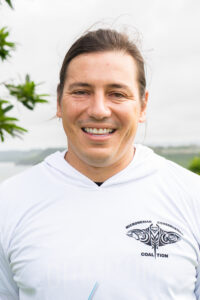
University of Guam graduate biology student and Guam NSF EPSCoR graduate research assistant Therese Miller gained research experience this summer through a course held by the University of Washington. The class was called Biodiversity and Integrative Taxonomy of Invertebrates and was held at the university’s field station in Friday Harbor Laboratories on San Juan Island from July 18 to August 18, 2022.  
The course focused on methods for documenting and describing the species-level diversity of invertebrate animals through activities such as field trips to collect samples, dissecting, photography, and genetics work.  

The class was taught by two instructors: Gustav Paulay, Ph.D., a curator and professor at the University of Florida who served as the director of the UOG Marine Laboratory from 1991 to 2000 and has extensive experience in studying marine invertebrate zoology.  

Kevin Kocot, Ph.D., a curator and professor at the University of Alabama, hosted workshops on bioinformatics and studying meiofauna. Bioinformatics is an interdisciplinary field that develops software and tools to understand biological data. Meiofauna are small invertebrates that live on or near the bottom of bodies of water.  

“Together, they not only encouraged our passions for studying marine biodiversity but also equipped us with the tools to further our careers,” said Miller.  

Over the course of the program, Miller worked on a research project that involved describing species of blood stars (Henricia), a sea star found along the Pacific Coast which is typically red-orange in color but can vary from tan to almost purple. 

“Historically, what appear to be several different species are all called the same name in the literature or are left undescribed,” said Miller. “My project entailed collecting about 50 specimens of these sea stars and taking DNA from them to see how closely they were genetically related.”  

During the course, she found two specimens of a species that were the first to be sampled in the Juan de Fuca Island strait. This species had previously been found along California and Oregon.  

Throughout her time in Washington, Miller was able to see cultural aspects of San Juan Island such as various small farms throughout the island as well as a fishing vessel that belonged to the indigenous Native American tribes of the Pacific Northwest.   

“It was fascinating to learn about some of the native tribes that have lived in the area for several centuries,” said Miller. “I also relearned the importance of characterizing biodiversity in the anthropogenic age, particularly for marine species, which are largely understudied compared to terrestrial fauna. This is especially important to me living on Guam since marine biodiversity here is so rich and there is so much to research and explore. I felt this course really inspired me to open my eyes more to the world around me and consider what species here have yet to be identified.” 


Six new graduate research assistants join Guam NSF EPSCoR

2022 GRA Orientation Photo 2

Guam NSF EPSCoR welcomed six new members to its Graduate Research Assistantship program during an orientation held on Friday, August 26, 2022.  
 
Over the course of the three-year program, these six graduate research assistants will receive tuition coverage, a salary, as well as mentorship and support over the course of their graduate program as they conduct research regarding coral reefs, coastal systems, genetics and genomics, or identifying patterns of regional biodiversity.  
 
These new GRAs include Grace Jackson, Lauren Kallen, Andrew O’Neill, Xavier De Ramos, Zoe Trumphour, and Garret O’Donnell.  
 
“I would like to welcome our new students to the program,” said Terry Donaldson, the principal investigator and director of the Guam NSF EPSCoR program. “You will get to utilize equipment, instruments, and various assets to conduct your research that people used to dream about. When I was a student, a lot of this stuff had not been invented yet. You’ve earned your place here. We’re behind you and we want you to succeed.”  

The GRA program is part of Guam NSF EPSCoR’s goal to develop a research program to help ensure the sustainability of coral reef ecosystems in the face of environmental change. In total, Guam NSF EPSCoR now has 20 graduate research assistants.  
 
Each of the graduate research assistants were given free memberships to the Guam Green Growth Makerspace and Innovation Hub. Guam NSF EPSCoR helps support Guam Green Growth.  

“This is like a whole other fancy lab,” said Austin Shelton, Guam NSF EPSCoR’s co-principal investigator and the director of the University of Guam Center for Island Sustainability and Sea Grant. “Outside of campus, you can go down to the CHamoru Village in Hagatña and use 3D printers, CNC routers, and laser cutters as well as brand new terracotta printers. If anybody wants to use that to build tiles to start growing stuff on, you can plug in the 3D designs and start building there.”  

For three years, these students will be a part of a project that covers a diverse range of research areas.  

“For this grant, the research crux here involves understanding why some corals are more resilient than others, climate change and temperature increases, and watershed degradation and sedimentation,” said Bastian Bentlage, co-principal investigator of the Guam NSF EPSCoR. “We have a lot of associated research projects, as well. Some of you will focus on coralline algae, crustaceans, diatoms, as well as fish that spend part of their life in freshwater systems and then another in the ocean. There’s a broad variety of research areas, but the overarching theme is how our reefs will fare in a changing climate.”  

The new graduate research assistants will also be able to access near-peer mentorship opportunities in which they can learn from their peers and postdoctoral students as well as teach undergraduate and high school teachers over the course of their term. 

“This program is such a great opportunity, especially for master’s students,” said Garret O’Donnell, a new graduate research assistant. “It’s very well-funded compared to a lot of master’s programs. When it comes to other universities, sometimes students would have to pay for their positions, so it’s helpful to have a salary on top of my tuition coverage that allows me to do this.”  

EPSCoR researcher participates in a collaborative paper on genetic data recording

Coral Study Justin 3

A report that brought together researchers all over the United States highlights the need to address gaps in data recording to improve biological diversity monitoring across the globe.  

Justin Berg, a University of Guam EPSCoR graduate research assistant, collaborated with other researchers to produce the paper, “Poor data stewardship will hinder global genetic diversity surveillance.” PNAS published the brief report in July this year. 

For the study, the researchers looked at publicly available data in the International Nucleotide Sequence Database Collaboration (INSDC). The study notes that most scientific journals require authors to archive their genetic data in a permanent database, and the INSDC is the leading repository of raw genomic data. 

With the available data in the INSDC and other open-access repositories, the study notes that researchers can now “genotype thousands of loci or sequence whole genomes from virtually any species.”  

During the research process, Berg said they found gaps or missing metadata in these data sets, or it indicated different geographical locations. According to Berg, as of October 2020, the Sequence Read Archive of INSDC contained 16,700 unique wild and domesticated eukaryotic species and 327,577 individual organisms. He said only 14 percent of the genomic data had spatiotemporal metadata for genetic diversity monitoring. 

Berg said, “That essentially means when people place their genetic sequences in a database, from an international level all the way to the United States NCBI (National Center for Biotechnology Information), they may be missing data sets and missing metadata that are concurrently in past or current studies. Right now, through this project, we show that 86 percent of these projects were missing some form of metadata, including the year that it was collected or the location where it was collected.” 

According to the report, the researchers looked at aquatic and terrestrial domesticated species recorded in the INSDC through the NCBI because biodiversity studies mostly focus on these targets. 

The report notes that, in principle, these data can “provide time-stamped records for genetic diversity monitoring, to support the goals of the United Nations Convention on Biological Diversity (CBD).” In addition, the data can be used to shed light on “the evolutionary and ecological processes that shape biodiversity across the globe.” 

As an instrument for sustainable development, the CBD focuses on the conservation of biological diversity, the sustainable use of its components and the fair and equitable sharing of the benefits arising out of the utilization of genetic resources. 

“This study can help with genetic diversity monitoring through the United Nations Convention on Biological biodiversity. It can do this by including increased metadata in the future. So, if someone from another part of the world wants to go in, anyone can access this genetic data,” Berg said.  

Berg and the other researchers said they join others in calling for ambitious goals to safeguard genetic diversity and the knowledge structures that will support this goal. “Common to proposed genetic diversity monitoring agendas is a shared vision whereby agile pipelines would intake raw genomic data and produce outputs that directly inform conservation policies and decisions,” the researchers said. 

The researchers emphasized that without appropriate archival genomic data that include the spatiotemporal metadata, crucial information will be unavailable to such pipelines, and researchers will be unable to monitor genetic biodiversity or reconstruct past baselines. 

Berg said they are planning to release a more comprehensive report on their findings.  

The paper can be accessed through PNASa peer-reviewed scientific journal.