
Math students present research on coral reef dynamics

2022 SMRP Photo 1

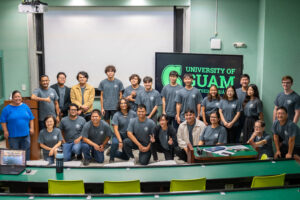
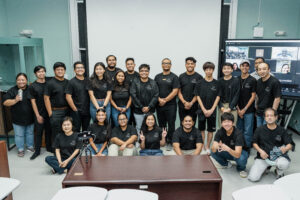
Six students presented their research about the effects of coral bleaching, coral diseases, rising temperatures, and controlling crown-of-thorns (COTS) starfish populations using mathematical modeling this summer as part of the 2022 Summer Joint Math Research Program showcase held on July 15. The students – five undergraduate students and one high school student – were part of the 2022 Summer Math Research Experience held from May 23 to July 16 at the University of Guam.  
The program was part of the Guam Ecosystems Collaboratorium for Corals & Oceans (GECCO) project, funded by the university’s Guam NSF EPSCoR grant. 

“You’ve inspired research by what I have seen from the titles of your projects,” said Austin Shelton, the director of the UOG Center for Island Sustainability and Sea Grant, during the showcase’s opening remarks. “These are the kinds of things the community needs to understand our coastal and terrestrial resources.”  

The Summer Math Research Experience was held in conjunction with two other research programs: the Young Research Experience in Mathematics and the National Research Experience for Undergraduates Program.  

Using data collected from researchers at the UOG Marine Laboratory, the models were developed to use as a tool to forecast changes in the island’s coral reefs.  

“Creating these mathematical models is important so that we can see and predict the changes from these environmental situations,” said UOG Assistant Professor Mathematics Jaeyong Choi, one of the program’s mentors. ”Using the mathematical models, we can use them to simulate situations based on the data collected from the researchers at the marine laboratory.”  

During the program, the students were split into two teams to focus on two projects.  

The first group looked at whether rising sea surface temperatures were a bigger threat to Acropora pulchra and Porites populations than crown-of-thorns starfish, which prey on stony coral. Outbreaks of these starfish can cause severe damage to coral reefs over just a few weeks.  

 “Applying math to science feels like you’re exploring,” said Siwen “Lulu” Shao, a high school student at St. John’s Catholic School. “You never encounter the same problem. When we built this complex mathematical model, all you have to do is change numbers and parameters and this model would be able to apply to any COTS and any coral relationship in the world.” 

The second group focused on how two different coral species – Acropora pulchra and Porites massive – react in situations of bleaching and disease along with how the presence of seaweed inhibits their ability to recover. 

“Being in this program has been pretty amazing and eye-opening,” said Ernie Samelo, an undergraduate mathematics major at the University of Guam. “I’ve learned a lot of stuff about math and applying it in real life and coral. Corals are something I never thought would have so many layers to it. I’ve loved every moment of this program.” 

Five students join summer math program

SMRE 2022 Photo 1
SMRE 2022 Photo 1
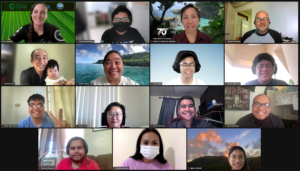
Five students have been welcomed to the 2022 Summer Research Experience, a six-week research program from May 13 to July 26, 2022 that will have students study mathematical models of coral reef responses to climate change.

Five students have been welcomed to the 2022 Summer Math Research Experience, a six-week research program from May 13 to July 26, 2022 that will have students study mathematical models of coral reef responses to climate change.

During the program, students will gain experience with industry-standard software, network with participants in other summer research programs, and develop skills in oral presentations and technical reports.

“I’m looking forward to this experience because this will be my first time being in a research program,” said Ernie Samelo, an undergraduate in mathematics. “I want to experience everything and apply what I’ve learned in math to this research.”

In addition, the program welcomed two research assistants who will assist the GECCO students along with those who are participating in other concurrent summer math programs such as the National Research Experience for Undergraduates Program.

“I look forward to learning from everyone and I hope everyone can learn from me,” said Cabrini Aguon, an undergraduate in mathematics. “It’ll be a mutual exchange of growth throughout this process.” Over the course of the program, the students will use data collected from the Common Garden Project, a four-year EPSCoR-funded study launched last year that will examine three habitat-forming coral species over a multi-year span and their responses to environmental change.

“Math is the language of nature. You can describe the processes of nature using mathematical models,” said UOG Associate Professor Bastian Bentlage. “If you have a good model, you can identify certain key parameters that are important for corals’ response to stress, and you can make informed decisions about reef management planning and intervention strategies.”

Two GECCO summer math students accepted to graduate school

241231352 3118595371749164 3644647848654926961 n
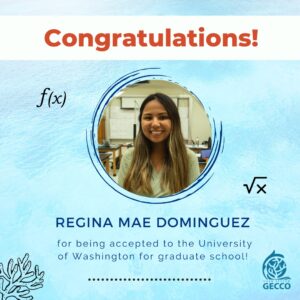
Two University of Guam alumni who participated in the first ever GECCO Summer Math Research Experience (SMRE) have been accepted into grad school!
 
The GECCO Summer Math Research Experience was held from June 7 to July 23, 2021. Participants addressed issues such as overfishing parrotfish, coral bleaching, and coral diseases using mathematical modeling.
 
Henry Song, a recent computer science graduate, says that the Summer Math Research Experience equipped him with the tools and skills to pursue a graduate education.
 
“I have considered applying to grad programs prior to the program, but it was through the advice and guidance of the faculty mentors, research assistants, and overall experience that convinced me to apply to my target school: Seattle University. I hope to follow my dream of becoming a software engineer, and potentially pursue a Ph.D. in the future!” said Song.
 
Song will attend Seattle University this month.
Regina Mae Dominguez, one of two research assistants who served as mentors for the SMRE students, will attend the University of Washington for graduate school.
 
Students wanting to participate in the next Summer Math Research Experience can email epscor.smrp@triton.uog.edu or visit our website for more information.
 

Students in GECCO’s first summer math program study overfishing, coral disease

5R5A9549

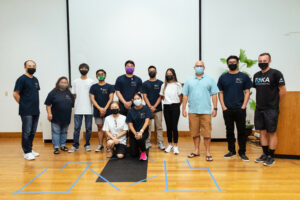
The effects of overfishing parrotfish, coral bleaching, and coral diseases are some of the local issues that students sought to address using mathematical modeling this summer. The students — five undergraduate students and one recent graduate — were part of the first-ever Summer Math Research Experience held from June 7 to July 23 at the University of Guam.

“The more I dove into modeling systems in this program, I’ve realized that math can actually do a lot,” said Henry Song, a recent computer science graduate. “I didn’t realize that something like coral reefs were able to be modeled by math. It was a really good learning experience.” 

The summer program was part of the Guam Ecosystems Collaboratorium for Corals & Oceans (GECCO) project, funded by the NSF EPSCoR grant. Part of the project’s aim is to increase the number and diversity of students who pursue careers in STEM. 

“All of the projects this year were focused on local issues, so I was excited to help out this summer,” said Regina Mae Dominguez, one of two research assistants who served as mentors for the students.

The Summer Math Research Experience was held in conjunction with two other research experience programs: the Young Research Experience in Mathematics and the National Research Experience for Undergraduates Program. Students in these programs investigated the effects of pathogens on the population dynamics of the coconut rhinoceros beetle while the other group developed models to study the population dynamics of the Mariana eight-spot butterfly and parasitoid wasps. 

The students’ work from this first GECCO summer program will assist modeling efforts in the Common Garden Project, a four-year EPSCoR-funded study launched in August that will examine three habitat-forming coral species over a multi-year span and their responses to environmental change. 

“By Year 2, we should have a dataset ready,” said Dr. Bastian Bentlage, associate professor of bioinformatics. “Halfway through this year’s math program, we collected the first two data points for the Common Garden. Since we’re interested in seasonal dynamics, having data from a full season should allow them to apply that data to their models.”

Once the models have been developed, they will be used to support reef management and intervention strategies. 

“We’re going to model disease transmission and the corals’ responses to environmental stress,” said Dr. Leslie Aquino, associate professor of mathematics. “The math faculty will look at what the students this year have done, and our next set will continue to build on these models or expand on them.” 

Participate in the Summer Math Research Experience

Students wanting to participate in the next Summer Math Research Experience can email epscor.smrp@triton.uog.edu or visit https://guamepscor.uog.edu/smre/ for more information. 

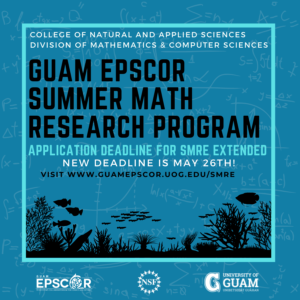
EPSCoR Summer Math Research Program SMRE Application Deadline Extended!

EPSCoR SMRE Deadline
Blue Modern Math Classroom Poster 1

Guam, USA – May 19, 2021 – Are you a STEM undergraduate or recent graduate student interested in mathematics and ensuring the sustainability of our local environment? If you’re self-motivated, well-organized, and majoring in Mathematics, Biology, Computer Science, Engineering, or related field, Guam EPSCOR has a valuable summer research experiences for you — and it’s paid! 

The Guam EPSCoR Summer Math Research Program (SMRP) is extending an application deadline and seeking applications for:  

The Summer Math Research Experience (SMRE) is seven (7) weeks-long taking place from June 7th to July 24th, 2021. The SMRE aims to give qualified STEM undergraduate Sophomores, and Juniors an opportunity to participate in research experiences in the mathematical sciences, with applications in the natural sciences. Students will study mathematical models of coral reef responses to adverse effects and stressors such as bleaching, disease, low water flow, and high turbidity. Eligible applicants must have completed MA203: Calculus I or equivalent with a grade “B” or better. Selected applicants will be paid a stipend of $3,500, assigned a faculty mentor, gain skills in industry standard software, and more! For applications and more information please visit www.guamepscor.uog.edu/smre  

The Summer Math Research Assistant (SMRA) application window CLOSED on May 19, 2021. Thank you for your interest and please apply next summer.   

The program seeks to increase the number and diversity of students who choose careers in STEM (Science, Technology, Engineering, and Mathematics). All qualified students are encouraged to apply, in particular women, minorities, and students with disabilities. 

The deadline to apply for SMRE is extended to 5 p.m. on May 26th, 2021. Accepted students will be notified by May 28th, 2021Late applications may be considered until all positions are filled.  For more information visit our web pages linked above or contact epscor.smrp@triton.uog.edu  


About Guam EPSCOR 

The Guam EPSCoR program at the University of Guam is funded by a five-year, $20 million grant from the National Science Foundation’s Established Program for the Stimulation of Competitive Research (EPSCoR). The program aims to broaden the participation of underrepresented students in STEM fields through developing a research program that helps ensure the sustainability of coral reef ecosystems in the face of environmental change. Guam EPSCoR aims to situate Guam as a premier research and STEM education hub bolstering sustainability, economic development, and informed decision-making by engaging communities in 21st-century science. 


Summer Research Positions Available with EPSCoR Math Summer Research Program 2021!

EPSCoR Summer Math Research Program SquarePoster
Guam EPSCoR Summer Math Research Program TITLE only

STEM Undergraduate and Recent Graduate Students:

Study mathematical modeling, gain research experience, and get paid for the summer! 

Guam, USA – May 12, 2021 – Are you a STEM undergraduate or recent graduate student interested in mathematics and ensuring the sustainability of our local environment? If you’re self-motivated, well-organized, and majoring in Mathematics, Biology, Computer Science, Engineering, or related field, Guam EPSCOR has a valuable summer research experiences for you — and it’s paid! 

The Guam EPSCoR Summer Math Research Program (SMRP) is seeking applicants for 2 (two) Summer Research positions:  

The Summer Math Research Experience (SMRE) is seven (7) weeks-long taking place from June 7th to July 24th, 2021. The SMRE aims to give qualified STEM undergraduate Sophomores, and Juniors an opportunity to participate in research experiences in the mathematical sciences, with applications in the natural sciences. Students will study mathematical models of coral reef responses to adverse effects and stressors such as bleaching, disease, low water flow, and high turbidity. Eligible applicants must have completed MA203: Calculus I or equivalent with a grade “B” or better. Selected applicants will be paid a stipend of $3,500, assigned a faculty mentor, gain skills in industry-standard software, and more! For applications and more information please visit www.guamepscor.uog.edu/smre  

The Summer Math Research Assistant (SMRA) is nine (9) weeks-long taking place from May 24th to July 24th, 2021. The SMRA aims to provide STEM undergraduate Seniors and recent graduates an opportunity to gain experience as research assistants and near-peer mentors for undergraduate participating in EPSCoR Summer Math Research Experience (SMRE). Assistants will also mentor participants of the National Research Experience for Undergraduates Program (NREUP), and Young Scholars Research Experience in Mathematics (YSREM) conducting modeling for the population dynamics studies of the invasive Coconut Rhinoceros Beatle and the parasitoid wasp attacking the Mariana Eight Spot Butterfly. Eligible applicants should be proficient in using LaTeX, Beamer MATLAB, and/or R. Selected applicants will be paid a stipend of $4,500. For applications or more information please visit www.guamepscor.uog.edu/smra  

The program seeks to increase the number and diversity of students who choose careers in STEM (Science, Technology, Engineering, and Mathematics). All qualified students are encouraged to apply, in particular women, minorities, and students with disabilities. 

The deadline to apply is 5 p.m. on May 19th, 2021. Accepted students will be notified by May 21st, 2021. Late applications may be considered until all positions are filled.

For more information visit our web pages linked above or contact epscor.smrp@triton.uog.edu  

About Guam EPSCOR 

The Guam EPSCoR program at the University of Guam is funded by a five-year, $20 million grant from the National Science Foundation’s Established Program for the Stimulation of Competitive Research (EPSCoR). The program aims to broaden the participation of underrepresented students in STEM fields through developing a research program that helps ensure the sustainability of coral reef ecosystems in the face of environmental change. Guam EPSCoR aims to situate Guam as a premier research and STEM education hub bolstering sustainability, economic development, and informed decision-making by engaging communities in 21st-century science.