
UOG welcomes back to shore the first Pacific Islander to reach the deepest point of the ocean

5R5A9761

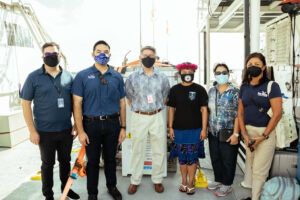
University of Guam President Thomas W. Krise, along with representatives from UOG Sea Grant and Guam EPSCoR, greeted Nicole Yamase on her return from the deepest known point in the world’s oceans on March 13, 2021, at the Port Authority of Guam.

Yamase, a native of Pohnpei in the Federated States of Micronesia and a Ph.D. candidate at the University of Hawai’i, made history the week of March 8, 2021, as the first Pacific Islander to descend to the ocean’s deepest known point — the Challenger Deep in the Mariana Trench.

Yamase’s voyage took place in the Limiting Factor, a commercial deep-submergence vehicle that holds the record for the deepest manned descent in the Challenger Deep. The full dive took 10 hours and reached 35,764 feet below sea level.

“This expedition was not only an opportunity to conduct science but also an opportunity to share my culture with the world,” Yamase said.

For her trip, Yamase brought two FSM flags along with a small wooden canoe in honor of her ancestors.

In addition to the UOG teams, Yamase was welcomed to shore by Port Authority General Manager Rory Respicio and representatives from the Micronesia Conservation Trust and The Micronesia Challenge.

As a recipient of the Bill Raynor Micronesia Challenge Scholarship, which is awarded through Micronesia Conservation Trust, Yamase was asked by the Micronesia Conservation Trust to represent the FSM on this voyage.

After departing on March 8 for a 30-hour journey to the Mariana Trench aboard the research vessel Pressure Drop, Yamase dove in the Limiting Factor, the world’s only private submersible capable of reaching “full ocean depth” of 36,000 feet. The vehicle, a Triton Submarines 36000/2, was piloted by Victor Vescovo, a world record holder, researcher, scientist, and adventurer.

“It was an honor to be there for Nicole when she returned to land and celebrate her historic accomplishment,” said Austin Shelton, director of UOG Sea Grant and a board member of the Micronesia Conservation Trust. “I’m so thankful and excited for all the new Micronesian marine scientists she is surely inspiring.”

Yamase’s research focuses on the effects of climate change on the marine plant community to help predict the future health of coral reefs. Yamase has now returned back to Hawaii to continue her doctoral studies.

In the past, the UOG Marine Laboratory has collaborated on voyages to the Mariana Trench, most notably on James Cameron’s National Geographic and Rolex Deepsea Challenger expedition in 2012.

Link to original article.

Coral research director at UOG elected to head regional association

headshot terry donaldson

Professor Terry J. Donaldson of the University of Guam has been voted president-elect of the Western Association of Marine Laboratories. Donaldson serves as the principal investigator and project director for Guam EPSCoR, a $6 million research grant to study the effects of climate change on coral reefs, and was the former director of the UOG Marine Laboratory.

WAML, a regional subsidiary of the National Association of Marine Laboratories, is a network of nonprofit marine laboratories in the Western United States and Pacific Islands that aims to stimulate research and promote education in the marine sciences and to identify problems unique to nonprofit marine laboratories within its jurisdiction.

“My service as president-elect of WAML will be beneficial to the University of Guam, the UOG Marine Laboratory, and Guam EPSCoR in that the linkages, collaborations, and joint research funding opportunities I help to develop and participate in will promote Guam as a premier destination for coral reef research,” Donaldson said.

Additionally, he said, the association works to represent the interests of its member laboratories on both a regional and national scale.

The UOG Marine Lab has been a member of both WAML and NAML since 1986. Donaldson first represented the university in WAML when he was the director of the Marine Lab from late 2013 to early 2016 and maintained the role afterward.

In addition to his duties as president-elect, Donaldson will simultaneously serve as vice chairman on the board for a two-year term. He will then take the role of president in October 2021. He was elected during the associations’ Fall Biennial Meeting, held Sept. 30 to Oct. 2 at the Hatfield Marine Science Center in Newport, Ore.

His appointment comes as the UOG Marine Lab ushers in its 50th anniversary year.

Link to original article: https://www.uog.edu/news-announcements/2019-2020/2020-coral-research-director-at-uog-elected-to-head-regional-association.php

Guam EPSCoR PI selected as president-elect for Western Association of Marine Laboratories

headshot terry donaldson

Dr. Terry Donaldson, Guam-EPSCoR principal investigator and project director, was voted president-elect of the Western Association of Marine Laboratories (WAML). 

His election was held at WAML’s meeting held in conjunction with the National Association of Marine Laboratories (NAML) Fall Biennial Meeting from Sept. 30 to Oct. 2 at the Hatfield Marine Science Center in Newport, Oregon. In addition to his assigned duties, he will also serve as vice chair of WAML’s Board of Directors for a two-year term. 

WAML is a regional subsidiary of NAML and its membership includes non-profit marine laboratories operated by federal, state, university and other non-profit organizations in the Western United States and Pacific Islands.  WAML’s mission is to stimulate research, promote education in the marine sciences, and provide a forum for the resolution of problems common to non-profit marine laboratories in the United States.

The association encourages the wise use and conservation of marine and coastal resources. For more information about WAML and NAML, please go to www.naml.org.

Guam EPSCoR graduate to continue work in marine sciences

2019 uog biorepository kelokelo 2
img 0031 compressor

Guam EPSCoR graduate research assistant (GRA) Mildred Kelokelo is set to pursue a career in making significant contributions to marine sciences now that she has completed the biology master’s program at the University of Guam through support from the National Science Foundation (NSF).

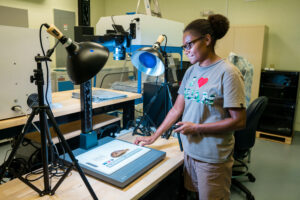
Kelokelo received her Master of Science in Biology degree in Fañomnåkan 2019. She worked at the UOG Marine Laboratory, where she helped preserve and catalogue marine specimens in the Guam Ecosystems Collaboratorium Biorepository.

It was there where she drew out her thesis: “Sexuality and Sexual Maturity of the Arc-eye Hawkfish, Paracirrhites arcatus (Cirrhitidae).” Kelokelo evaluated its sexual patterns and reproductive cycles to determine whether or not this type of hawkfish is a protogynous hermaphrodite — its female reproductive organs maturing quicker than the male counterparts. Her thesis defense was well-received and is now on its way to being published.

“Through funding provided by NSF, I was able to not only obtain a master’s degree, but do research that I enjoy, meet other colleagues from different marine science backgrounds, and learn skills and knowledge and gain experiences that help build my career,” Kelokelo said.

20190424 marine lab 08729 compressor

Kelokelo enrolled at UOG after meeting and working with Guam EPSCoR Principal Investigator Dr. Terry Donaldson in Papua New Guinea. The two attended a workshop on field methods for fish gonad histology, and Donaldson was impressed with her work ethic.

“I knew she was interested in post-graduate training, so I recruited her to UOG’s graduate biology program at the Marine Laboratory,” Donaldson said.

Kelokelo accepted a EPSCoR graduate research assistantship and moved to Guam to continue her research. As her mentor, Donaldson said Kelokelo became an asset to the lab and her peers. She assisted Donaldson in a second workshop on fish gonad histology and later co-authored a publication and manuscript on the subject.
“Papua New Guinea has gained a new scientist, one trained at UOG and a fine example of what EPSCoR is about.  I look forward to collaborating with her in the future,” Donaldson said.

Now having earned her master’s degree, Kelokelo said she hopes to continue her work in the field, whether it be cataloguing specimens or continuing with more research on marine fish reproductive biology using histology methods.

“I have learned a great deal while a graduate student with the biorepository and it has taught me to develop good working ethics, including time management to get assigned tasks done, team effort, and developing skills within the laboratory,” she said. “I am grateful for all the support NSF has provided during my studies at the UOG Marine Laboratory.”

47955813337 0095167eaa o compressor