
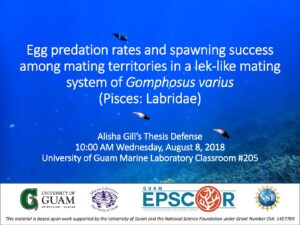
Alisha Gill Thesis Defense

Alisha Gill

Bachelor of Science in Organismal Biology, Montana State University, 2015
Thesis: Egg predation rates and spawning success among mating territories in a lek-like mating system of Gomphosus various (Pisces: Labridae)
Mildred Kelokelo Thesis Proposal

Mildred Kelokelo

Bachelors of Science in Fisheries and Marine Resources, Papua New Guinea University of Natural Resources and Environment, 2014
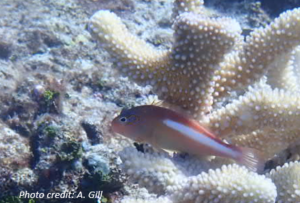
Thesis: “Sexuality and Reproductive Cycle of the Arc-eye Hawkfish, Paracirrhites arcatus (Cirrhitidae)”
Mildred’s work will compare patterns of sexuality, gonad structure and maturity, and reproduction. This work will compliment previous studies on other members of the family, geographic variation, reproductive behavior and phylogeny.
Frank Camacho Roberto Thesis Proposal

Frank Roberto

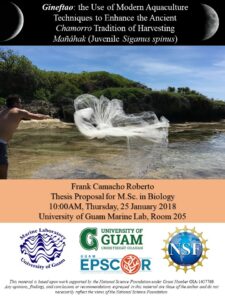
Frank is working to adapt modern aquaculture techniques to rear and spawn the scribbled rabbitfish in order to explore its feasibility as an aquaculture product for purposes of stock enhancement. The scribbled rabbit fish is culturally and ecologically important to the island and stock enhancement would aid in perpetuating indigenous fishing practice of harvesting manahak (juvenile S. spinus). Data from this project could help establish hatcheries and initiate restocking programs.
UOG Faculty Share Cutting-Edge Genetic Research Approaches in Hong Kong
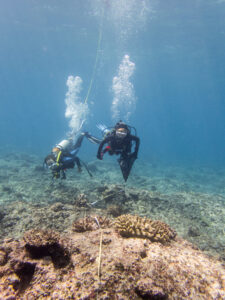
University of Guam Marine Laboratory (UOGML) faculty and Guam Ecosystems Collaboratorium (GEC) Researchers, Dr. Sarah Lemer and Dr. David Combosch recently presented at the University of Hong Kong’s Swire Institute of Marine Science about their ongoing efforts to characterize the bleaching resilience of Guam’s reef corals.
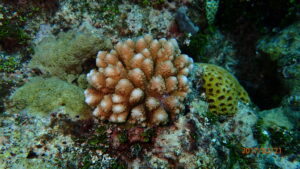
Held on October 16, 2017 and organized by Dr. Dave Baker at the University of Hong Kong’s School of Biological Sciences, the special guest seminar focused on Drs. Combosch and Lemer’s participation in the GEC and their scientific approaches to exploring the complex question of coral resiliency to environmental stress. Drs. Combosch and Lemer discussed their approach of implementing a combination of research strategies that includes fieldwork, molecular species differentiation, phylogenomics, population genomics, and experimental gene expression assays.
“We’re using cutting-edge genomic tools and we’re asking questions that have not been asked here before,” said Dr. Lemer. “With our newly implemented genomic facility, we are now able to do everything on island, from sample collection, data generation and analyses. Also, we enable students and our colleagues at the UOG Marine Laboratory to use those tools and approaches for their own work.”
“The questions that we’re asking are highly relevant and urgently required for local conservation and management,” said Dr. Combosch. “For example, we study the dispersal scales of marine organisms, which has important implications for the resilience of local populations and ecosystems and their ability to recover after disturbances, which is fundamental for an informed design of marine protected areas.”
The GEC was formed in 2015 in the aftermath of the island experiencing its largest coral bleaching event in 2013. At the time researchers had noted a difference in bleaching susceptibility among the affected coral species and populations. Today GEC Researchers seek to understand what accounts for the differences observed by studying the genetics of coral species around Guam. This insight will inform local, regional, and global conservation efforts and coral research and is made possible through the University of Guam’s Established Program to Stimulate Competitive Research (EPSCoR) program, a $6 million grant award from the National Science Foundation (NSF).
Guam EPSCoR’s Guam Ecosystems Collaboratorium Seed Funding
REQUEST FOR PROPOSAL (RFP)
For: Guam EPSCoR’s Guam Ecosystems Collaboratorium Seed Funding
Submission Deadline: November 5, 2017
Guam EPSCoR’s Guam Ecosystems Collaboratorium is seeking proposals from junior and newly recruited research faculty for seed funding opportunities for 2017-2018. Guam EPSCoR seed funding will include experimental project costs for collaborative projects in the areas of oceanography, coral genetics, bioinformatics, genomics, and Integrated Digitized Biocollections (iDigBio), and can include support for travel for training or support that is directly linked to the implementation of research and/or advancing the competitive nature of proposed EPSCoR goals. Funding for travel to scientific meetings is acceptable if the researcher is presenting EPSCoR related research. Competitive seed funding proposals should outline how the proposed work clearly advances the research areas listed above as it is related to Guam EPSCoR strategic goals.
Multiple seed funding awards of up to $10,000 will be awarded to researchers that have submitted a proposal in areas related to Guam EPSCoR research goals. Successful proposals will be selected based on the research quality and on the demonstrated potential to achieve significant results that lead to peer reviewed publications and future grant proposals. Funded proposals are expected to be completed by July 1, 2017, unless otherwise noted or advised.
Applicants should submit a one page proposal, timeline for planning and research, and budget breakdown no later than November 5, 2017.
Proposals should be submitted to guamepscor@gmail.com.
For more information you may visit www.guamepscor.uog.edu or contact:
Dr. Terry Donaldson, Guam EPSCoR PI/PD
tdonaldson@triton.uog.edu
Mellani Lubuag, Guam EPSCoR Program Manager
lubuagm@triton.uog.edu
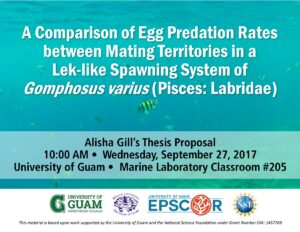
Alisha Gill Thesis Proposal

Alisha Gill

Alisha’s study will consider differential rates of egg predation from and courtship interruption by planktivirous damselfishes. Damselfish densities are greater at the spawning aggregation site compared to the haremic mating sites because of fish feeding by snorkelers and divers, so egg predation rates and reproductive success are expected to differ. Possible compensation at spawning aggregation sites because of increased mating opportunities may offset egg loss and courtship interruption effects.
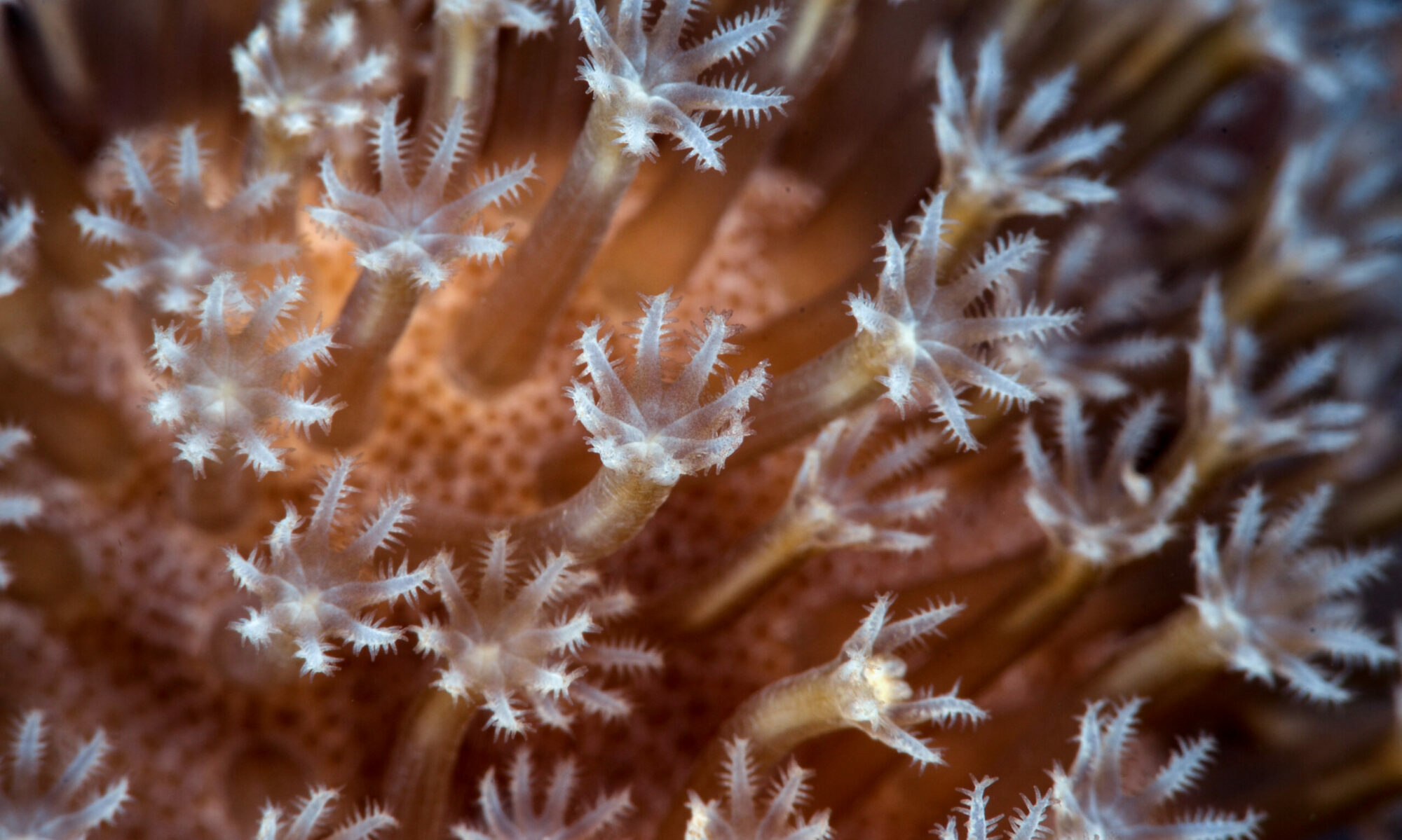
Unraveling the Diversity of a Dominant and Ecologically-Important Group of Reef Builders
Guam Ecosystems Collaboratorium Colloquium

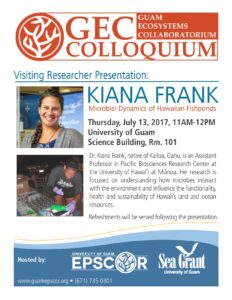
VISITING RESEARCHER PRESENTATION
DR. KIANA FRANK
11AM, Thursday, July 13, 2017
University of Guam, Science Building, Rm. 101

Title: Microbial dynamics of Hawaiian Fishponds
Abstract: Native Hawaiians harnessed the natural activity of coastal ecosystems by engineering fishponds that promoted primary productivity to cultivate herbivorous fish. Because the success of fishponds rests on the productivity of algae and photosynthetic microbes, understanding how microbial abundance, diversity, and composition change across time and space – especially in response to climatic anomalies and restoration efforts – is critical to inform current management practices. Here we use comparative phylogenetic analysis of 16S rRNA gene data to characterize microbial diversity in the context of the geochemical environment to provide significant insight into 1) the environmental drivers of naturally occurring microbial variability, as well as 2) the science encoded in traditional Hawaiian stories. This research provides a data-rich context to support and innovate Native Hawaiian methodologies for restoring fishponds.
Dr. Kiana Frank, native of Kailua, Oahu, is an Assistant Professor in Pacific Biosciences Research Center at the University of Hawai’i at Mānoa whose research is focused on understanding how microbes interact with the environment and influence the functionality, health and sustainability of Hawaii’s land and ocean resources.
For more information contact (671) 735-0301 or email guamepscor@gmail.com
This activity is hosted by Guam EPSCoR and University of Guam Sea Grant
Cyberinfrastructure Update
Guam’s strategic location in the Pacific uniquely positions the island to become a regional leader for research and education networking. A major goal for Guam EPSCoR is to support the development of a cyberinfrastructure that will promote collaborative academic efforts and research opportunities for higher education, emerging technologies, cultural growth and economic development.
Toward this goal, Guam EPSCoR is proud to share several key milestones that were recently achieved:
UOG Chief Information Officer Hired

The University of Guam named Rommel Hidalgo its new Chief Information Officer in January 2016. This is a new position at the University, and one that oversees all campus IT activities. The Chief Information Officer will provide the leadership and vision to implement improvements to the campus’ cyberinfrastructure and helps to lay the foundation for increased research collaboration.
UOG Hosted NSRC Campus Network Design Workshop
The University of Guam hosted a Network Startup Resource Center (NSRC) Campus Network Design workshop in July 2016. This workshop had multi-institutional participation from around the Micronesian region, including, Palau Community College, Palau Ministry of Education, Northern Marianas College, Marshall Islands, College of Micronesia, Guam Department of Education, and Guam Community College. It also featured direct engineering engagement that resulted in significant changes to the network on Guam.
UOG Bandwidth Increased
The University of Guam campus bandwidth was upgraded from 150Mb to 750Mb in July 2016, with connectivity extended to both the University of Guam Marine Laboratory (UOGML) and Water and Environmental Research Institute of the Western Pacific (WERI) in August 2016.
UOG IT Staff Awarded NRSC/I2 Technology Exchange Fellowship

UOG Junior Network Engineers, Randy Dahilig and Jose Santiago were awarded the NSRC/I2 Technology Exchange Fellowship. The annual Internet2 Technology Exchange, which convenes in September 2016, is the premier technical event in the global Research & Education community and the fellowship marks the University of Guam’s first participation in it.