
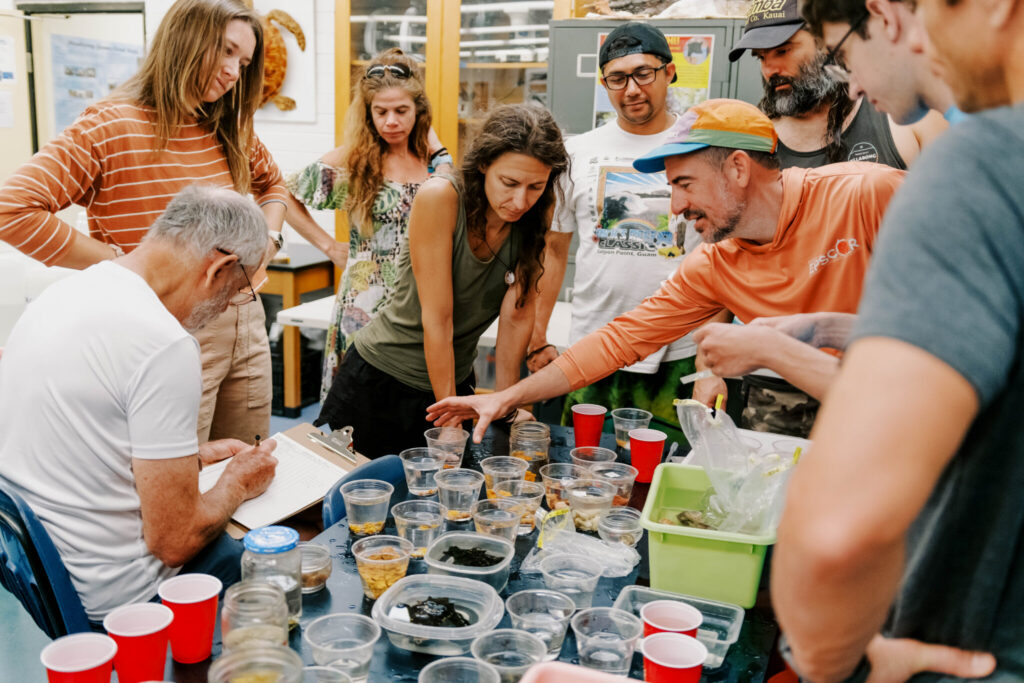
EPSCoR research showcased at 2025 UOG Conference on Island Sustainability

EPSCoR undergraduate student researcher Napu Camacho with his poster at the 2025 Conference on Island Sustainability.

From undergraduate students to faculty members, researchers from the University of Guam NSF EPSCoR program showcased their recent and ongoing projects at the 16th University of Guam Conference on Island Sustainability (CIS2025).

Student Research Experience (SRE) Program

Four undergraduate student researchers revealed their projects under the 2025 EPSCoR SRE Program during the CIS2025 Community Night Poster Presentations. The EPSCoR SRE Program allows students to work with mentors who will guide them in gaining experience in research and encourage careers in STEM.

Among the posters on display was Na’pu Camacho’s project “Assessing Marine Fish-Biodiversity in Pago Bay Using Environmental DNA (eDNA) Analysis.” Under the tutelage of Bastian Bentlage, PhD, Camacho will be collecting water samples along different sites within Pago Bay at different tide levels. The water samples will then be filtered to extract environmental DNA (or eDNA) to observe the variety of fish species within the existing marine habitats.

Camacho believes that his research will be useful for numerous reasons including the ability to assess environmental changes within a marine system as well as helping develop the use of eDNA as a reliable method of evaluating fish biodiversity.

“I’d really love to discover a new species,” said Camacho about his ultimate research goal, “because then I can have it named after me.”

Here are the Guam EPSCoR SRE research posters presented at CIS2025 Community Night: 

    •  “Assessing Marine Fish-Biodiversity in Pago Bay Using Environmental DNA (eDNA) Analysis” by Napu Camacho
    • “Underexplored Sand Biofilm Habitats of Mastogloia in Guam” by Maya Flores 
    • “Guam’s Enigmatic Ghost Shrimp: Biodiversity and Taxonomy of Local Callianassidae” by Diego Ray Quiogue 
    • “Assessing Symbiont Responses to Heat Stress in Acropora pulchra” by Ale’a Duenas
BA7A3778
Guam NSF EPSCoR Graduate Research Assistant Diana Noto presents on her project "Diversity of True Crab (Infraorder: Brachyura) Inhabitants Across Algal Hosts” at the 16th UOG Conference on Island Sustainability.

EPSCoR researchers presented at CIS2025 breakout sessions

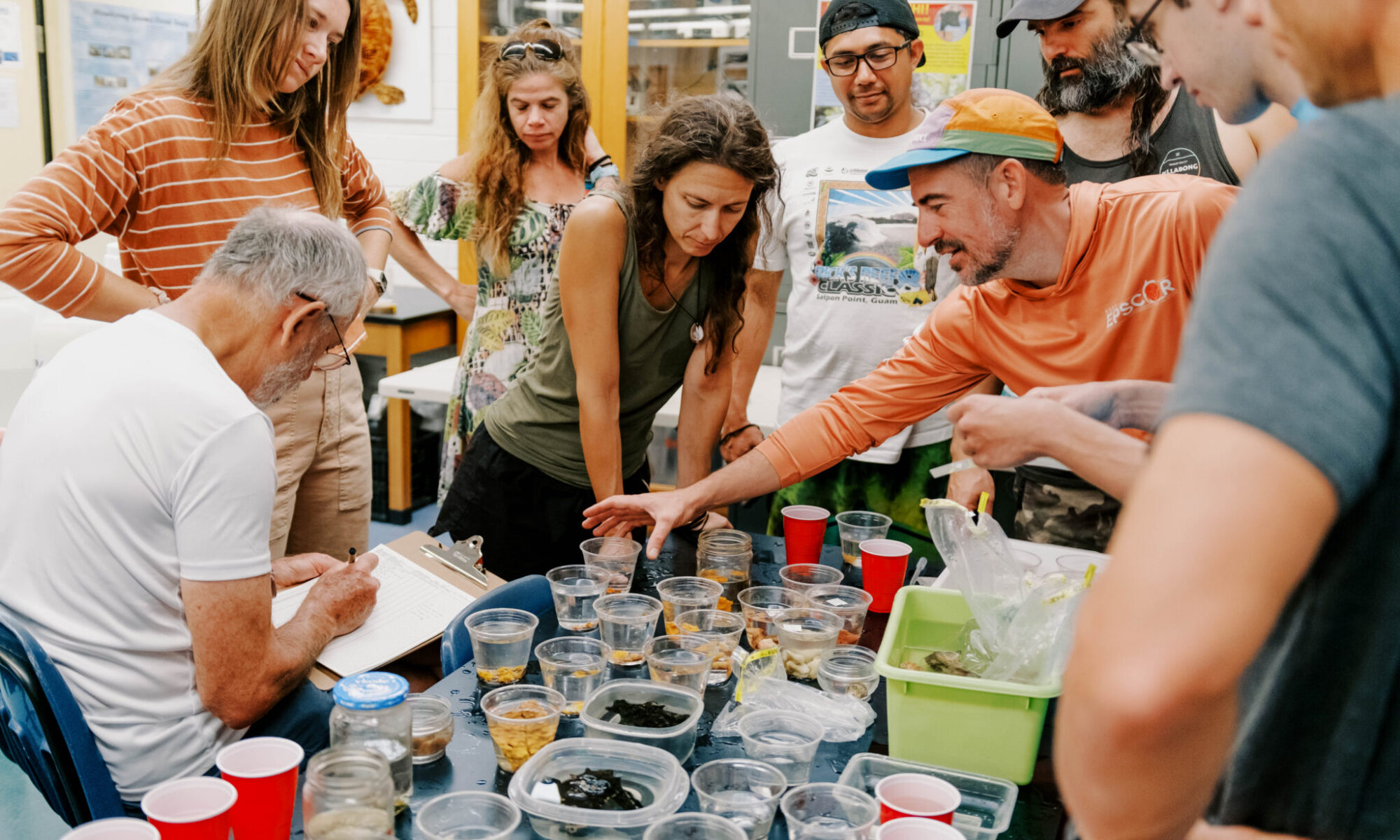
On Thursday, April 10, a breakout session with researchers under the EPSCoR GECCO program was held featuring Biorepository Assistant Professor on Vertebrate Morphology Michalis Mihalitsis, PhD,  Graduate Research Assistant Andrew O’Neil and Graduate Research Assistant Diana Noto. During the session, the researchers presented findings and progress of recent and ongoing projects.

Mihalitsis’s presentation was on the feeding ecology of species of surgeonfish, during which he discussed the morphological adaptations of some species to feed on algae and shared video footage to demonstrate those adaptations.

O’Neil updated on his ongoing research studying the effects of turbidity and sedimentation on reef fish, in particular the twinspot damselfish. Among the objectives of his study include examining changes in gill structure and oxygen efficiency as a result of the sedimentation.

Finally, Noto presented progress on her thesis “Diversity of True Crab (Infraorder: Brachyura) Inhabitants Across Algal Hosts.”  Noto has been collecting macroalgae across reef habitats on Guam to observe the species of true crabs that can be found within them. She intends for her research to fill an existing knowledge gap since despite macroalgae’s significance within marine ecosystems, there are few studies on it within the tropical Pacific region.

“Macroalgae is generally an under-explored habitat for biodiversity,” Noto stated during her presentation. “There’s more research that has been done on temperate ecosystems. However, only two studies have occurred in tropical ecosystems, which is likely due to the fact that a lot of our focus here tends to be on the coral we have and less on the algae, but we’re trying to work on that with this.”

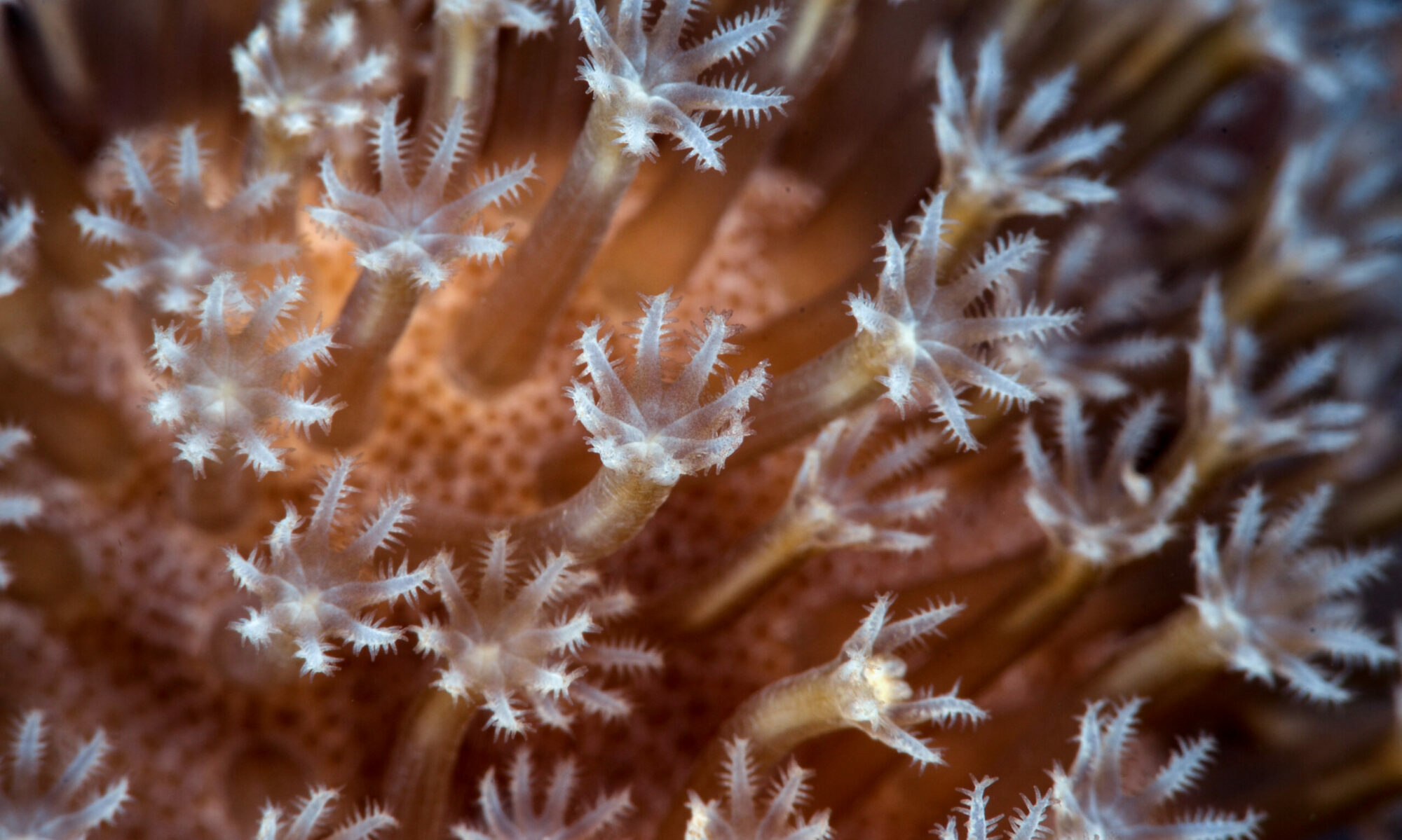
Research and projects under the Guam NSF EPSCoR GECCO Project are meant to promote understanding of the Micronesian region’s biodiversity and identify solutions that promote the sustainability of coral reefs in rapidly changing environments across the tropical Pacific.

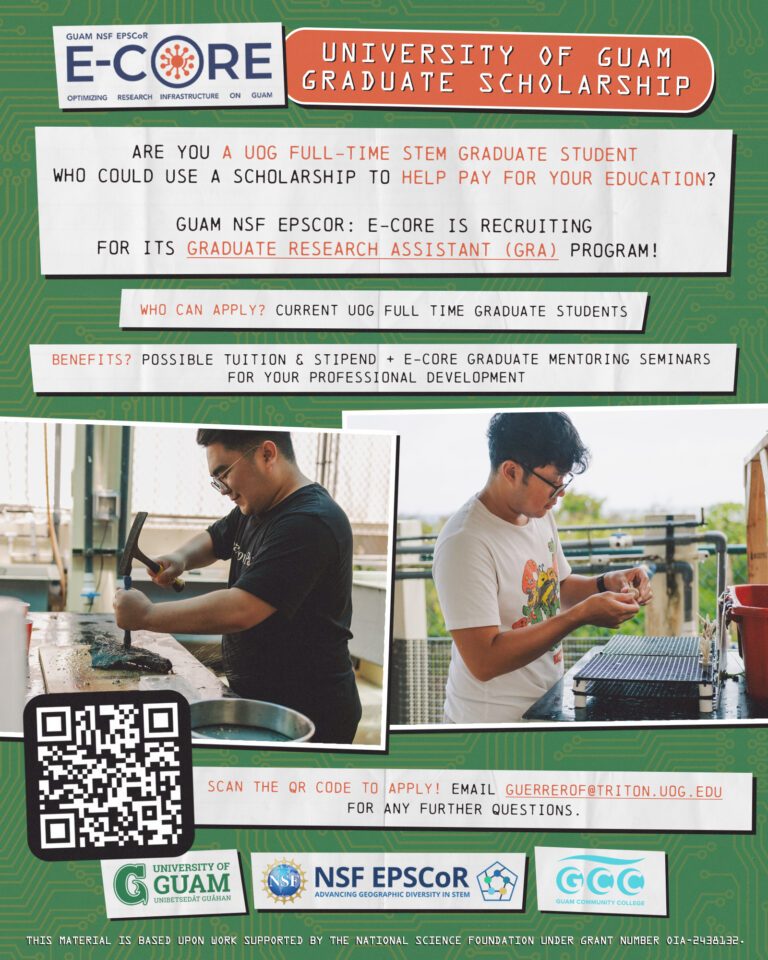
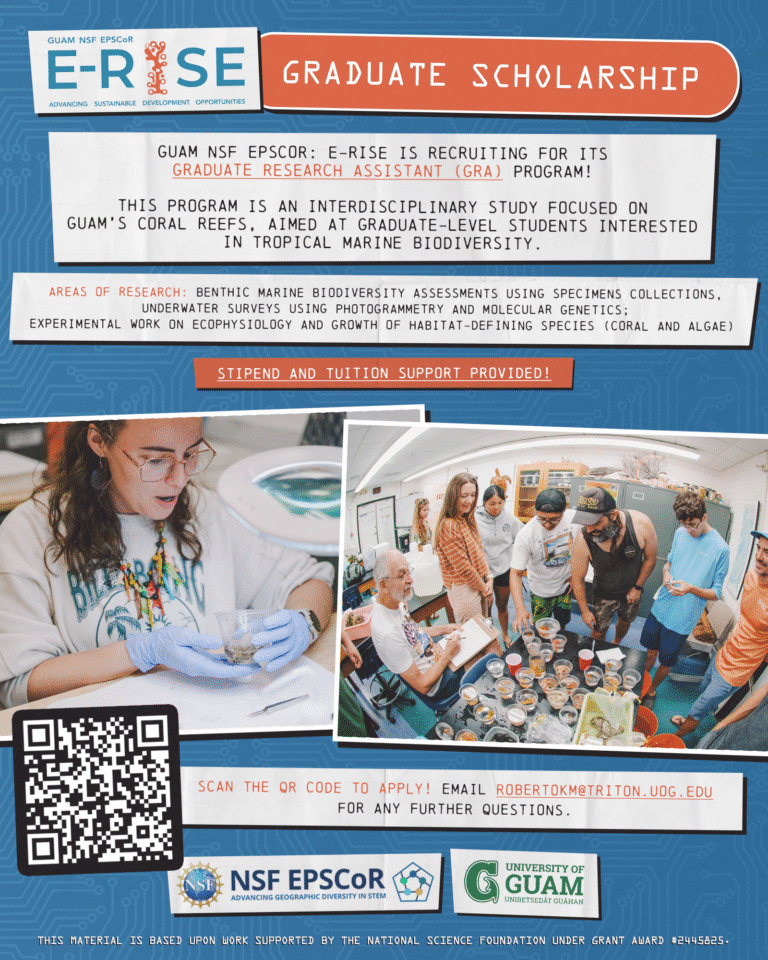
Prospective graduate students: Study coral reefs, gain research experience, have tuition waived, and earn $18,000!

EPSCoR Flyer GRA 2021 Final Social Media Square 020121

Are you a prospective graduate student interested in ensuring the sustainability of coral reefs and the marine environment?

If you’re self-motivated, well-organized, and have a Bachelor of Science in Biology, Environmental Science, or related field, Guam EPSCOR has a valuable graduate student research experience for you — and it’s paid!

The Graduate Research Assistantship is a three-year-long program designed to train graduates in scientific research. Selected students will benefit from a tuition waiver of up to 12 credits per semester for the pursuit of a master’s degree, research training, faculty mentorship, possible travel opportunities, and an $18,000 annual stipend ($1,500 per month).

Selected applicants will choose to specialize from the following disciplines: Ecology, Genomics, and/or Oceanography. Depending on chosen specialization, students may learn about DNA extraction and sequencing and/or how to read and analyze data to characterize marine environments. The program may involve hands-on fieldwork to investigate coral reefs or to deploy and retrieve oceanographic instruments while working at the UOG Marine Laboratory. Graduate students will also receive support for their individual thesis defenses.

The program seeks to increase the number and diversity of students who choose careers in STEM (Science, Technology, Engineering, and Mathematics). All qualified students are encouraged to apply, in particular women, minorities, and students with disabilities.

The deadline to apply is 5:00 pm on March 31, 2021, and accepted students will be notified by April 14, 2021.

Late applications may be considered until the UOG Masters Application Deadline, pending availability of positions.

For more information, contact Sho Hammond at hammonds@triton.uog.edu.

You may download an application by clicking the button below.

Guam EPSCoR Graduate Research Assistant Justin Berg receives 2020 Graduate Student Award

Congratulations to UOG Graduate Student Justin Thomas Berg for being recognized with the 2020 Graduate Student Award from the UOG Office of Graduate Studies.

The 2020 Graduate Awards is an annual competition recognizing excellence, innovation, and impact within the graduate degree programs.

Berg is expected to receive his Master of Science Degree in Biology at UOG in Spring 2021. He holds a bachelor’s degree from the University of Delaware, double majoring in biology and pre-veterinary medicine and animal biosciences with a minor in chemistry.

He currently is studying the effects of sedimentation on the coral microbiome in southern Guam, specifically how runoff affects the coral microbiome in a degraded watershed. Berg works at the UOG Marine Laboratory in the Bentlage Laboratory and helps with the coral restoration efforts in the Raymundo Laboratory. Berg is also a Guam EPSCoR Graduate Research Assistant and represented the UOG Marine Laboratory at the National EPSCoR conference in October 2019 in South Carolina.

“It’s truly an honor to be recognized for the work that I have applied myself at the University of Guam. I would like to thank the University for this recognition. I would like to thank Guam EPSCoR for their funding and allowing me to work on my high-level, impactful thesis. I would like to thank students, faculty, and boat captains at the UOG Marine Laboratory for the support towards my thesis. Most importantly, I would like to thank my advisor, Dr. Bastian Bentlage. Bastian is a true role model in the lab and pushes me to do better every day. Thank you for this honor! Si yu’os ma’åse,” Justin Berg.

After he completes his graduate studies, Berg aims to receive his doctorate degree and teach in a research university.

Dr. Bastian Bentlage, assistant professor of bioinformatics, UOG Marine Laboratory, says Berg received the award because he not only excels academically in the MS Biology program but he also volunteers his time to serve the program in many ways including being the program’s student representative and providing extensive mentorship to UOG undergraduates and Guam high school students who pursued research internships with Guam EPSCoR program.

“Justin is an exceptional graduate student, excelling both academically and as a mentor shaping the experiences of our student interns. I am very happy that Justin’s efforts are being recognized with this award and feel blessed to serve as his advisor,” Dr. Bastian Bentlage,

On behalf of the entire Guam EPSCoR Team, Congratulations Justin!

2018 Graduate Research Assistantship Opportunities

guam epscor gra 2018 flyer 0
gra opp banner

Guam EPSCOR is a 5-year, $6 million grant to the University of Guam from the National Science Foundation. The program aims to develop a Guam Ecosystems Collaboratorium to ensure the sustainability of coral reef ecosystems in the face of environmental change. Guam EPSCoR aims to situate Guam as a premier research and STEM (Science Technology, Engineering and Mathematics) education hub bolstering sustainability, economic development, and informed decision-making by engaging communities in 21st-century science.

In addition to its research goals, Guam EPSCoR seeks to increase the number and diversity of students who choose STEM careers by engaging students in its Graduate Research Assistantship Program (GRA). The GRA program is a year-long program open to select graduate students seeking research opportunities with Guam EPSCoR faculty. Student research training and tasks may include field work to investigate coral reefs or to deploy and retrieve oceanographic instruments, as well as work in the University of Guam Marine Laboratory’s Molecular Lab. Selected students will learn about DNA extraction and sequencing and/or how to readout and analyze data to characterize marine environments. Ideal candidates are self-motivated, well organized, and have research interests related to the objectives of the Guam Ecosystems Collaboratorium.

The University of Guam and Research Corporation of the University of Guam are Equal Opportunity Employers that have received NSF funding to broaden the participation of underrepresented students in STEM fields. As such, the GRA Program remains open to all qualified students, but women, minorities, and students with disabilities are particularly encouraged to apply.

guam epscor gra 2018 flyer

ELIGIBILITY

  • Must be a U.S. citizen, permanent resident of Guam, or non-immigrant alien admitted into Guam under the Compacts of Free Association
  • Cumulative GPA of at least 3.0 in undergraduate studies or 3.25 in graduate studies

BENEFITS

  • Research experience and training
  • Faculty/Researcher mentoring
  • Annual stipend of up to $18,000.00
  • Tuition Waiver of up to 21 credits per semester for up to three academic years for graduate students
  • Possible travel opportunities

APPLICATION SUBMISSION

  • Drop off this application and transcript to:
    Guam EPSCoR Office, University of Guam, Dean Circle House #4
    Office Hours 8AM – 5PM, Monday – Friday
  • Or, you can email documents to Mellani Lubuag at lubuagm@triton.uog.eduPDF format only. Please put “2018 Guam EPSCOR GRA Application” in the subject line.

SPACE IS LIMITED.
DUE DATE: JULY 2, 2018 (CHST)FOR MORE INFORMATION, CONTACT:
Mellani Lubuag, Program Manager
lubuagm@triton.uog.edu  /  (671) 735-0301/09