
Two GECCO summer math students accepted to graduate school

241231352 3118595371749164 3644647848654926961 n
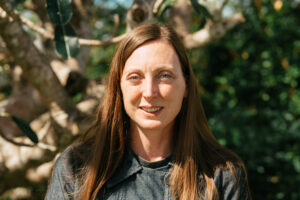
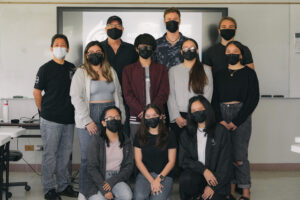
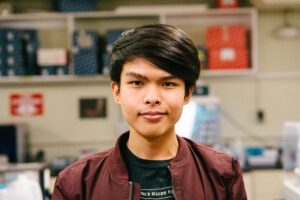
Two University of Guam alumni who participated in the first ever GECCO Summer Math Research Experience (SMRE) have been accepted into grad school!
 
The GECCO Summer Math Research Experience was held from June 7 to July 23, 2021. Participants addressed issues such as overfishing parrotfish, coral bleaching, and coral diseases using mathematical modeling.
 
Henry Song, a recent computer science graduate, says that the Summer Math Research Experience equipped him with the tools and skills to pursue a graduate education.
 
“I have considered applying to grad programs prior to the program, but it was through the advice and guidance of the faculty mentors, research assistants, and overall experience that convinced me to apply to my target school: Seattle University. I hope to follow my dream of becoming a software engineer, and potentially pursue a Ph.D. in the future!” said Song.
 
Song will attend Seattle University this month.
Regina Mae Dominguez, one of two research assistants who served as mentors for the SMRE students, will attend the University of Washington for graduate school.
 
Students wanting to participate in the next Summer Math Research Experience can email epscor.smrp@triton.uog.edu or visit our website for more information.
 

S/T committee explores pandemic recovery opportunities to move priorities forward

Science Tech Comm 2
Science Tech Comm 2

At the University of Guam EPSCoR Science and Technology (S/T) Committee meeting earlier this month, members looked at addressing its priority challenge areas by tapping into resources that recently opened to support the recovery of communities during the pandemic. 

The S/T committee’s priority challenge areas include IT and cybersecurity, biosciences and technology transfer, medical and healthcare, and sustainability (food-waste-energy nexus).  

Robert Underwood, committee vice-chair and voting member, said possible funding sources include the Department of Commerce’s Economic Development Administration grants. The EDA grant received around $3 billion from the American Rescue Plan Act to reinvest in communities across the US. The program can support both the development of pandemic recovery strategies and the implementation of recovery projects.  

The recovery projects under the grant are aligned with the focus of the S/T committee. The list of eligible projects includes construction and development of technology-based facilities, wet labs, science and research parks, workforce training facilities, and telecommunications infrastructure. The EDA grant could potentially generate anywhere between $500 thousand to over $5 million in funding.  

With the committee’s mandate to expand the University’s research capabilities, tapping into statewide planning, research, and network grants supported by EDA was also discussed during the meeting.  

The meeting also highlighted several gains achieved by committee members which address the priority challenge areas. For example, Melanie Mendiola, GEDA administrator and committee voting member, provided updates on the government’s plan to build a medical campus facility, which addresses the medical and healthcare challenge area. According to Mendiola, the first phase of the project includes constructing a Center for Disease Control laboratory on Guam. She said the Office of Island Affairs (OIA) under the CDC has approved around $30 million for the project.  

At the start of the meeting, UOG President Thomas Krise also provided updates on the University’s infrastructure projects such as the School Engineering, the Student Center, and the Guam Cultural Repository building. He anticipates the repository to open by the end of this year. Krise also highlighted the importance of delivering the message that research advances can help the community, and activities relating to science and technology are investments that yield returns. 

For the next few months, the S/T steering committee will be developing a new Guam Science and Technology plan focusing on the following areas: Micronesia/international research collaboratorium; STEM capacity-building; STEM infrastructure; communication, and; diversified economy. 

University of Guam biology student wins prize for diatom discoveries in Micronesia

New Diatoms Photo 1 1

Britney Sison, an undergraduate biology and chemistry student at the University of Guam, has won an award for her discovery of five potentially undocumented diatoms in mud samples from the Micronesian Islands of Palau, Yap, Pohnpei, and the Marshall Islands. Her discoveries are in addition to two potentially new diatom species found earlier this year by UOG student Gabriella Prelosky.


Diatoms are single-celled algae found in oceans, lakes, and rivers. They are primary producers in the food chain as photosynthetic organisms, according to UOG Professor Emeritus of Biology Christopher Lobban, who mentors the student researchers in the Microscopy Teaching & Research Laboratory on the UOG campus.

Sison’s discovery happened during her research fellowship under the NSF INCLUDES: SEAS Islands Alliance program, a $10 million initiative funded by the National Science Foundation to broaden participation in STEM fields of students in U.S. territories and affiliated islands.


Her presentation — “New species of conopeate Nitzschia in the Pacific Islands” — won third place in the student poster competition at the 26th International Diatom Symposium, held virtually from Aug. 23 to 25 out of Yamagata, Japan. The symposium brought together hundreds of diatom researchers from around the world.


The species Sison focused on in her presentation were just five of many potentially new species of diatoms she found while examining microbial mat and mud samples.


Diatom samples from Palau, Yap, Pohnpei, and the Marshall Islands were collected and mailed to the UOG lab by interns in the 2021 NSF INCLUDES Bridge-to-Bachelor’s summer program: Kebang Ngiraklang, a student at the Palau Community College under the mentorship of Vernice Yuki, and Iverson Aliven and Marlin Lee Ling, from the College of Micronesia-FSM under the mentorship of Brian Lynch.

Using the laboratory’s new Scanning Electron Microscope (SEM), which was funded by the university’s Guam NSF EPSCoR grant, Sison and Lobban were able to examine the samples intensively.


Sison is now in the process of naming the potentially new species. One of them will be named Nitzschia biseriata because of its unique characteristic of having double rows of pores on its body instead of one.

“‘Two rows’ translated into Latin is ‘biseriate,’” Lobban said. “If there’s an obvious characteristic like that, it’s useful to name it that way because then it will tell people something about the species.”

Sison’s findings will officially be new species once a paper about the diatoms has been peer-reviewed and approved for publication.

“It’s been really interesting to study diatoms,” Sison said. “In the words of Dr. Lobban, it’s like an adult treasure hunt. You never know what you’ll find.”

Both Sison and Prelosky will present more complete results of her project at the 2021 National Diversity in STEM Digital Conference, which will be held by SACNAS from Oct. 25–29. The NSF INCLUDES: SEAS Islands Alliance is administered by the UOG Center for Island Sustainability and Sea Grant programs in partnership with the School of Education at the University of Guam. UOG faculty members Austin Shelton, Cheryl Sangueza, and Else Demeulenaere serve as investigators of the grant award. NSF INCLUDES collaborates closely with the Guam NSF EPSCoR program, also funded by the National Science Foundation.

Students in GECCO’s first summer math program study overfishing, coral disease

5R5A9549

The effects of overfishing parrotfish, coral bleaching, and coral diseases are some of the local issues that students sought to address using mathematical modeling this summer. The students — five undergraduate students and one recent graduate — were part of the first-ever Summer Math Research Experience held from June 7 to July 23 at the University of Guam.

“The more I dove into modeling systems in this program, I’ve realized that math can actually do a lot,” said Henry Song, a recent computer science graduate. “I didn’t realize that something like coral reefs were able to be modeled by math. It was a really good learning experience.” 

The summer program was part of the Guam Ecosystems Collaboratorium for Corals & Oceans (GECCO) project, funded by the NSF EPSCoR grant. Part of the project’s aim is to increase the number and diversity of students who pursue careers in STEM. 

“All of the projects this year were focused on local issues, so I was excited to help out this summer,” said Regina Mae Dominguez, one of two research assistants who served as mentors for the students.

The Summer Math Research Experience was held in conjunction with two other research experience programs: the Young Research Experience in Mathematics and the National Research Experience for Undergraduates Program. Students in these programs investigated the effects of pathogens on the population dynamics of the coconut rhinoceros beetle while the other group developed models to study the population dynamics of the Mariana eight-spot butterfly and parasitoid wasps. 

The students’ work from this first GECCO summer program will assist modeling efforts in the Common Garden Project, a four-year EPSCoR-funded study launched in August that will examine three habitat-forming coral species over a multi-year span and their responses to environmental change. 

“By Year 2, we should have a dataset ready,” said Dr. Bastian Bentlage, associate professor of bioinformatics. “Halfway through this year’s math program, we collected the first two data points for the Common Garden. Since we’re interested in seasonal dynamics, having data from a full season should allow them to apply that data to their models.”

Once the models have been developed, they will be used to support reef management and intervention strategies. 

“We’re going to model disease transmission and the corals’ responses to environmental stress,” said Dr. Leslie Aquino, associate professor of mathematics. “The math faculty will look at what the students this year have done, and our next set will continue to build on these models or expand on them.” 

Participate in the Summer Math Research Experience

Students wanting to participate in the next Summer Math Research Experience can email epscor.smrp@triton.uog.edu or visit https://guamepscor.uog.edu/smre/ for more information. 

G3 Conservation Corps helps plant more than 2,000 trees to prevent erosion

G3 Group tree planting

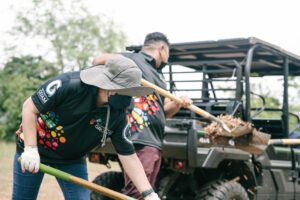
The growing reforestation movement was in full display as more than 2,000 trees were planted in the hills of Malesso’ on July 24 by the Guam Green Growth Conservation Corps, a joint program of the University of Guam Center for Island Sustainability, the Office of the Governor, and Guam NSF EPSCoR’s Education and Workforce Development objective.

The Corps worked alongside the Department of Agriculture Forestry Division, and more than 200 interns and volunteers.

The effort was part of the As Gadao Manell Watershed Restoration Project and one of several Island Beautification Task Force activities organized by the Office of the Lieutenant Governor of Guam to commemorate Guam’s 77th Liberation Day. 

“[The Forestry Division] is trying to plant trees to prevent erosion, to put back and recover native and endemic species, and try and solve some environmental issues out there,” Lt. Gov. Joshua Tenorio said. “Tree planting this morning is one of the very critical pieces in the plan.”

The G3 Conservation Corps members spent the week prior working alongside the DOA team preparing the land for the planting event.

“We spent about four days bush-cutting in a very specific manner, taught by the forestry team, to prepare the land for this event, and it made it so easy for the volunteers to come in and plant so many trees,” said G3 Conservation Corps member Joey Certeza.  “Preparing the land, and now seeing it with so many people helping out, is very satisfying and gratifying.” 

The corps members created contour lines in the southern ridge to create space for trees to be planted and pruned previously planted acacia trees (Acacia auriculiformis) to prepare for the introduction of understory natives to develop a native forest.

“We are working to convert the highly fire-prone landscape, which is dominated by invasive grass species, to forested lands,” said Christine Fejeran, the Forestry and Soil Resources Division chief at the Guam Department of Agriculture. “The acacias help amend soils and shade out the grasses giving native trees a chance, once planted.”

The G3 Conservation Corps is a newly launched workforce development program preparing the local community for the emerging green economy. It is part of the Guam Green Growth initiative, the island’s most comprehensive public-private partnership ever created to achieve a sustainable future for the island. 

UOG Marine Lab students cleanup the beach

DSC09806
DSC09797
DSC09795
DSC09824
DSC09815
DSC09806

Students and researchers from the UOG Marine Laboratory came out last Saturday morning to clean up a part of Pago Bay.

The beach cleanup was organized by Anela Duenas, an NSF INCLUDES: SEAS Islands Alliance research fellow who is being mentored by Dr. Bastian Bentlage.

“I really liked the idea of cleaning up the beach that is connected to the bay where we take our seawater from to use for our research. It helped me feel more connected to what we do and think about how we can help more beyond the research that we do at the marine lab,” Duenas said.

Flyers were posted last week throughout the UOG Marine Laboratory to invite people to join the event. Participants found items such as fishing lines, bottles, wrappers, a grill, and a hat.

Committee begins development on STEM capacity plan

Science and Technology Meeting 1

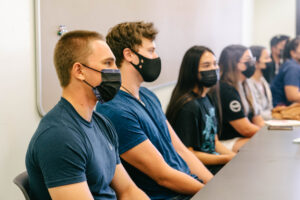
Members of the Guam Science and Technology Steering Committee met on June 29 to discuss ways to bolster the island’s STEM capacity and improve connectivity throughout the Micronesia and the region. 

Comprised of 17 members from government, business, and academic communities, the committee oversees the Guam EPSCoR program’s Guam Ecosystems Collaboratorium for Corals and Oceans (GECCO). The committee also oversees the Guam NASA EPSCoR program.   

Over the next three to six months, the committee will develop a five-year plan that will focus on achieving five objectives:  

  • Serve as a state-of-the-art regional research hub for Guam and the region  
  • Build STEM capacity through education and workforce development  
  • Support STEM infrastructure and identify opportunities in the public sector for potential economic activity  
  • Promote increased communication about STEM throughout Micronesia and the region for informed decision making, knowledge sharing, and continuing education  
  • Create a diversified economy  

“The plan is in development, but its purpose is to blend research knowledge and private sector, economic development, and government investment and effort into something that benefits our society,” said Dr. Robert Underwood, President Emeritus of the University of Guam, who serves as the committee’s vice chair. “First, we’re going to have to have some consultation from economic players – people who would inform us about what plans and activities they have in mind so that we’re informed as a committee.”  

Melanie Mendiola, the chief executive officer of the Guam Economic Development Authority, and Docomo Pacific President Roderick Boss were elected to serve as the committee’s co-chairs.  

Gary Hiles, the chief economist of the Guam Department of Labor, presented information gathered from census data about the categories of STEM employment possibilities and jobs available on Guam. During his presentation, Hiles noted that registered nurses, civil engineers, and computer specialists are the most common STEM occupations on the island.  

“Next time, we may hear from someone about the work they’re doing economically or for the military buildup,” said Underwood. “We may want the governor to talk about her vision, or the speaker to get the legislature’s opinion, or someone from the chamber of commerce. In my own mind, I’m trying to figure out how to best secure that input and see how we can benefit from that.” 

After Hiles’ presentation, the committee members discussed potential areas of economic and research activities to prioritize such as solid waste issues, application of marine science research, creating a teaching hospital for medical professionals, and cybersecurity development.  

At the end of the meeting, the committee members were tasked to indicate which two out of the five objectives they would like to work on. Teams will be organized around the objectives and additional members may be drawn from external sources in the private sector, government, and educational institutions.  

The board will meet on a bimonthly basis. The next anticipated meeting will be in August. Guam EPSCoR is funded by the National Science Foundation (NSF).  

### 

EPSCoR Summer Math Research Program SMRE Application Deadline Extended!

EPSCoR SMRE Deadline
Blue Modern Math Classroom Poster 1

Guam, USA – May 19, 2021 – Are you a STEM undergraduate or recent graduate student interested in mathematics and ensuring the sustainability of our local environment? If you’re self-motivated, well-organized, and majoring in Mathematics, Biology, Computer Science, Engineering, or related field, Guam EPSCOR has a valuable summer research experiences for you — and it’s paid! 

The Guam EPSCoR Summer Math Research Program (SMRP) is extending an application deadline and seeking applications for:  

The Summer Math Research Experience (SMRE) is seven (7) weeks-long taking place from June 7th to July 24th, 2021. The SMRE aims to give qualified STEM undergraduate Sophomores, and Juniors an opportunity to participate in research experiences in the mathematical sciences, with applications in the natural sciences. Students will study mathematical models of coral reef responses to adverse effects and stressors such as bleaching, disease, low water flow, and high turbidity. Eligible applicants must have completed MA203: Calculus I or equivalent with a grade “B” or better. Selected applicants will be paid a stipend of $3,500, assigned a faculty mentor, gain skills in industry standard software, and more! For applications and more information please visit www.guamepscor.uog.edu/smre  

The Summer Math Research Assistant (SMRA) application window CLOSED on May 19, 2021. Thank you for your interest and please apply next summer.   

The program seeks to increase the number and diversity of students who choose careers in STEM (Science, Technology, Engineering, and Mathematics). All qualified students are encouraged to apply, in particular women, minorities, and students with disabilities. 

The deadline to apply for SMRE is extended to 5 p.m. on May 26th, 2021. Accepted students will be notified by May 28th, 2021Late applications may be considered until all positions are filled.  For more information visit our web pages linked above or contact epscor.smrp@triton.uog.edu  


About Guam EPSCOR 

The Guam EPSCoR program at the University of Guam is funded by a five-year, $20 million grant from the National Science Foundation’s Established Program for the Stimulation of Competitive Research (EPSCoR). The program aims to broaden the participation of underrepresented students in STEM fields through developing a research program that helps ensure the sustainability of coral reef ecosystems in the face of environmental change. Guam EPSCoR aims to situate Guam as a premier research and STEM education hub bolstering sustainability, economic development, and informed decision-making by engaging communities in 21st-century science. 


Biology student discovers two potentially new species from Yap

5R5A1608

Gabriella Prelosky, an undergraduate biology student at the University of Guam, is in the process of naming two potentially new species of diatoms that she found while examining a mud sample from a mangrove in Yap. Diatoms are single-celled algae found in oceans, lakes, and rivers. 

“They’re primary producers, so they’re photosynthetic organisms,” said UOG Professor Emeritus of Biology Christopher Lobban, Prelosky’s mentor. “The other characteristic they have is that they’re the base of the food chain — they’re part of the reason why mangroves are rich areas. In freshwater studies, there’s been a push to know more about water quality, and diatoms act as water quality indicators.”

Prelosky is working in Lobban’s Microscopy Teaching & Research Laboratory on the UOG campus for a research fellowship with the NSF INCLUDES: SEAS Islands Alliance program, a $10 million initiative funded by the National Science Foundation to broaden participation in STEM fields of students in U.S. territories and affiliated islands.

In studying the mud sample, Prelosky came across a very long figure. 

She said, “I took a couple pictures and showed it to Dr. Lobban, and he said, ‘I’ve never seen anything like that before.”’ 

Lobban sent the pictures to a colleague, who identified the specimen as a member of the genus Gompotheca.

“At that point, we started thinking that we found something new,” Lobban said. “There are only two species in the genus Gompotheca, and they’re both characterized as being very rare. One species had been studied in a scanning electron microscope, and we can see the differences between them, so we know it wasn’t that one. The second one doesn’t even look like it belongs in the same genus.” 

A few weeks later, Prelosky found the second potentially new species from the same sample.

“Dr. Lobban noticed that it looked like a different species,” Prelosky said. “But what was distinct about it is that it had these arches and these flaps. He looked more into it and said it was probably a new species as well.” 

According to Lobban, new species are being found all the time because marine tropical diatoms have not been extensively explored. Much of the literature on single-celled algae dates to the 1800s.

Both findings will officially be new species once a paper about the diatoms has been peer-reviewed and approved for publication.

‘I wanted to name them after people important to me’

In documenting and describing the species in a research paper, Prelosky will also get to name them. She announced the names at the first annual UOG STEM Conference, which took place virtually from April 16–17. 

“The first one is named Gompotheca marciae,” Prelosky said. “I talked to my parents about naming them after my two grandmothers: Mary from my dad’s side and Marcia from my mom’s. They have similar names, so it was easy to combine them.” 

Prelosky named the second one Campylodiscus tatreauae after Linda Tatreau, her former science teacher from George Washington High School. 

“I named it after her because she’s been such a helpful person in my journey to marine biology,” Prelosky said. “I thought it would be nice to name it after her because without her, I wouldn’t be where I am today.”

The NSF INCLUDES: SEAS Alliance is administered by the Center for Island Sustainability and the Sea Grant program at the University of Guam and collaborates closely with the Guam EPSCoR program, also funded by the National Science Foundation.

Link to original article.

Summer Research Positions Available with EPSCoR Math Summer Research Program 2021!

EPSCoR Summer Math Research Program SquarePoster
Guam EPSCoR Summer Math Research Program TITLE only

STEM Undergraduate and Recent Graduate Students:

Study mathematical modeling, gain research experience, and get paid for the summer! 

Guam, USA – May 12, 2021 – Are you a STEM undergraduate or recent graduate student interested in mathematics and ensuring the sustainability of our local environment? If you’re self-motivated, well-organized, and majoring in Mathematics, Biology, Computer Science, Engineering, or related field, Guam EPSCOR has a valuable summer research experiences for you — and it’s paid! 

The Guam EPSCoR Summer Math Research Program (SMRP) is seeking applicants for 2 (two) Summer Research positions:  

The Summer Math Research Experience (SMRE) is seven (7) weeks-long taking place from June 7th to July 24th, 2021. The SMRE aims to give qualified STEM undergraduate Sophomores, and Juniors an opportunity to participate in research experiences in the mathematical sciences, with applications in the natural sciences. Students will study mathematical models of coral reef responses to adverse effects and stressors such as bleaching, disease, low water flow, and high turbidity. Eligible applicants must have completed MA203: Calculus I or equivalent with a grade “B” or better. Selected applicants will be paid a stipend of $3,500, assigned a faculty mentor, gain skills in industry-standard software, and more! For applications and more information please visit www.guamepscor.uog.edu/smre  

The Summer Math Research Assistant (SMRA) is nine (9) weeks-long taking place from May 24th to July 24th, 2021. The SMRA aims to provide STEM undergraduate Seniors and recent graduates an opportunity to gain experience as research assistants and near-peer mentors for undergraduate participating in EPSCoR Summer Math Research Experience (SMRE). Assistants will also mentor participants of the National Research Experience for Undergraduates Program (NREUP), and Young Scholars Research Experience in Mathematics (YSREM) conducting modeling for the population dynamics studies of the invasive Coconut Rhinoceros Beatle and the parasitoid wasp attacking the Mariana Eight Spot Butterfly. Eligible applicants should be proficient in using LaTeX, Beamer MATLAB, and/or R. Selected applicants will be paid a stipend of $4,500. For applications or more information please visit www.guamepscor.uog.edu/smra  

The program seeks to increase the number and diversity of students who choose careers in STEM (Science, Technology, Engineering, and Mathematics). All qualified students are encouraged to apply, in particular women, minorities, and students with disabilities. 

The deadline to apply is 5 p.m. on May 19th, 2021. Accepted students will be notified by May 21st, 2021. Late applications may be considered until all positions are filled.

For more information visit our web pages linked above or contact epscor.smrp@triton.uog.edu  

About Guam EPSCOR 

The Guam EPSCoR program at the University of Guam is funded by a five-year, $20 million grant from the National Science Foundation’s Established Program for the Stimulation of Competitive Research (EPSCoR). The program aims to broaden the participation of underrepresented students in STEM fields through developing a research program that helps ensure the sustainability of coral reef ecosystems in the face of environmental change. Guam EPSCoR aims to situate Guam as a premier research and STEM education hub bolstering sustainability, economic development, and informed decision-making by engaging communities in 21st-century science.