
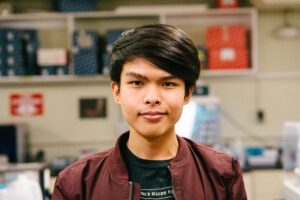
Students will gain hands-on experience and mentorship through STEM internship  

EPSCoR SRE Photo 1
EPSCoR SRE Photo 1
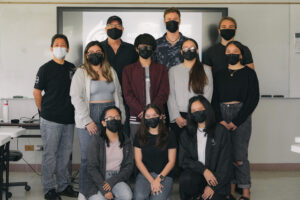
Guam NSF EPSCoR welcomes 10 undergraduate students to its 2022 Student Research Experience! These students will gain valuable research experience and mentorship this year by conducting fieldwork, learning laboratory skills, and preparing a research paper and a presentation of their findings.

Guam NSF EPSCoR welcomes 10 undergraduate students from the University of Guam to its 2022 Student Research Experience. Through the internship program, the students will gain valuable research experience and mentorship this year by conducting fieldwork, learning laboratory skills, and preparing a research paper and a presentation of their findings to exhibit at various STEM conferences.  

The program is designed to increase the number and diversity of students, particularly from Pacific Islands, who choose STEM careers by giving them the skills and confidence needed for academic and career development.  

The students were briefed about the internship during a virtual orientation on Friday, Feb. 4.  

“I am very happy to welcome our new SRE students,” said Terry Donaldson, the principal investigator of Guam NSF EPSCoR. “This program is really a game-changer. This will either help you become a research scientist later in your career or just teach you how to better adapt to the situations that arise in whatever you do.” 

As part of the internship, the students will participate in near-peer mentorship programs that will allow them to interact with high school, undergraduate, and graduate students who are a part of Guam NSF EPSCoR and with the NSF INCLUDES: SEAS Islands Alliance program. 

“This experience for me was so amazing. Not only did it change me as a student, but it changed me as a person,” said Ariana Orallo, a 2021 SRE intern and an undergraduate biomedical pre-pharmacy student at UOG. “Prior to this, I had no knowledge about anything that I was going into. I was working with corals, so it was really intimidating at first. But as you keep going, it keeps getting easier and the knowledge sticks with you.” 

For more information about the Guam NSF EPSCoR Student Research Experience, visit https://guamepscor.uog.edu/sre/. 

STEM internship offers hands-on experience to students 

SRE Meet and Greet
SRE Meet and Greet
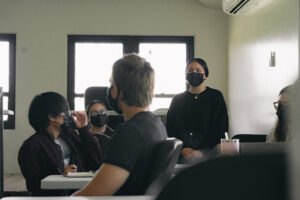
Ten undergraduate students will gain valuable research experience and mentorship this year through the Guam NSF EPSCoR Student Research Experience.

Ten undergraduate students will gain valuable research experience and mentorship this year through the Guam NSF EPSCoR Student Research Experience. The students, most of whom had never participated in a STEM research program were welcomed to the program during a meet-and-greet session on Dec. 17, 2021. 

The program is designed to increase the number and diversity of students, particularly from Pacific Islands, who choose STEM careers by giving them the skills and confidence needed for academic and career development. 

Each academic year, undergraduate students from the University of Guam and the Guam Community College are selected to participate in the year-long program and choose a research project, collect data, and then prepare a research paper and presentation of their findings.  

Depending on student interest, training in molecular laboratory skills such as DNA extractions, polymerase-chain reaction, DNA sequencing and analyses may be part of the internship.  

“I’m excited to experience more hands-on work. Because of COVID, labs closed and that made it difficult to learn these skills,” said Lynn Galang, a UOG undergraduate integrative biology student. “I’m just excited to get more experience.”  

Over the course of the program, Galang will be mentored by Sarah Lemer, a UOG assistant professor of marine invertebrate genomics in the Marine Laboratory.  

As part of the internship, the students will participate in near-peer mentorship programs that will allow them to interact with high school, undergraduate, and graduate students who are a part of Guam NSF EPSCoR and with the NSF INCLUDES: SEAS Islands Alliance program. 

“This program is like a year-long interview, said Cheryl Sangueza, a UOG Associate Professor of Education and the Guam NSF EPSCoR Student Program Coordinator. “It opens the door to opportunities off-island like conferences and other research experiences.”  

For more information about the Guam NSF EPSCoR Student Research Experience, visit https://guamepscor.uog.edu/sre/ 

UOG students present and network at STEM diversity conference

Louise SACNAS

Four members of the Guam NSF EPSCoR undergraduate Student Research Experience and five research fellows from the NSF INCLUDES: SEAS Islands Alliance program presented their research at the 2021 SACNAS National Diversity in STEM Digital Conference from Oct. 25 to Oct. 29, 2021.  

SACNAS, the Society for Advancement of Chicanos/Hispanics and Native Americans in Science, is the largest multicultural STEM diversity program in the US.  

During the conference, the students were able to attend workshops, research presentations, and connect with officials from schools nationwide for research experience opportunities.  

“I feel great that I got to present at SACNAS,” said Louise Pascua, a UOG undergraduate biology student. “I wasn’t sure if we were going to finish in time for the conference because we had a lot of difficulties, but everything worked out in the end. I’m glad I got to show everyone all the work I’ve been doing this past year.”  

Through the Guam NSF EPSCoR undergraduate Student Research Experience, Pascua was mentored by UOG Professor of Biology Daniel Lindstrom. Pascua’s presentation entitled, “Genetic Barcoding of all Amphidromous Nerite and Thiarid Snails Native to Guam,” focused on determining whether or not certain species of snails were native to Guam.  

“I feel very thankful and appreciative that a student with my background was able to present at this conference,” said Merry Remetira, a UOG undergraduate civil engineering student. “Everyone has been very kind.”  

UOG Assistant Professor of Oceanography Atsushi Fujimura mentored Remetira for her Student Research Experience. Remetira’s project, “The Relationship between Seagrass Cover and Water Physicochemical Parameters in Achang Bay, Guam” focused on determining water quality and environmental factors that affected the growth of seagrass on Guam. According to the study, seagrass meadows are beneficial ecosystems that provide habitats and food sources for many marine species.  

During the conference, the students were able to connect with organizations and colleges for research opportunities. 

Representatives from Texas A&M University and Iowa State University reached out to Pascua and Remetira about their work. 

Boston University, Rutgers University, and the Scripps Institution of Oceanography were among several institutions that contacted Gabriella Prelosky, a UOG undergraduate biology student, about research experience opportunities.  

As an NSF INCLUDES: SEAS Islands Alliance research fellow, Prelosky was mentored by Christopher Lobban, a UOG Professor Emeritus of Biology. Her project, “Biodiversity of mangrove diatom communities in three Western Pacific islands” focused on documenting the most frequently occurring diatom species in Guam, Palau, and Yap. Through her project, 13 new species of diatoms were recognized. Earlier this year, Prelosky discovered two potentially new diatom species from Yap.  

“A lot of people reached out to me to check out their programs and even my dream school messaged me! It was a lot of fun and it’s an opportunity that not a lot of people get to experience,” said Prelosky. “I feel really lucky.” 

The NSF INCLUDES: SEAS Islands Alliance is administered by the UOG Center for Island Sustainability and Sea Grant programs in partnership with the School of Education at the University of Guam. Austin Shelton, Cheryl Sangueza, and Else Demeulenaere serve as investigators of the grant award. NSF INCLUDES collaborates closely with the Guam NSF EPSCoR program, also funded by the National Science Foundation. 

Merry R SACNAS
“I feel very thankful and appreciative that a student with my background was able to present at this conference,” said Merry Remetira, a UOG undergraduate civil engineering student.

Biology student discovers two potentially new species from Yap

5R5A1608

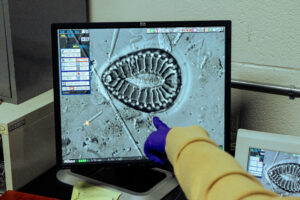
Gabriella Prelosky, an undergraduate biology student at the University of Guam, is in the process of naming two potentially new species of diatoms that she found while examining a mud sample from a mangrove in Yap. Diatoms are single-celled algae found in oceans, lakes, and rivers. 

“They’re primary producers, so they’re photosynthetic organisms,” said UOG Professor Emeritus of Biology Christopher Lobban, Prelosky’s mentor. “The other characteristic they have is that they’re the base of the food chain — they’re part of the reason why mangroves are rich areas. In freshwater studies, there’s been a push to know more about water quality, and diatoms act as water quality indicators.”

Prelosky is working in Lobban’s Microscopy Teaching & Research Laboratory on the UOG campus for a research fellowship with the NSF INCLUDES: SEAS Islands Alliance program, a $10 million initiative funded by the National Science Foundation to broaden participation in STEM fields of students in U.S. territories and affiliated islands.

In studying the mud sample, Prelosky came across a very long figure. 

She said, “I took a couple pictures and showed it to Dr. Lobban, and he said, ‘I’ve never seen anything like that before.”’ 

Lobban sent the pictures to a colleague, who identified the specimen as a member of the genus Gompotheca.

“At that point, we started thinking that we found something new,” Lobban said. “There are only two species in the genus Gompotheca, and they’re both characterized as being very rare. One species had been studied in a scanning electron microscope, and we can see the differences between them, so we know it wasn’t that one. The second one doesn’t even look like it belongs in the same genus.” 

A few weeks later, Prelosky found the second potentially new species from the same sample.

“Dr. Lobban noticed that it looked like a different species,” Prelosky said. “But what was distinct about it is that it had these arches and these flaps. He looked more into it and said it was probably a new species as well.” 

According to Lobban, new species are being found all the time because marine tropical diatoms have not been extensively explored. Much of the literature on single-celled algae dates to the 1800s.

Both findings will officially be new species once a paper about the diatoms has been peer-reviewed and approved for publication.

‘I wanted to name them after people important to me’

In documenting and describing the species in a research paper, Prelosky will also get to name them. She announced the names at the first annual UOG STEM Conference, which took place virtually from April 16–17. 

“The first one is named Gompotheca marciae,” Prelosky said. “I talked to my parents about naming them after my two grandmothers: Mary from my dad’s side and Marcia from my mom’s. They have similar names, so it was easy to combine them.” 

Prelosky named the second one Campylodiscus tatreauae after Linda Tatreau, her former science teacher from George Washington High School. 

“I named it after her because she’s been such a helpful person in my journey to marine biology,” Prelosky said. “I thought it would be nice to name it after her because without her, I wouldn’t be where I am today.”

The NSF INCLUDES: SEAS Alliance is administered by the Center for Island Sustainability and the Sea Grant program at the University of Guam and collaborates closely with the Guam EPSCoR program, also funded by the National Science Foundation.

Link to original article.

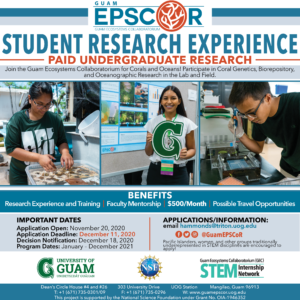
Undergrads: Study coral reefs, gain research experience, and get paid!

EPSCoR Flyer SRE 2021 Application Match V1.2 Resize for Social Website Removed

Are you an undergraduate student interested in ensuring the sustainability of coral reefs and the marine environment? If you’re self-motivated, well-organized, and trained in basic lab procedures and microscopy, Guam EPSCOR has a valuable student research experience for you — and it’s paid!

The Student Research Experience program, which will take place from January-December 2021, is designed to train undergraduates in scientific research specific to coral reef ecosystems. Selected students will benefit from research training, faculty mentorship, possible travel opportunities, and a stipend of $500 per month.

The program may involve hands-on fieldwork to investigate coral reefs or to deploy and retrieve oceanographic instruments as well as work in the UOG Marine Laboratory’s Molecular Lab. Students will learn about DNA extraction and sequencing and/or how to read and analyze data to characterize marine environments.

The program seeks to increase the number and diversity of students who choose careers in STEM (Science Technology, Engineering, and Mathematics). All qualified students are encouraged to apply, in particular women, minorities, and students with disabilities.

The University of Guam and the Research Corporation of the University of Guam are equal-opportunity employers that have received National Science Foundation funding to broaden the participation of underrepresented students in STEM fields.

The deadline to apply is 5 p.m. on Dec. 11, 2020, and accepted students will be notified by Dec. 18.

Requests for applications may be directed to Sho Hammond at hammonds@triton.uog.edu. For more information, visit www.guamespscor.uog.edu.

About Guam EPSCOR
The Guam EPSCOR program at the University of Guam is funded by a five-year, $20 million grant from the National Science Foundation. The program aims to develop Guam Ecosystems Collaboratorium for Corals & Oceans (GECCO) to ensure the sustainability of coral reef ecosystems in the face of environmental change. Guam EPSCoR aims to situate Guam as a premier research and STEM education hub bolstering sustainability, economic development, and informed decision-making by engaging communities in 21st-century science.

EPSCoR Flyer SRE 2021 Final

Link to original article: https://www.uog.edu/news-announcements/2020-2021/2020-uog-undergrads-epscor-program.php

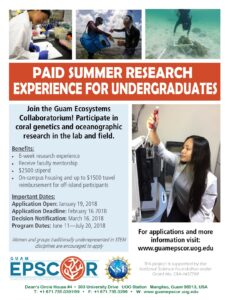
2018 SRE (DEADLINE EXTENDED)

guam epscor sre 2018
sre banner3

Guam EPSCOR is a 5-year, $6 million grant to the University of Guam from the National Science Foundation. The program aims to develop a Guam Ecosystems Collaboratorium to ensure the sustainability of coral reef ecosystems in the face of environmental change. Guam EPSCoR aims to situate Guam as a premier research and STEM (Science Technology, Engineering and Mathematics) education hub bolstering sustainability, economic development, and informed decision-making by engaging communities in 21st-century science.

guam epscor sre 2018 1

In addition to its research goals, Guam EPSCoR seeks to increase the number and diversity of students who choose STEM careers by engaging students in its Summer Research Experience (SRE) Program. The SRE program is a six-week program open to select undergraduate students seeking research opportunities this summer. Student research training and tasks may include field work to investigate coral reefs or to deploy and retrieve oceanographic instruments, as well as work in the University of Guam Marine Laboratory’s Molecular Lab. Selected students will learn about DNA extraction and sequencing and/or how to readout and analyze data to characterize marine environments. Ideal candidates are self-motivated, well organized, and have basic training or experience in lab procedures and microscopy.

The University of Guam and Research Corporation of the University of Guam are Equal Opportunity Employers that have received NSF funding to broaden the participation of underrepresented students in STEM fields. As such, the SRE Program remains open to all qualified students, but women, minorities, and students with disabilities are particularly encouraged to apply.

ELIGIBILITY

  • Must be a U.S. citizen and/or permanent resident of Guam
  • Undergraduate student in good academic standing
  • Available 8AM – 5PM between June 11 – July 20, 2018, and flexibility to work some nights and weekends

BENEFITS

  • Research experience
  • Faculty/Researcher mentoring
  • $2500 stipend
  • Possible travel opportunities
  • On-campus housing and up to $1500 travel reimbursement for off-island participants

APPLICATION SUBMISSION

  1. Drop off this application and transcript to:
    Guam EPSCoR Office, University of Guam, Dean Circle House #4
    Office Hours 8AM – 5PM, Monday – Friday
  2. Or, you can email documents to Mellani Lubuag at lubuagm@triton.uog.edu
    PDF format only.

SPACE IS LIMITED.
DUE DATE: February 28, 2018 by 5:00PM

FOR MORE INFORMATION, CONTACT:
Mellani Lubuag, Program Manager
lubuagm@triton.uog.edu  /  (671) 735-0301/09

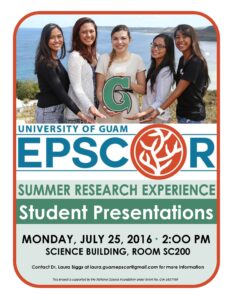
SRE Student Presentations

sre presentation flyer 2017 0
sre banner

SUMMER RESEARCH EXPERIENCE (SRE)
Undergraduate Student Presentations

sre presentation flyer 2017 0

9AM, Wednsday, July 26, 2017
University of Guam, School of Business & Public Administration, Rm. 129

Please join us for Guam EPSCoR’s Summer Research Experience (SRE) Student Presentations. Under the tutelage of Guam EPSCoR faculty at the University of Guam (UOG), undergraduate students from UOG and Duke University have undertaken research projects this summer and will present their findings to the community on July 26th. Join us to learn how the students’ projects have contributed to Guam EPSCoR’s research mission.

Resources

Campus Map