
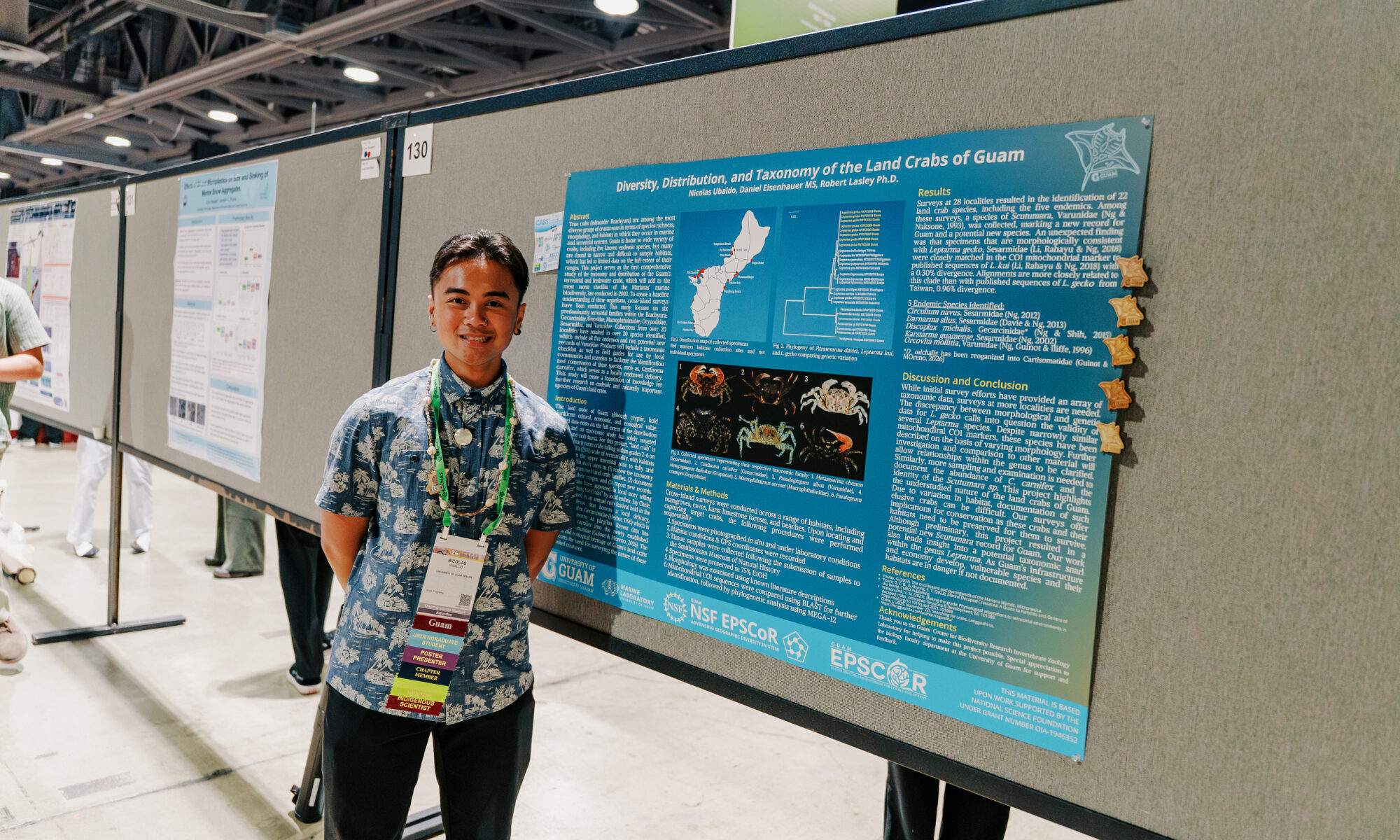
Guam is home to a wide variety of crabs, but many live in narrow, hard-to-reach habitats, and scientists know little about how far their ranges extend. At the 2026 SACNAS Annual Conference, student researcher Nicolas Ubaldo presented a poster on the first comprehensive study of the taxonomy and distribution of Guam’s land crabs, titled “Diversity, Distribution, and Taxonomy of the Land Crabs of Guam.”
The project was carried out with Daniel Eisenhauer, MS, and Ubaldo’s mentor, Robert Lasley, Ph.D., UOG assistant professor and curator of crustacea at the Guam Center for Biodiversity Research Invertebrate Zoology Laboratory. The Guam NSF EPSCoR E-CORE program supported the research.
“My project deals with documenting the distribution of Guam’s land crabs,” Ubaldo said of the work, which combined field and lab research to track down reported crabs and identify them through both physical features and genetic analysis.
Ubaldo said the motivation is personal as well as scientific. “The biggest inspiration to pursue this research has been from my past advisors as well as my love for my island,” he said. He hopes the work will draw attention to animals that rarely get it. “I hope to find ways with my research to shed light on underrepresented animal communities and contribute towards Guam’s environmental conservation.”
The need is real. Guam’s five known endemic crab species, found nowhere else, live alongside many others, yet the most recent checklist of the Marianas’ marine biodiversity dates to 2003. The land crabs also carry cultural weight. They appear in local storytelling, and the village of Malesso holds an annual crab festival honoring the delicacy known in CHamoru as pång’lao, the land crab Cardisoma carnifex. Recent research has placed that species in a newly established family, Cardisomatidae.
To build a baseline, the team surveyed across the island in mangroves, caves, karst limestone forests, and beaches. For each crab, they photographed it in the field and in the lab, recorded habitat conditions and GPS coordinates, took tissue samples for submission to the Smithsonian National Museum of Natural History, and preserved specimens in ethanol. They then compared physical features to published descriptions and matched mitochondrial DNA sequences against published ones for further identification.
So far, surveys at 28 localities have identified 22 land crab species, including all five of Guam’s endemics: Circulium navus, Darnarma silus, Discoplax michalis, Karstarma guamense and Orcovita mollitia. The team also collected a species of Scutumara, a new record for Guam and a potential new species.
According to the poster presentation, an unexpected result involved the genus Leptarma. Specimens that look like Leptarma gecko matched published genetic sequences of a related species, L. kui, with only 0.30% divergence, and were more distant from published L. gecko sequences from Taiwan, at 0.96%. That mismatch between appearance and DNA raises questions about whether several Leptarma species are valid, and further comparison with other material is needed to untangle their relationships.
The researchers say more surveys and sampling are needed, including to document how abundant C. carnifex is and to confirm the identity of the Scutumara. Because these crabs are elusive and their habitats vary, they argue that documentation is especially important as Guam’s infrastructure and economy develop, since undocumented species are most vulnerable to habitat loss.
The project will produce a taxonomic checklist and field guides for local communities and scientists to help identify and protect these species.
Beyond his poster, Ubaldo said he was eager to take part in the wider conference. “I’m most looking forward to meeting unique people who have similar research interests as me but come from completely different backgrounds,” he said. “I think it’s interesting and inspiring to learn about what drives other young scientists to pursue research.”
The project was supported by the Guam Center for Biodiversity Research Invertebrate Zoology Laboratory. The material is based on work supported by the National Science Foundation under grant number OIA-1946352.
AT A GLANCE
- The big idea: Many of Guam’s land crabs live in hard-to-sample habitats, so little is known about where they occur. This study documents which species live on the island and where to support their conservation.
- What they did: The team surveyed mangroves, caves, karst limestone forests and beaches. They photographed crabs, recorded habitat and GPS data, collected tissue samples, and identified specimens by comparing their physical features to published descriptions and matching their mitochondrial DNA.
What they found: Surveys at 28 localities identified 22 species, including all five endemics, plus a potential new Scutumara record for Guam.
What it means: More surveys are needed, and the crabs and their habitats must be preserved as Guam develops. A taxonomic checklist and field guides will help communities and scientists identify and protect these species.
Acknowledgments: The Guam Center for Biodiversity Research In vertebrate Zoology Laboratory. This material is based on work supported by the National Science Foundation under grant number OIA-1946352.