
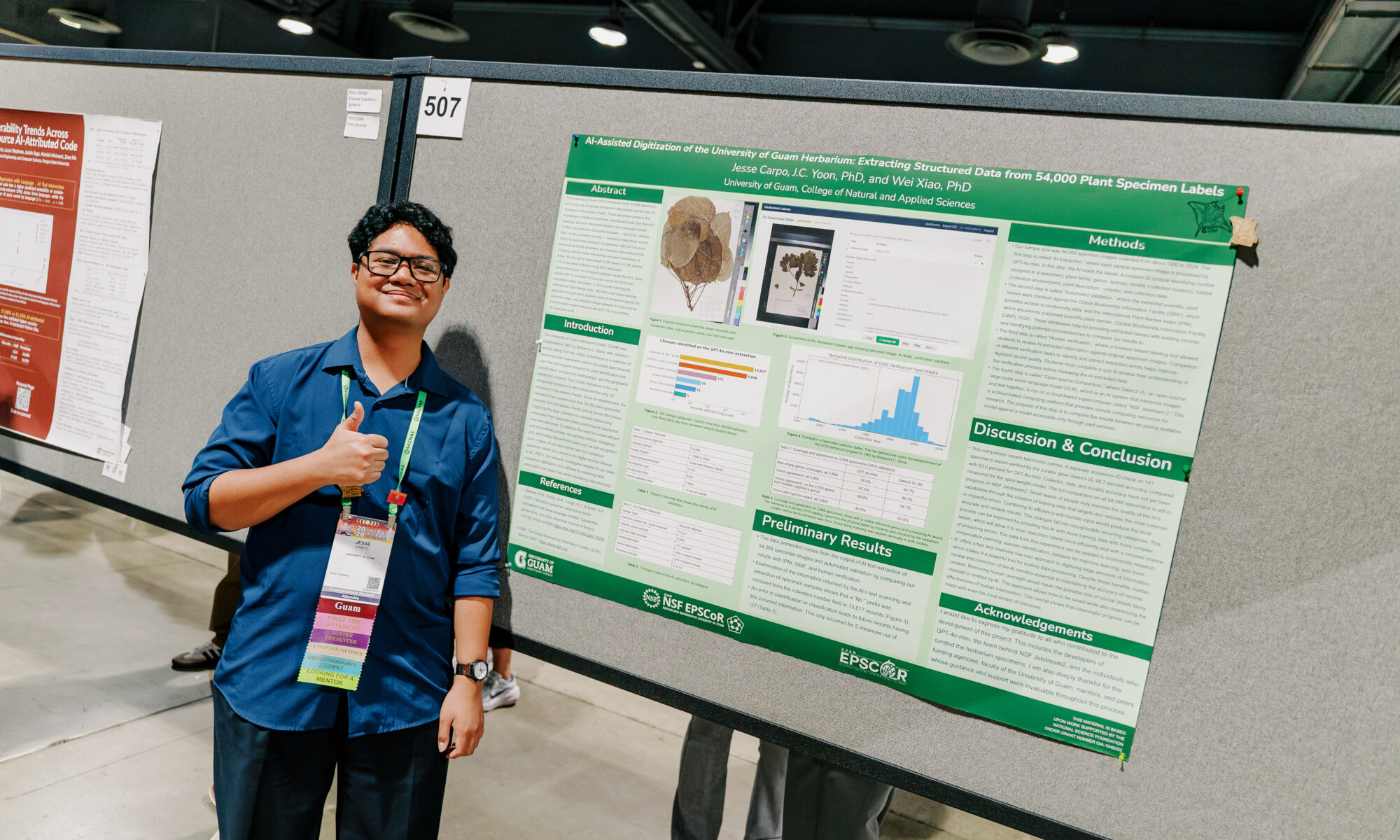
Inside the University of Guam Herbarium sit 54,068 pressed plant specimens, each with a label recording what the plant is, who collected it, where, and when. At the 2026 SACNAS Annual Conference, UOG student researcher Jesse Carpo presented a poster asking whether AI can turn those labels into searchable data.
Carpo and mentors J.C. Yoon, Ph.D., assistant professor of physics, and Wei Xiao, Ph.D., assistant professor of biology and curator of the UOG Herbarium College, worked together on the research. Guam NSF EPSCoR provided funding support.
Carpo explained the technology at its center, ”Vision-language models are AI systems capable of interpreting text in images and converting it into structured data.”
Typing tens of thousands of labels by hand would take enormous time and resources, so the team tested a cheaper route. “We wanted to investigate if an open-weight AI model can provide a cost-effective alternative to a paid-access AI model for digitizing herbarium specimen labels,” Carpo said.
The team first ran GPT-4o-mini, a paid model, on all 54,068 images and checked the extracted names against the Global Biodiversity Information Facility (GBIF) and the International Plant Names Index (IPNI). Students then compared AI output with each specimen image in a browser-based tool, after passing a quiz on the process.
Finally, the team ran an open-weight model, Qwen3-VL-8B, on NSF Jetstream2. Carpo described the comparison, ”We wanted to compare the models’ per-image cost and results on a shared academic computer.”
The paid model finished the collection but misread some collector names and years. On 141 curator-verified specimens, Qwen reached 95.7 percent accession-ID accuracy versus 83.0 percent for GPT-4o-mini, and added 11,268 records matching the International Plant Names Index. Linkage to an expert-curated reference set was 97.1 percent on a 451-specimen audit. Collector, date and locality accuracy for Qwen are not yet measured, and the full run is still in progress.
The preliminary results, drawn from AI extraction of the 54,068 images and checks against IPNI, GBIF and human verification, also point to a pattern. The AI dropped the “No.” prefix from the collection number field in 13,817 records. Because an identification or classification error carries into future records, the team also tracked those, and they occurred in only 5 of 127 instances.
The team stresses that human review remains essential, since AI can misread or omit crucial details. If the project succeeds, the records will be available to the public through a web portal.
Carpo said, ”This resource will help support botanists, ecologists and more seeking plant records from Micronesia and the herbarium itself.” resources and the high cost of imported construction materials.”
For Carpo, the conference is also about people: “What I’m looking forward to most is networking with people at the conference and seeing what opportunities will be available for both undergraduates and postgraduate students.”
AT A GLANCE
- The big idea: Can a free, open-weight AI model digitize herbarium specimen labels as accurately as a paid one, and at lower cost? The goal is to make the University of Guam Herbarium’s 54,068 specimens searchable by researchers and the public.
- What they did: The research team extracted label data from all 54,068 specimen images using GPT-4o-mini, checked scientific names against the Global Biodiversity Information Facility (GBIF) and the International Plant Names Index (IPNI), built a tool for students to verify AI output against specimen images, and ran the open-weight Qwen3-VL-8B model on the same collection using NSF Jetstream2.
What they found: On 141 curator-verified specimens, Qwen reached 95.7% accession-ID accuracy versus 83.0% for GPT-4o-mini, and it added 11,268 records matching the International Plant Names Index. Linkage to an expert-curated reference set was 97.1% on a 451-specimen audit. Collector, date, and locality accuracy for Qwen are not yet measured, and the full comparison is still in progress.
What it means: Open-weight AI looks like a promising, cost-effective option for digitizing natural history collections, but human review is still essential. Combining AI speed with student verification could make plant records accessible to botanists, ecologists, and others worldwide.
Acknowledgments: This material is based on work supported by the National Science Foundation under grant number OIA-1946352.