

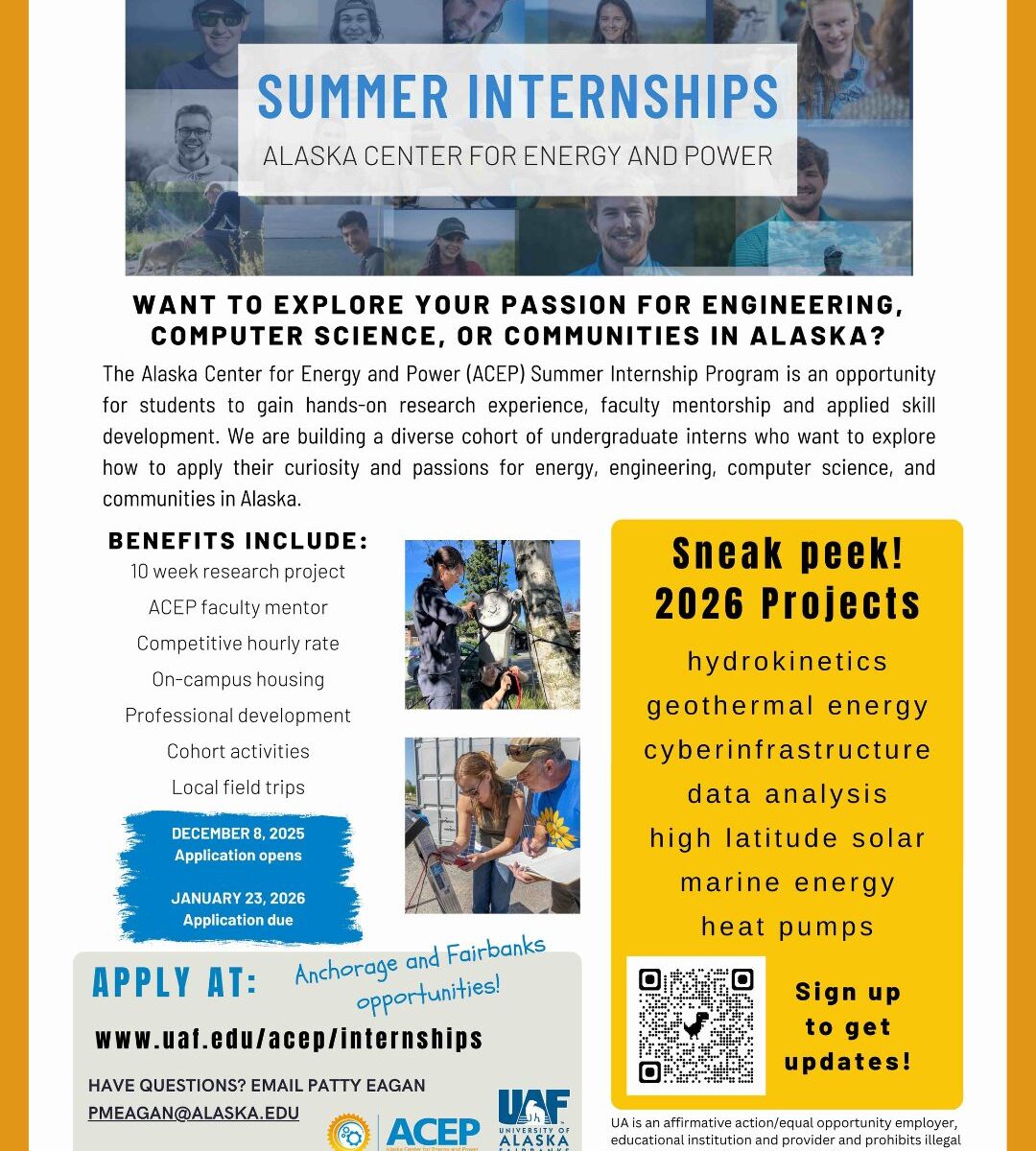
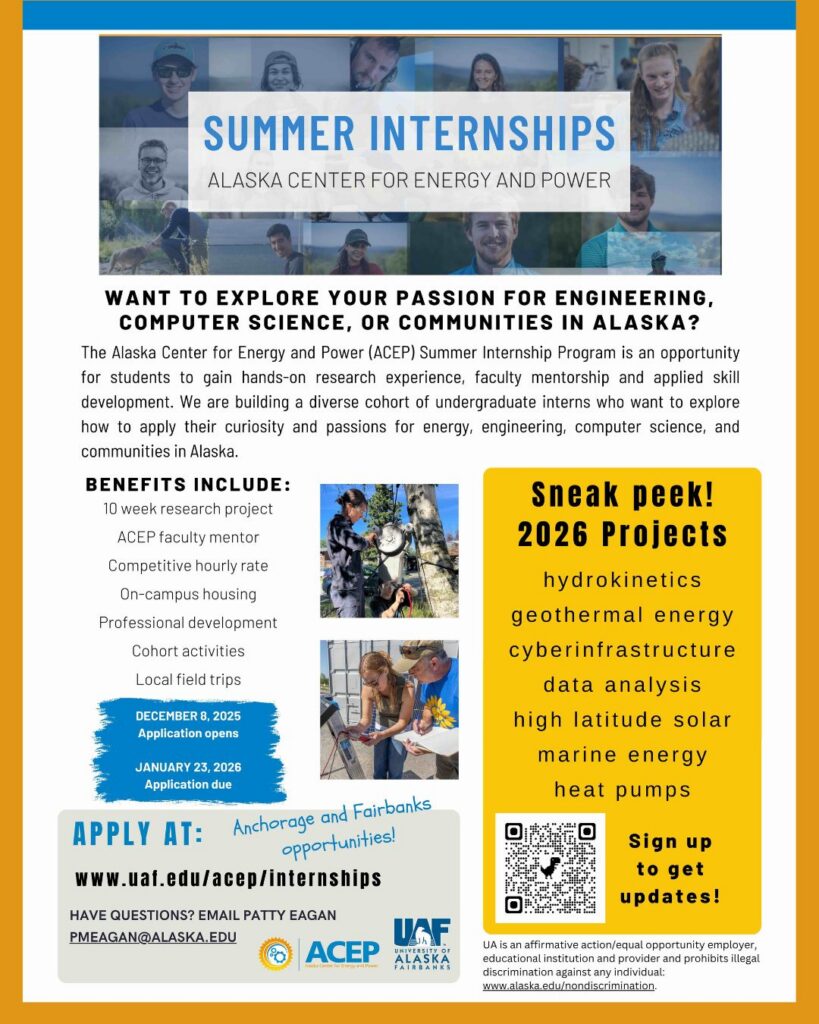
The University of Alaska Fairbanks (UAF) Alaska Center for Energy and Power (ACEP) summer internship is a 10-week program for students interested in renewable energy and energy security.
One of the projects will study Maritime Energy in Alaska and Guam, mentored by Magnus de Witt.
WEBSITE to apply: https://www.uaf.edu/acep/education-workforce-development/summer-internship-program/internship-program.php
PROJECT ABSTRACT
Maritime Energy in Alaska and Guam
Mentor: Magnus de Witt
Location: Fairbanks
Key topics: Maritime Energy, Energy Economics, Energy Security, Arctic-Pacific collaborations
Strand: REU
Maritime energy technologies represent a rapidly emerging technology, with significant potential to help coastal and island communities harness local energy resources. By harnessing the power of waves, tides, currents, and offshore wind, reliance on imported fossil fuels can be reduced, supporting more resilient and sustainable energy systems. The utilization of local resources is of particular interest for remote and isolated communities, where transporting conventional fuels is logistically challenging and costly.
At first glance, Alaska and Guam may appear to have little in common, one located in the far north and the other in the western Pacific; a closer look, however, shows substantial similarities. Both regions are geographically remote, heavily dependent on imported fossil fuel, and consequently face high and volatile energy costs. Their dependence on external fuel supplies makes them vulnerable to disruptions in the global energy market, supply chain risks, and to geopolitical shocks.
In addition to these shared challenges, both Alaska and Guam hold strategic importance for U.S. national security. Each region hosts critical dual-use infrastructure that requires reliable and secure energy systems. Therefore, maintaining resilient energy infrastructure is crucial for ensuring operational readiness and supporting the resilience of local communities. Developing and deploying maritime energy technologies in these regions could therefore strengthen not only local energy independence and economic stability but also contribute to national security by enhancing the resilience of vital assets in remote locations.
Project Description: This project will combine detailed economic modeling, energy security evaluation, and technological feasibility studies of maritime energy sources in Alaska and Guam, aiming to promote sustainable, secure, and economically beneficial maritime energy systems in remote islanded locations.
- How do the energy economics of maritime decarbonization in Guam and Alaska compare?
- What lessons can Guam and Alaska share about balancing national defense, maritime trade, and clean energy transition goals?
- Energy security analysis focusing on local energy availability, reliability, and supply diversification.
- Techno-economic feasibility of renewable marine energy resources in the specific geographic and climatic contexts of Alaska and Guam.
- Environmental and socio-economic benefits, such as emissions reduction and local workforce development.
Project Goals / Expected Outcomes: A report on the lessons learned, both positive and negative, and resulting recommendations for future geothermal projects. Additionally, it is expected that the student will present the research to his peers and, if possible, to a broader community. A student who is motivated to aim for publication in a scientific journal is strongly encouraged to apply.
Relevant Majors and Skills: This project seeks a student who is passionate about geothermal and energy economics. It is not bound to a particular field of study; however, the student should have some understanding of geothermal, economics, and geology. Moreover, the student should possess strong communication skills and a desire to solve problems independently. Possible majors include geology, energy economics, geothermal, or geophysics.
Work setting: This intern will work from the ACEP Fairbanks office. Mentorship will be in person.