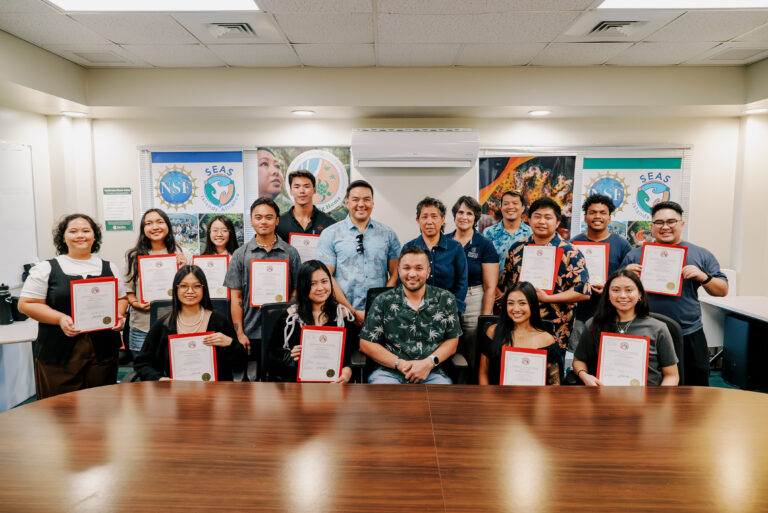
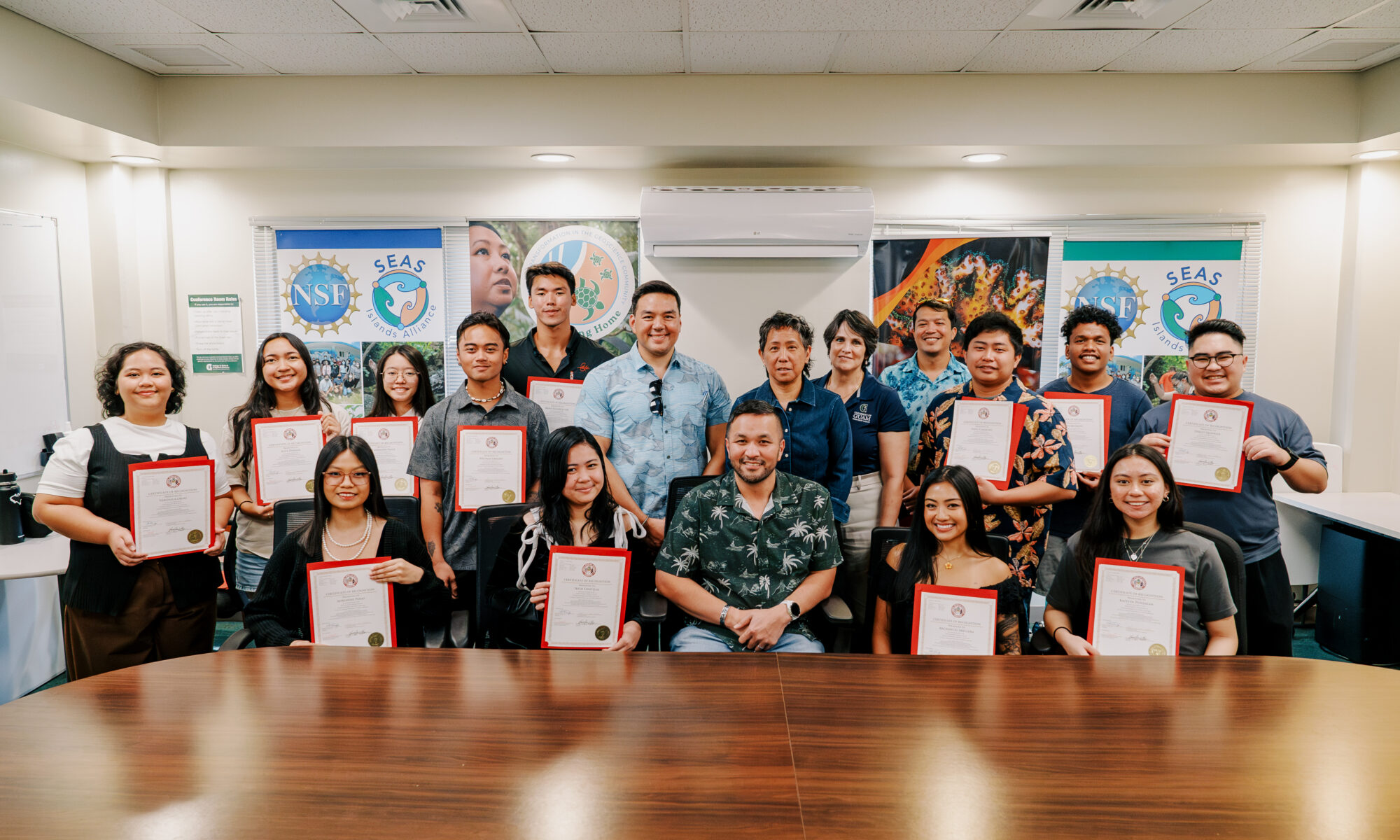
The 17 University of Guam students who attended the Society for Advancement of Chicanos/Hispanics and Native Americans in Science (SACNAS) National Diversity in STEM (NDiSTEM) Conference received formal recognition from the Guam Legislature for representing the island at the national event. The students participated in the conference as members of the Guam NSF EPSCoR, SEAS Islands Alliance and Navigating Home programs at UOG.
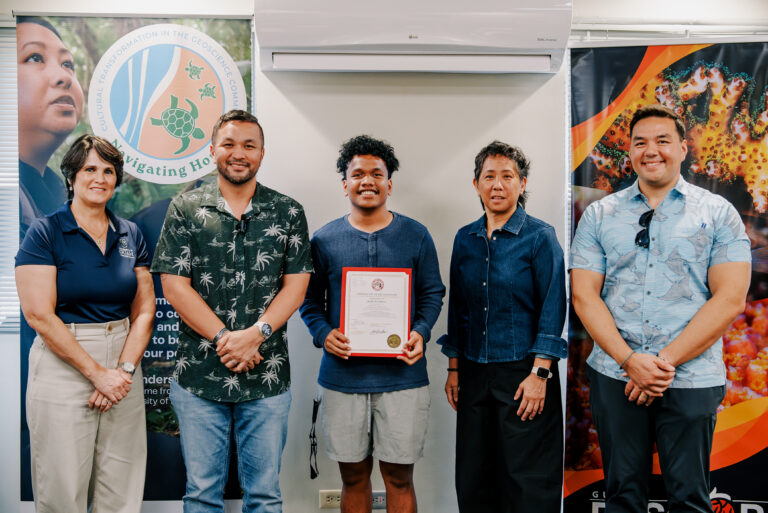
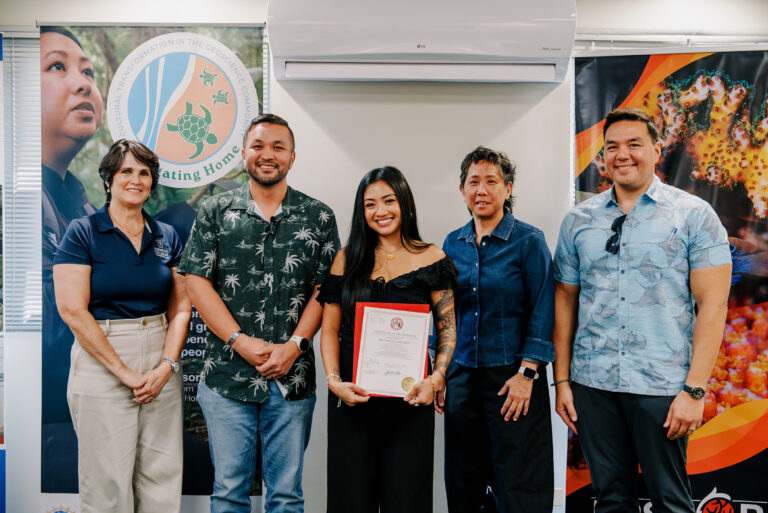
Sen. Vincent A.V. Borja, who chairs the Legislature’s Committee on Education, presented certificates to the students during a ceremony held at the UOG College of Natural and Applied Sciences conference room.
Among those recognized were three UOG students who earned recognition for their research presentations. Azer Bilimon, a student in the UOG School of Engineering, received the Native American/Indigenous Student Research Abstract Award, while Archancel Abellera and Cameron San Agustin received Outstanding Research Presentation awards.
Borja commended the students for their achievements and for representing Guam on a national stage. “We want to ensure that we, as elected officials and public leaders, recognize the work that our students do here at the University of Guam,” Borja said. “For me, this is a big deal.”
Borja noted that participation in national conferences sparks interest in Guam, particularly when students return home after receiving awards and share their experiences with the university and the community.
For Abellera, receiving an award was unexpected but affirming. “I was really surprised to be recognized,” she said.
Her award-winning presentation, “Preserving Endangered Orchids in the Marianas: Propagation Techniques for Species Recovery,” focused on conserving Dendrobium guamense, an endangered orchid found only in the Marianas.
“It was a great experience. I feel like I’ve stepped into a world where I have more trust in my skills,” she said.
Bilimon’s presentation, “Evaluating the Mechanical and Sustainable Benefits of Fibrous Reinforcement in Seawater and Freshwater Mortar Mixtures,” explored the use of coconut fibers in construction. The project was inspired by the resource challenges faced by island communities such as Guam and the Marshall Islands.
Meanwhile, San Agustin’s presentation, “Exploring Propagation Techniques for Conservation of Myrtella bennigseniana, a Native Savanna Shrub,” examined methods to improve the propagation of Myrtella bennigseniana, a native shrub that helps restore Guam’s savanna ecosystems threatened by land development and habitat loss.
Cheryl Sangueza, Ph.D., co-principal investigator of the NSF INCLUDES SEAS and NSF Navigating Home grants and head of student experience for Guam NSF EPSCoR, said UOG has participated in SACNAS conferences since 2018.
For some of the students, this was their first time traveling off island, according to Sangueza, who added that SACNAS exposes them to a broader community of STEM professionals while also bringing recognition to Guam.
She noted that the conference draws approximately 7,000 participants and features around a hundred research presentations. “The most important thing is going out and representing who we are as students from Guam,” Sangueza said. She added that mentors and conference attendees frequently seek out the UOG booth to commend the professionalism and quality of the students’ presentations.
UOG Center for Island Sustainability and Sea Grant Director Austin Shelton, Ph.D., highlighted the broader impact of research opportunities on student success.
“We’ve created close to 300—or even more than 300—research opportunities for students that didn’t exist before,” Shelton said. “That allows us to do things like take them to national conferences.”
Shelton emphasized that geographic distance often limits access to national opportunities for students in Guam. “At these conferences, students are gaining scholarships, fellowships, job opportunities and acceptance into graduate programs,” he said.
UOG sent a 28-member delegation to the 2025 SACNAS Conference, including students, mentors, and science communicators. The nation’s largest multicultural and multidisciplinary STEM event took place in Columbus, Ohio, drawing participants from across the United States and its territories.
Support for select students to attend the SACNAS Conference was also made possible in part by USDA‑NIFA‑funded NextGen Grant.