
UOG celebrates third G3 Conservation Corps graduation 

DSC05072
DSC05072

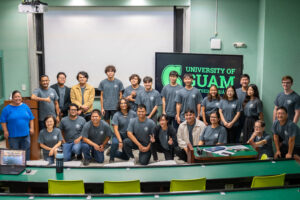
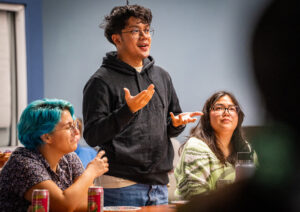
The Guam Green Growth (G3) initiative at the University of Guam celebrated the graduation of its third conservation corps cohort on Friday, August 11, at the Sinajana Community Arts Hall.  

The innovative workforce development program is designed to prepare the island for the emerging green economy. Launched in collaboration with the UOG Center for Island Sustainability and UOG Global Learning and Engagement in 2021, the G3 Conservation Corps program is a full-time training experience spanning five months each year.   

Participants received instruction on a wide range of sustainability topics, covering areas such as agriculture, aquaculture, island beautification, invasive species removal, reforestation, circular economy, ocean conservation, and renewable energy.  

The latest batch of G3 Conservation Corps members who successfully completed the comprehensive program include Maria Balbin, Jace Blas, Zeriah Blas, Cassie Bordallo, Michael Herbert, Michael Jude Hernandez, Connor Law, Laura Layan, Javier Mercado, Ciara Taijeron, Michael Torres, and Elisa Rose Padilla.  

“We’ve learned a lot here and from all of our partners,” said Balbin, who served as corps crew supervisor. 

Also at the graduation, UOG President Anita Borja Enriquez hailed the graduates as conservation corps warriors. “You are a special group of conservation leaders. You represent us as ambassadors to our youth and to members of our community through your experiences…Congratulations! We look forward to seeing you do amazing things.” 

Governor Lou Leon Guerrero also commended the graduates. “The 12 of you are very significant to the conservation of our island. You have gone through an experience that we will probably never go through,” she said.  

Meanwhile, Austin Shelton, UOG Center for Island Sustainability and Sea Grant director, highlighted the unique experience of the third batch of conservation corps. He said the process prepared the corps for the environmental challenges that are occurring in the region and the rest of the world. 

“This season was a little bit different. We had an unexpected typhoon, and we had to do things differently. You got on-the-job training for what is becoming the new reality. Climate change is here, and we are seeing an increasing frequency of storms and rising sea levels,” he said. 

Shelton also mentioned the impactful multiplier effect generated by the G3 Conservation Corps program, especially in partnership development. For example, he said the program facilitated the establishment of the G3 Art Corps and the newly formed G3 Kupu Corps collaboration with Kupu, a Hawai’i’-based youth leadership development program, now providing eight additional year-long corps positions in Guam and CNMI.   

He also underscored G3’s ongoing commitment to expand the movement. He said current efforts of the program attracted new federal funding, enabling the future development of G3 partnerships across Micronesia and the Pacific. 

UOG graduate student studies algae at the University of Washington  

Marine Botany Photo 2

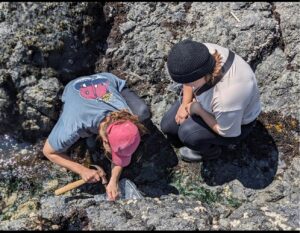
Grace Jackson, a University of Guam graduate biology student and Guam NSF EPSCoR graduate research assistant, gained research experience this summer through a course held at the Friday Harbor Laboratory at the University of Washington from June 11 to July 14, 2023.  

The class was called Marine Botany: Diversity and Ecology and covered classical and contemporary methods for identification, classification, and phylogenetic analysis of algae. Taught by Thomas Mumford, Ph.D., and D. Wilson Freshwater, Ph.D., the five-week course focused on the diversity of algae species found around San Juan Island.  

“I was interested in taking this class because I am studying crustose coralline algae for my thesis,” said Jackson, who is under the mentorship of UOG Professor of Marine Biology, Tom Schils. “I thought that learning about algae from a different ecosystem would give me a broader perspective and appreciation for the work I am doing in Guam.”  

Over the course of the program, Jackson explored the species-rich intertidal habitats around San Juan Island. She also worked on a research project that focused on identifying San Juan Island’s different species of crustose coralline algae, which are rock-hard calcareous red algae that can be found at intertidal rocky shores or coral reefs.  

“Forming my group and getting them excited about our topic and coaching them along the way taught me a lot about science communication,” said Jackson. “Writing the research report also fostered my writing skills. This whole experience has given me a greater appreciation for the work I have been doing in Guam. I can’t wait to get back in the lab and practice what I have learned.”

G3 partner GUMA holds graduation ceremony 

DSC09878

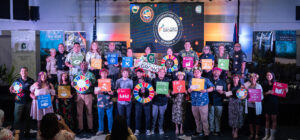
Guam Unique Merchandise & Art (GUMA) held a graduation ceremony for its current batch of entrepreneurs on Saturday, July 29, at the Planet Hollywood at DFS by T Galleria.  

The event was a celebration of the successful completion of a 16-week training and mentoring program for approximately 72 graduates from more than 50 local companies. The graduates represent various sectors, from food, retail to agriculture. 

GUMA and the G3 Circular Economy Makerspace and Innovation Hub are partners in promoting the growth of local businesses in an emerging green economy. By providing essential resources and support, the partnership aims to empower Guam’s talented artists, cultural producers, and entrepreneurs to turn their creative concepts into sustainable businesses. 

With support from Guam NSF-EPSCoR, the G3 Circular Economy Makerspace and Innovation Hub plays a vital role in nurturing the growth of new businesses in an emerging green economy. The makerspace provides a creative space for entrepreneurs to upcycle discarded materials and transform them into marketable products. With advanced tools such as 3D printers, a laser cutter, computer numerical control router, vinyl cutter, and power tools, the makerspace can process various materials, including wood, metal, and plastic.  

Beyond its local impact, the collaboration between GUMA and G3 Circular Economy Makerspace and Innovation Hub also contributes to achieving United Nations Sustainable Development Goal (SDG) 3, which aims to promote Decent Work and Economic Growth.  

By fostering an environment conducive to innovative cottage industries, the partnership seeks to reduce Guam’s dependence on imports and decrease waste generation, paving the way for a more sustainable, green economy. 

Moreover, these efforts align with G3’s goals of reducing reliance on imported goods and minimizing waste generation.  

The graduation ceremony concluded with a sense of hope and promise for the future of Guam’s entrepreneurial landscape. Equipped with the support of GUMA and the innovative resources provided by the G3 Circular Economy Makerspace and Innovation Hub, these graduates are now ready to conquer the challenges of the local market and build businesses that not only contribute to the local economy but also promote environmental responsibility. 

Two UOG students explore turning seawater into clean energy 

Clean Energy Photo 1

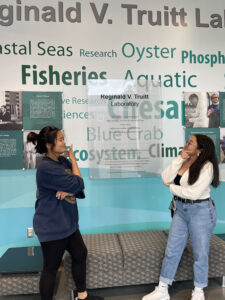
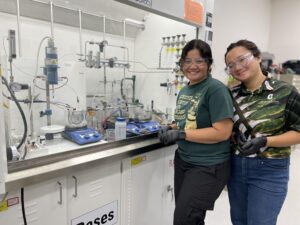
Anna Mallari and Merry Remetira, two undergraduate civil engineering students from the University of Guam, are researching how to convert seawater into renewable energy as part of a collaboration between UOG and the U.S. Department of Energy’s (DOE) Pacific Northwest National Laboratory (PNNL) to establish a diverse and equitable recruitment and retention program to build UOG and Guam’s future energy workforce.  
 
The program they are a part of is called BES-RENEW, or Basic Energy Sciences –  
Reaching a New Energy Sciences Workforce, which works to increase participation of underrepresented groups in clean energy research.  
 
As part of the program, Mallari and Remetira will receive training along with UOG Assistant Professor of Chemistry John Limtiaco at the PNNL campus in Richland, Washington from June 2nd to August 11th, 2023. The laboratory is a leading center of technological innovation in sustainable energy.  

“I’m excited because we will be learning new science that will be beneficial to the island once we come back. I hope that me and Anna will get the necessary tools that we can get there and apply it here when we want to further our careers,” said Remetira.  

Mallari is a 2023 Guam NSF EPSCoR undergraduate student researcher while Remetira is from the 2021 cohort.  

For those looking into applying for opportunities like BES-RENEW, Mallari said it’s important for students to try new experiences.  

“It’s good to diversify your background and be a well-rounded engineer,” said Mallari. “EPSCoR has taught me that since we are in college, we’re not supposed to know everything. We’re supposed to learn. I think that’s a very good lesson to take with me for the rest of my life.”  
 

UOG grad student teaches marine ecology course in Yap

Headshot Pablo
Headshot Pablo scaled
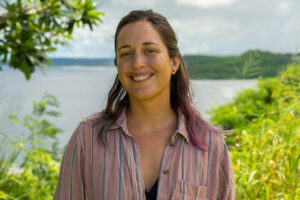
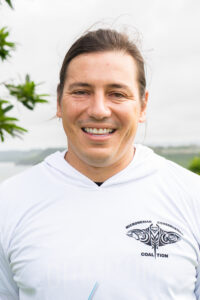
Pablo De la Vega, a graduate biology student from the University of Guam and Guam NSF EPSCoR graduate research assistant, was one of the instructors for an educational program called Marine Island Ecology at the Yap Catholic High School from June 14 to July 7, 2023.

Pablo De la Vega, a graduate biology student from the University of Guam and Guam NSF EPSCoR graduate research assistant, was one of the instructors for an educational program called Marine Island Ecology at the Yap Catholic High School from June 14 to July 7, 2023.  

Organized by the Micronesian Conservation Coalition (MCC), the summer program allows participating high school seniors to gain fieldwork experience and learn about the marine life in Yap. MCC is a nonprofit organization that aims to conserve island habitats and species throughout Micronesia.  

The program was split into different segments that focused on several areas of Yap’s island ecology. Students would discuss theory and lab protocols and then spend the next day in the field putting what they learned in the classroom to practice.  

During his time in the program, De la Vega covered classes related to microbiology.  

“They were all familiar with fermentation and familiar with different kinds of bacteria. In their culture, they consume tuba, which is made through fermentation and different kinds of yeasts and bacteria interacting with each other,” said De la Vega. 

De la Vega said that the experience has deepened his appreciation for the environmental knowledge of indigenous cultures.  

“Learning from everyone who participated in the course made me realize that the only way to promote change and protection of the environment is by learning from the cultures that have preserved it for millennia and empowering the next generation to lead the changes we need from a global perspective if we want to continue having an inhabitable planet,” said De la Vega. 

De la Vega said that he is grateful to MCC for giving him an opportunity to explore Yap and connect with its people.  

“I really want to thank Ms. Julie Hartup from MCC,” said De la Vega. “The programs that MCC have put together are a good example on how you can combine science with social impact.”  

UOG grad student explores the small world of meiofauna

Meiofauna Workshop Photo 3

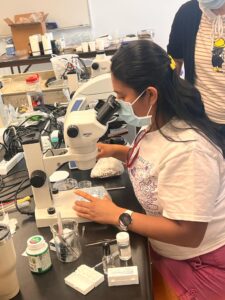
Sarai Vega, a biology graduate student from the University of Guam was one of 13 participants selected worldwide to attend the 2023 Dauphin Island Sea Lab Meiofauna Diversity and Taxonomy Workshop in Alabama from May 10 to May 19, 2023.  

Meiofauna are invertebrates that live in both marine and freshwater environments that are small enough to pass through a 0.45 micrometer mesh. They live in between the grains of sand and mud on the seafloor and riverbeds. Copepods, flatworms, and nematodes fall under meiofauna.  

Because the meiofauna group is broad, the field remains understudied despite its ecological importance.  
 
“Meiofauna have a high turnover, so they reproduce very fast and they don’t live very long,” said Vega. “Because of this, they are a food source to bigger animals like crabs and sea cucumbers. In turn, those bigger animals are food for other animals. If this group didn’t exist, it would affect that chain.”  

Over the course of the workshop, Vega was able to connect with meiofauna experts from around the world as well as learn different collection and sampling techniques for DNA metabarcoding of meiofauna communities around Dauphin Island.  

As a Guam NSF EPSCoR Graduate Research Assistant, Vega became interested in researching meiofauna to incorporate it into her thesis project, which focuses on studying the formation of sediment plumes in the Pago Watershed in central Guam and how they affect the island’s environment.  

Sediment from soil erosion due to fires and invasive species such as wild pigs and deer can wash into rivers, streams, and bays during rainfall. Once in the water, these plumes of sediment can pollute bodies of water and smother coral reef systems.   

“These sediment plumes consist of very fine sediment,” said Vega. “I want to understand what’s happening and how they affect meiofauna.”  

Vega said that her experience attending the workshop has benefited her development as a scientist.  

“Being in the workshop was very hard in the beginning, but I got to learn a lot by asking other people how they’d process their samples so by the end of the workshop, I was faster,” said Vega. “As a scientist, I feel like if there’s any new skill I would like to have, I’ll just have to practice and I’ll get better. Learning is infinite and it’s exciting to know that.”  

Tramonte defends master’s thesis  

Carlos Tramonte Thesis Defense Photo 1

On June 13, 2023, Guam NSF EPSCoR Graduate Research Assistant Carlos Tramonte defended his Master of Science in Biology thesis at the University of Guam Marine Laboratory.  

Tramonte’s thesis was titled, “Coral Species Replacements on Guam’s Reef Flats: Investigating the Role of Symbiodiniaceae Dynamics and Environmental Stressors.” 

His chairperson was Dr. Bastian Bentlage. Along with Bentlage, Tramonte’s committee consisted of UOG Marine Laboratory Director Dr. Laurie Raymundo, and Dr. Sarah Davies from Boston University.   

Following the completion of his graduate program, Tramonte will pursue doctoral work at University of Hawaiʻi at Mānoa with the support of the Graduate Research Fellowship Program from the National Science Foundation.   

Tramonte will be working on mesophotic reef systems in American Samoa and will be looking into coral physiology and environmental DNA (eDNA). 

UOG student sets sail on deep-sea research voyage  

Image 4

University of Guam undergraduate communication major Gabriella Piper was part of the first cohort of students and educators from the Science, Technology, Engineering, and Math Student Experiences Aboard Ships (STEMSEAS) program aboard the Exploration Vessel (EV) Nautilus, which set sail for Sidney, British Colombia from Honolulu, Hawa’i on June 15, 2023. 

STEMSEAS is a National Science Foundation-supported program that provides ship-based exploratory experiences for undergraduates from diverse backgrounds aboard research vessels to engage in geoscience and oceanography activities.  

The EV Nautilus is owned by Ocean Exploration Trust, which is under the direction of Robbert Ballard, the researcher known for finding the wreck of the Titanic.   

The 10-day seafloor mapping expedition was sponsored by Ocean Networks Canada.  

Piper joined a cohort of 12 students and instructors and expressed her excitement about this opportunity to learn more about science communication.  

“I still cannot believe it,” said Piper. “It is a little surreal to be honest. When I first applied, I did not expect to get in because of how many people apply to this program every year, so getting the letter of acceptance felt like such a huge accomplishment.”  

Piper found out about the STEMSEAS program during her time as a 2022 Guam NSF EPSCoR undergraduate student researcher when she attended the 2022 Society for the Advancement of Chicanos/Hispanics and Native Americans in Science Conference in Puerto Rico last October. On the way to the event, she was able to connect with a STEMSEAS alum and then later discussed the program with outreach representatives at the conference.  

“My experience with the Student Research Experience Program was incredible and during it I got to network with so many wonderful and unique individuals who helped me discover my passion for science communication,” said Piper. “It is because of the program and the individuals within it that I was able to find this opportunity and learn about the different ways in which I can make a meaningful contribution to the STEM community.”  

Guam NSF EPSCoR assists with post-typhoon food distribution

Mawar Food Distribution
Guam NSF EPSCoR joined the Guam Green Growth Initiative and the University of Guam Sea Grant in packing and distributing food to the island community on May 31, 2023 in response to the destructive impact of Typhoon Mawar. Pictured here is Emily Wendte, Guam NSF EPSCoR Education and Workforce Development Program Associate, assisting with the food distribution.

Guam NSF EPSCoR joined the Guam Green Growth Initiative and the University of Guam Sea Grant in packing and distributing food to the island community on May 31, 2023 in response to the destructive impact of Typhoon Mawar.  

The powerful typhoon hit the island on May 24, 2023.  
 
The organizations gathered at the Guam Department of Education’s Commodity Distribution Warehouse in Piti to provide assistance to the Emergency Food Assistant Program along with the Office of the governor, government officials, and volunteers.  

The program achieved its target of packing 7,500 bags of food commodities which included items such as canned beans, cream of mushroom soup, and fruit.  

G3 Conservation Corps assists in campus post-typhoon clean-up

connar cutting
connar cutting

A day after typhoon Mawar left a trail of destruction all over the island, the Guam Green Growth Conservation Corps (G3CC) got down to work by helping out with on-campus cleanup at the University of Guam.  

 All 12 members of the current G3CC cohort collected felled branches, organic matter, and debris that littered the campus grounds. They also cleared portions of the road where cars and pedestrians pass through, opening access to areas within the university.  

G3 Conservation Corps member Ciara “CiCi” Taijeron said, “Today, it is sad to see so many trees without leaves on them and all the organic matter is everywhere…I am very relieved that my team and I are safe and everybody on Guam is trying to recover from this unfortunate natural disaster.” 

Every Friday, G3 Conservation Corps members usually assist in village beautification activities. With post-typhoon recovery in full swing all over the island, the team recognized the need to refocus their energy and contribute to these ongoing efforts.  

UOG Center for Island Sustainability and Sea Grant Sustainability Coordinator Phil Cruz said, “The G3 Conservation Corps is our workforce development program, where participants are exposed to jobs related to sustainability. We are shifting gears a bit, focusing on beautification of our island in terms of post-typhoon cleanup.” 

 Cruz added, “Because Guam Green Growth is a community-based organization, it is essential to our G3 Conservation Corps to engage with the community in such a time where we need so much assistance as possible.  

According to UOG Center for Island Sustainability and Sea Grant Director Austin Shelton, PhD, the G3 Conservation Corps will also contribute to other aspects of the recovery efforts.  

 “Right now, we are clearing roads in the Mangilao area and the University of Guam campus. We will get moving around the island and help with some of our response activities,” he said. 

Shelton also encouraged the community to reach out to the UOG Center for Island Sustainability and Sea Grant. 

 “If there is any way that you think we can assist, please feel free to reach out to us. We are looking forward to getting through this together and helping out as much as we can,” he added.  

Guam NSF EPSCoR is the catalyst for Guam Green Growth.

For more information about the G3 Conservation Corps’ post-typhoon recovery activities, follow us on social media @guamgreengrowth  

What is G3 and the G3 Conservation Corps?  

The UOG Center for Island Sustainability facilitates Guam Green Growth, or G3, in cooperation with the Office of the Governor of Guam and the G3 Working Group, whose members represent all sectors of society. With the SDGs and G3 Action Framework as a guide, G3 develops tangible solutions to sustainability challenges and contributes to a green economy for the island region.  

The G3 Conservation Corps program prepares the community for the emerging green economy. For the duration of the program, the 12 conservation corps members participate in workforce development training covering various sustainability topics, such as agriculture and aquaculture, island beautification, invasive species removal, reforestation, circular economy, recycling, to renewable energy.