
EPSCoR research showcased at 2025 UOG Conference on Island Sustainability

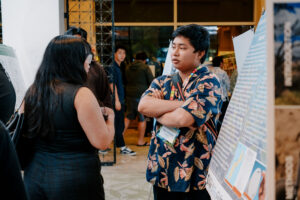
EPSCoR undergraduate student researcher Napu Camacho with his poster at the 2025 Conference on Island Sustainability.

From undergraduate students to faculty members, researchers from the University of Guam NSF EPSCoR program showcased their recent and ongoing projects at the 16th University of Guam Conference on Island Sustainability (CIS2025).

Student Research Experience (SRE) Program

Four undergraduate student researchers revealed their projects under the 2025 EPSCoR SRE Program during the CIS2025 Community Night Poster Presentations. The EPSCoR SRE Program allows students to work with mentors who will guide them in gaining experience in research and encourage careers in STEM.

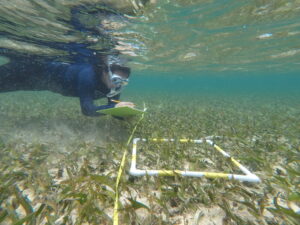
Among the posters on display was Na’pu Camacho’s project “Assessing Marine Fish-Biodiversity in Pago Bay Using Environmental DNA (eDNA) Analysis.” Under the tutelage of Bastian Bentlage, PhD, Camacho will be collecting water samples along different sites within Pago Bay at different tide levels. The water samples will then be filtered to extract environmental DNA (or eDNA) to observe the variety of fish species within the existing marine habitats.

Camacho believes that his research will be useful for numerous reasons including the ability to assess environmental changes within a marine system as well as helping develop the use of eDNA as a reliable method of evaluating fish biodiversity.

“I’d really love to discover a new species,” said Camacho about his ultimate research goal, “because then I can have it named after me.”

Here are the Guam EPSCoR SRE research posters presented at CIS2025 Community Night: 

    •  “Assessing Marine Fish-Biodiversity in Pago Bay Using Environmental DNA (eDNA) Analysis” by Napu Camacho
    • “Underexplored Sand Biofilm Habitats of Mastogloia in Guam” by Maya Flores 
    • “Guam’s Enigmatic Ghost Shrimp: Biodiversity and Taxonomy of Local Callianassidae” by Diego Ray Quiogue 
    • “Assessing Symbiont Responses to Heat Stress in Acropora pulchra” by Ale’a Duenas
BA7A3778
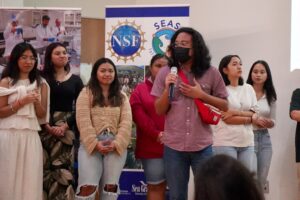
Guam NSF EPSCoR Graduate Research Assistant Diana Noto presents on her project "Diversity of True Crab (Infraorder: Brachyura) Inhabitants Across Algal Hosts” at the 16th UOG Conference on Island Sustainability.

EPSCoR researchers presented at CIS2025 breakout sessions

On Thursday, April 10, a breakout session with researchers under the EPSCoR GECCO program was held featuring Biorepository Assistant Professor on Vertebrate Morphology Michalis Mihalitsis, PhD,  Graduate Research Assistant Andrew O’Neil and Graduate Research Assistant Diana Noto. During the session, the researchers presented findings and progress of recent and ongoing projects.

Mihalitsis’s presentation was on the feeding ecology of species of surgeonfish, during which he discussed the morphological adaptations of some species to feed on algae and shared video footage to demonstrate those adaptations.

O’Neil updated on his ongoing research studying the effects of turbidity and sedimentation on reef fish, in particular the twinspot damselfish. Among the objectives of his study include examining changes in gill structure and oxygen efficiency as a result of the sedimentation.

Finally, Noto presented progress on her thesis “Diversity of True Crab (Infraorder: Brachyura) Inhabitants Across Algal Hosts.”  Noto has been collecting macroalgae across reef habitats on Guam to observe the species of true crabs that can be found within them. She intends for her research to fill an existing knowledge gap since despite macroalgae’s significance within marine ecosystems, there are few studies on it within the tropical Pacific region.

“Macroalgae is generally an under-explored habitat for biodiversity,” Noto stated during her presentation. “There’s more research that has been done on temperate ecosystems. However, only two studies have occurred in tropical ecosystems, which is likely due to the fact that a lot of our focus here tends to be on the coral we have and less on the algae, but we’re trying to work on that with this.”

Research and projects under the Guam NSF EPSCoR GECCO Project are meant to promote understanding of the Micronesian region’s biodiversity and identify solutions that promote the sustainability of coral reefs in rapidly changing environments across the tropical Pacific.

New EPSCoR undergraduate student researchers looking forward to jumping into labs

EPSCoR 250129 SEASEPSCOROrientation 103
Guam NSF EPSCoR welcomes 4 new undergraduate student researchers for 2025. Front Row (L-R): Ale'a Duenas, Napu Camacho, Diego Quiogue, and Maya Flores.

Guam NSF EPSCoR welcomes four new UOG students to the 2025 Student Research Experience (SRE) program.

Each student will undergo their own research projects under the guidance of one of the Guam NSF EPSCoR faculty mentors – either Christopher Lobban, Ph.D., Robert Lasley, Ph.D., or Bastian Bentlage, Ph.D.

Maya Flores, a sophomore majoring in psychology, has already begun working with Lobban observing diatoms in the genus Mastogloia

“I’ve already started doing some research so what I’ve found is that it requires a lot of patience, especially looking at diatoms for a couple of hours through the microscope,” said Flores.

She believes that she has the qualities required to diligently observe the microscopic organisms. In fact, she has already become comfortable identifying a few different species of diatoms under the microscope after just a few days studying under Lobban.

“I was just so surprised at how quickly I caught on,” said Flores. 

Napu Camacho, a junior in the biochemistry dual track, has begun discussing his research project with Bentlage. Camacho, who intends to go to medical school and become a doctor, plans to bring the skills he acquired doing course lab work to the research experience.

He hopes that through the research experience he will gain more experience in research that will help him in his future career in the medical field. 

On the other hand, Diego Quiogue, a biology major, still has yet to decide on a specific career path and hopes that the Student Research Experience will help him narrow his choices.

“Since biology is such a huge field, I was hoping [the research experience] would kind of help me narrow down, at least in terms of marine biology,” said Quiogue, who will be studying crustaceans with Lasley.

“I could decide whether or not I absolutely love it and then decide to maybe get a master’s in marine biology,” Quiogue said 

Ale’a Duenas, a previous NSF SEAS INCLUDES undergraduate fellow, will bring her previous research experience to her work under Bentlage. She hopes to be able to learn more about the work and benefits of the research that takes place in Bentlage’s laboratory. 

One of Duenas’ goals in this experience is to learn to share research in a way that helps to keep the community better informed. She believes that research is the most impactful when it is accessible and hopes to communicate her findings in a way that inspires and resonates with people.

To see the full interview with the new student researchers, you can watch the video below:

UOG EPSCoR and INCLUDES introduce 2025 undergraduate fellows 

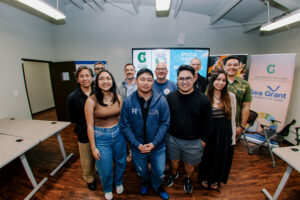
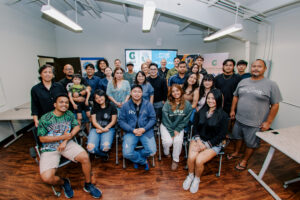
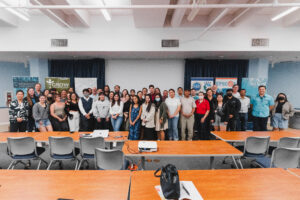
Above, the eight undergraduate research fellows for the Guam NSF EPSCoR and Guam NSF SEAS Island Alliance INCLUDES student research programs are together with their family, friends, and research mentors at the family orientation meeting in January

The University of Guam has announced the selection of eight students from diverse STEM fields as the 2025 undergraduate research fellows for the Guam NSF EPSCoR and Guam NSF SEAS Island Alliance INCLUDES programs.

The undergraduate fellows were introduced at a family orientation meeting held in January. Among the eight students, four are part of the NSF EPSCoR Student Research Experience (SRE), while the other four are part of the NSF SEAS Island Alliance INCLUDES undergraduate fellowship.

Here are the 2025 research undergraduate fellows:

  • Archancel Abellera (INCLUDES)
  • Azer Bilimon (INCLUDES)
  • Kiaza Jerao (INCLUDES)
  • Cameron San Agustin (INCLUDES)
  • Napu Camacho (EPSCoR)
  • Ale’a Duenas (EPSCoR)
  • Maya Flores (EPSCoR)
  • Diego Quioge (EPSCoR)

Both programs aim to encourage students to pursue careers in STEM fields. As part of their experience, students engage in research projects with various mentors who possess expertise in areas ranging from marine biology and plant conservation to engineering

Bastian Bentlage, Ph.D., associate professor of bioinformatics and co-principal investigator of Guam NSF EPSCoR, meets with the student researchers under his mentorship. The Guam NSF EPSCoR and Guam NSF SEAS Island Alliance INCLUDES student research programs recently introduced eight fellows for the 2025 Student Research Experience (SRE) and undergraduate fellowship programs at a family orientation meeting in January.

Some students have participated in other NSF EPSCoR or INCLUDES programs, such as Bilimon from the Marshall Islands, who worked with UOG Civil Engineering assistant professor Ernesto Guades, Ph.D., on research exploring the potential of coconut fibers as a construction material. Bilimon mentioned that he will continue working under Guades’ mentorship for his undergraduate fellowship.

Reflecting on his fellowship, Bilimon, who is enrolled in the civil engineering program at UOG, stated, “Science has always piqued my curiosity, thanks to my love for sci-fi movies, and I was part of the STEM students at my previous institution. Especially since the Marshall Islands has been struggling with climate change, I want to learn more to find solutions that can improve my community.”

For Jerao, being selected as a 2025 undergraduate fellow marks a significant step in her STEM career. She is eager to grow academically, professionally, and personally through this opportunity.

“What interests me in STEM is how it pushes the boundaries of what we know and can do. Whether it’s exploring new scientific principles or solving real-world problems, STEM allows us to translate complex ideas into practical solutions that can truly make a difference,” Jerao shared.

Duenas, a previous SEAS Island Alliance undergraduate fellow, has returned to the program, this time as a Guam NSF EPSCoR researcher under the mentorship of Bastian Bentlage, Ph.D. She explained, “I chose to pursue another student research experience to explore a wider range of opportunities beyond fisheries and gain exposure to different areas of research.”

Now that she has a better understanding of what to expect from the experience, Duenas is determined to make the most of her time in the program. “I hope to spend as much time as I can in the lab to learn new things beyond the scope of my project,” she said.

Robert Lasley, Ph.D., curator of crustacea with the University of Guam’s biorepository team, meets with the student researchers under his mentorship. The Guam NSF EPSCoR and Guam NSF SEAS Island Alliance INCLUDES student research programs recently introduced eight fellows for the 2025 Student Research Experience (SRE) and undergraduate fellowship programs at a family orientation meeting in January.

Quioque, whose mentor is Robert Lasley, Ph.D., the curator of crustacea of the Guam EPSCoR GECCO Biorepository, hopes the skills he acquires from the research experience will bolster his confidence in pursuing a career in biology.

“My inspiration for applying for the student research experience was to push myself out of my comfort zone,” said Quiogue, a junior majoring in Applied Biology. “I also wanted to gain valuable skills and experience.”

The undergraduate research programs offer participants a chance to collaborate with experienced researchers and benefit from ongoing mentorship. Through near-peer sessions, the participants can learn from individuals who have recently completed their fellowship. Participants also receive a monthly stipend to support their work in the program. Additionally, the program provides opportunities to attend national STEM conferences, allowing for networking and the exchange of knowledge.

Near Peer students reflect on 2024 experiences

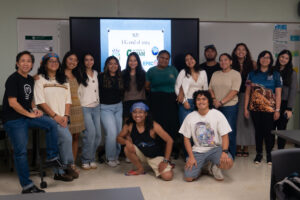
The 2024 cohort of the Near Peer mentorship consisting of 12 students from NSF INCLUDES SEAS Islands Alliance and Guam EPSCoR came together one final time in November 2024. 
The 2024 cohort of the Near Peer mentorship consisting of 12 students from Guam NSF EPSCoR and NSF INCLUDES SEAS Islands Alliance came together one final time in November 2024. 

From fostering independence to establishing a clear career path — the 12 students who participated in the 2024 Guam NSF EPSCoR Student Research Experience (SRE) and the Guam NSF SEAS Islands Alliance undergraduate fellowship shared their insights at a final Neer Peer mentorship meeting in November.

Overseen by Cheryl Sangueza, Ph.D., the Near Peer mentorship creates an opportunity for student researchers to learn from and mentor each other and shape their career paths in STEM (Science Technology Engineering and Mathematics). Sangueza is the student coordinator for Guam NSF EPSCoR and co-principal investigator of Guam NSF SEAS Islands Alliance.

One of the major goals of the program is to prepare the students for the SACNAS National Diversity in STEM Conference, teaching them how to network and best present themselves at the nation’s largest diversity conference. Another goal of the program is to help the students relate their experiences to things outside of science, including how their research connects with identity and culture.

“The process is the product,” said Sangueza during the meeting, driving home that the Near Peer mentorship and research experiences impact the evolution of their self-identity. “It’s the process and the journey that is the product.” 

Between bites of pizza, the students discussed their experiences in research, reflected on the year and wished each other well on their future endeavors. While they all had different backgrounds, experiences and intentions in participating, every student was able to clearly communicate the value of the program. 

Nicole Pineda, a Guam NSF EPSCoR SRE student, who is in the pre-med biology track decided to participate in the program to widen her perspective on STEM careers. She expressed that she found the mentorship incredibly valuable as she performed research on the ecophysiology of Ostreobiu, a genus of green algae. Despite having no background in marine biology, Pineda was welcomed by her mentors and peers in order to help her build a foundation on the topic.

“I really enjoyed having independence over my own project and something that I could see grow throughout the months,” said Pineda, adding that there was a sense of fulfillment from being able to have questions answered by her research as time went on.

Throughout the year the students not only grew professionally but also personally, finding that the program became a place to learn about themselves. For example, Pineda has become more interested in research-based STEM careers after completing the program.

(Left to Right) Ale'a Dueñas, Nadley Yow, and Nicole Pineda all smiles at the November 2024 Near Peer meeting.

Despite originally being disinterested in the length of time it takes to earn a Ph.D., Guam NSF SEAS Islands Alliance fellow Nadley Yow realized that she wanted to pursue one after interacting with so many scientists and discovering how much more knowledge there is out there.

Cyril Concepcion, another Guam NSF SEAS Islands Alliance fellow, came to appreciate how empowering it is to be a woman in STEM. Originally feeling the “Women in STEM” label to be tokenizing, her perspective shifted after time with her Near Peer cohort.  

“It’s more like an identity that you can help connect with others,” said Concepcion, admitting that she no longer feels limited by the term. “You can be that representation that little girls need.” 

(Left to Right) Mya Ngemaes, Jeniel Mian, Cyril Concepcion and Mak Dela Cruz sharing a laugh as they reflect on their undergraduate research experiences. 

Of course, while the program touts itself as a vehicle for self-discovery and career growth, the main benefit of the Near Peer mentorship was the camaraderie. While each students’ research varied, all of the students could agree on one thing: the program gave them a sense of community amongst fellow researchers.  

“If you didn’t already feel like you belong in the science community, you come into this and you find out that, there are people that feel the same way as you,” said MaryJolleen Perez, affectionately known as MJ to her peers. 


Perez, who studied diatoms under Guam NSF EPSCoR’s Christopher Lobban, Ph.D., spoke about feeling self-conscious over struggling with her research or not having enough information. She had been previously concerned that she was behind in her research, but later found reassurance that her peers could identify with that feeling. 

MJ Perez shares with fellow researchers at the final Near Peer meeting of 2024.

“The Near Peer definitely helped in a way sort of like affirm that I belonged here,” agreed Daniel Urbano, another Guam NSF EPSCoR student researcher, “because no matter how I felt in my research, like, ‘oh, I feel like I’m behind on things’ or like ‘this study isn’t as important as maybe some of the other studies’… everyone was sort of in the same boat when we went to Near Peer. We could talk about it peer to peer, as equals.”  

The Near Peer mentorship will start up again in Fañomnåkan 2025 with a new batch of student researchers. Students who participate in either the undergraduate fellowship or SRE can look forward to benefitting from the mentorship program.  

.

UOG accepting applications for paid student research program

UOG SRE 1
UOG SRE 1

The University of Guam is now accepting applications for the Student Research Experience (SRE) program for undergraduate students for the 2025 term.

The program is headed by the Guam National Science Foundation’s Established Programs to Stimulate Competitive Research (Guam NSF ESPCoR) Education Workforce Development (EWD) team. 

Selected students will participate in the year-long paid research internship and receive faculty mentoring, possible travel opportunities and a monthly $500 stipend. 

“This is a great opportunity for students who are interested in STEM to get hands-on lab experience with distinguished mentors here at UOG,” said Guam NSF EPSCoR EWD Project Associate Hannah Perez. “This is a wonderful development opportunity for undergrad students from UOG or GCC.”

The mentors for the upcoming cohort are:

-Bastian Bentlage, Ph.D. who specializes in coral molecular biology
-Christopher Lobban, Ph.D. a leading Diatom biologist
-Robert Lasley, Ph.D., an internationally renowned crustacean biologist

Interested students can visit guamepscor.uog.edu/student-research-experience-sre to submit applications now.  

Deadline for applications is October 31, 2024 with notifications of acceptance expected to be sent out by November 22, 2024. 

The program will officially take place from January to December 2025 at the University of Guam.

For more information, students can contact Perez at perezh8997@triton.uog.edu or call 671-787-3440. 


Guam NSF EPSCoR welcomes new student researchers

DSC08990

SRE:   

This year, Guam NSF EPSCoR welcomed five undergraduate students from the University of Guam to its Student Research Experience (SRE), a yearlong internship that provides these students with research training, fieldwork experience, and networking opportunities under the mentorship of scientists and subject matter experts from UOG.  


Nicole Pineda: 

Nicole Pineda feels that the SRE program will help bolster her skills as a biology major.  

During her time in the program, Pineda is studying the biodiversity and biological factors of the green algae genus Ostreobium under the mentorship of Héloïse Louise Rouzé, Ph.D. 

Pineda says that she is ecstatic to gain more research experience and learn skills outside of her time in the classroom.  

“I feel that this research internship would allow for the hands-on component that reaches further than studying my science courses at University alone and would propel me to develop different perspectives in my STEM career,” said Pineda.  


Daniel Urbano 

 Applied biology major Daniel Urbano considers being in the SRE program a major step in his scientific journey.    

“This will serve as a great jumping off point in my scientific career and I’m very happy that I’m able to participate as an EPSCoR SRE,” said Urbano.  


For his project, Urbano will research the assessment of macro algae community assemblage and diversity in Guam under the mentorship of Robert Lasley, Ph.D., a UOG senior research associate of crustacean biology.  


Urbano says that he looks forward to the opportunity to conduct field studies and diving deeper into his research in a formal lab setting.   


MaryJolleen Perez

Integrative biology major Maryjolleen Perez is excited to connect and collaborate with the other SRE participants in her cohort. 

“I feel extremely fortunate to have been given the opportunity to work alongside and learn from an amazing mentor and make new connections within the STEM field,” said Perez.  

Under the mentorship of Christopher Lobban, Ph.D., Perez is researching marine benthic diatom biodiversity and biogeography.  

Perez is most excited about acquiring a new perspective through data collection and is eager to immerse herself in the experience and expanding possibilities it affords.    


Ave Lyn Medina 

Chemistry and biology double major Ave Medina appreciates the support she’s experienced during her time in the SRE program.  

“The program and everyone involved in it have been extremely kind and wonderful to work with!” said Medina. “The program provides an incredible opportunity to gain practical experience in a laboratory setting. And what’s even more exciting is that as an SRE you get to play a major role in a research experiment right from the start.” 

Under the mentorship of Bastian Bentlage, Ph.D., Medina is researching how bacteria, specifically two strains of Endozoicomonas, may enhance the growth of Cladocopium C40, a genus of Symbiodiniaceae which plays a significant role in the health of coral reef ecosystems. 


Mya Ngemaes 

Mya Ngemaes is brimming with excitement to be a part of the EPSCoR Student Research Experience. 

As a third-year biomedical major minoring in sociology, Ngemaes is looking forward to broadening her understanding of STEM through the SRE program.  

It’s an amazing opportunity to be part of a program that fosters scientific exploration and innovation in STEM fields. The chance to contribute to research while gaining valuable experience and skills is truly invaluable.” 

Ngemaes is currently under the mentorship of Ciemon Caballes, Ph.D., researching the role of starvation in the decline of crown-of-thorns sea star (COTS) outbreaks; specifically Ngemaes is investigating abrupt decreases in COTS abundance at the end of outbreaks and the role of starvation in disease susceptibility and transmission for the purpose of understand the dynamics of COTS populations and their interactions with prey availability, pathogen susceptibility and transmission. 

Ngemaes looks forward to the opportunity to acquire more lab experience while working alongside others who share her deep passion for marine ecosystems. 

Guam NSF INCLUDES and EPSCoR welcomes 12 new student researchers

DSC08990

Guam National Science Foundation-Established Program to Stimulate Competitive Research (Guam NSF EPSCoR) and Guam NSF SEAS Island Alliance INCLUDES programs at the University of Guam welcomed 12 new student researchers and their families at an orientation held at the UOG CLASS Lecture Hall at the start of the year.  

The student researchers will be participating in the 2024 Student Research Experience (SRE) program. This initiative aims to boost the quantity and diversity of students pursuing careers in STEM fields.  

The program is specifically designed for undergraduates who are seeking valuable research opportunities. Out of the 12 student researchers, five are supported by Guam NSF EPSCoR and seven by Guam NSF SEAS Island Alliance INCLUDES. 

The event was also organized to introduce    the new SREs to their faculty mentors who will be working with them in the coming year.  

Emily Wendte, education and workforce development program associate for Guam NSF EPSCoR-Guam Ecosystems Collaboratorium for Corals and Oceans (GECCO) facilitated the family orientation event.  

Wendte emphasized the role of the family and mentors in the SRE program. “It’s important to us to involve the family members of our students as much as possible so that during the student’s year-long journey, family support groups are able to ask their student participants questions about how things are going in order to offer support.”  

“We want family support groups to understand the nature and requirements of the National Science Foundation grant, and that working along with it can ultimately lead to bigger and broader opportunities for the student”, added Wendte.  

The UOG CLASS Lecture Hall erupted with applause from families in attendance as students signed agreements officially entering themselves into the program. 

Wendte said that it is a binding agreement for students to fulfill the expectations and obligations outlined by the grant. This includes maintaining communication with peers and mentors, diligently performing research in labs, participating in fieldwork, and adhering to proper protocols and procedures. 

Among the mentors and students were alumni of the program, sharing advice and experiences with excited newcomers. 

Wendte recognized Brandon Respicio, a program alumnus at the orientation, recalling his journey through the program. Respicio participated in the Summer Math Research Experience (SMRE) and SRE in 2022 and 2023 respectively. 

Respicio’s list of accomplishments includes scholarship awards to attend the 2022 and 2023 Society for the Advancement of Chicanos/Hispanics and Native Americans in Science (SACNAS) National Diversity in STEM (NDiSTEM) conference. He also received recognition for his student poster presentation at the 2023 SACNAS NDiSTEM conference.  

Respicio is currently in his final semester at UOG as a secondary education student majoring in mathematics. He is a first-generation college student.   

Wendte says, “At completion of the program, he really wanted to share what he had accomplished that year with his family. His parents were beaming! They looked just as excited and proud as he did.” 

For Wendte, witnessing the growth of each student as they progressed through the program helps her to understand the significance of the work she continues to do. 

“At the end of the program, when we get to see the fulfillment, pride and joy these students have in what they accomplished—it’s really heartwarming. It’s one of those reminders of why we do what we do,” Wendte said. 


New Student Researchers Complete Guam NSF EPSCoR 2023 Student Research Experience Program

Anna Mallari

Guam NSF EPSCoR is excited to celebrate five undergraduate students from the University of Guam for completing their term with the 2023 Student Research Experience, which provides research opportunities and mentorship to selected students for a year.  

As part of their research training, these students conducted field work to investigate coral reefs and learned skills such as DNA extraction and sequencing.  

This year, the program’s student researchers engaged in a variety of fields such as coral genomics, marine microbiology, marine ecophysiology, and more. 


ANNA MALLARI

Anna Mallari is a civil engineering student who, under the mentorship of Dr. Bastian Bentlage, studied microbial communities in the soils within the La Sa Fua Watershed in southern Guam. 

“I believe that learning goes beyond the classroom setting, as it involves not only understanding theories and concepts but also applying them to solve real-world problems,” Mallari said. “Having the opportunity to conduct research that could contribute to our island’s sustainability is such a rewarding feeling.”  

Mallari said that engaging in a research experience as an undergraduate was a privilege for her and that she found conducting research outside of the field of engineering a welcome challenge.  

During her time in the program, Mallari was one of two UOG students who researched how to convert seawater into renewable energy as part of a summer program held at the U.S. Department of Energy’s Pacific Northwest National Laboratory.  


MERRY ANN OCAMPO  

Integrative biology major Merry Ann Ocampo said that the Guam NSF EPSCoR SRE program has not only opened up research opportunities for her, but the chance to connect with the community.  

“As much as I enjoy my research, sharing it with the community is the best part because I get to interact with others about my new findings and my experience in being a student researcher,” said Ocampo. “Seeing others interested in my research makes me really happy and reminds me why I love science and research.”  

Under the mentorship of Christopher Lobban, Ph.D., Ocampo studied the diatom genus Mastogloia on sea grass leaves. Diatoms are microalgae which can be found in every habitat where water is present. For her research project, Ocampo collected sea grass from various parts of Guam including sandy beaches and mangrove forests.  


MADELINE GONZALEZ 

Integrative biology major Madeline Gonzalez said that the Guam NSF EPSCoR SRE program is a great opportunity to learn new skills and explore careers.  

Under the mentorship of Sarah Lemer, Ph.D., Gonalez studied the phylogeny of Spondylidae, a family of bivalve mollusks.  

“Seeing the real-world applications of what I have been learning in my courses has been exciting.” said Gonzalez. “I’m always looking forward to learning something new – and there is always something new to learn in the lab.”  


CASSANDRA PAULE  

During her time in the Guam NSF EPSCoR SRE program, integrative biology major Cassandra Paule studied coral reproduction under the mentorship of Ciemon Caballes, Ph.D. 

“I’m ecstatic to be a part of this research community,” said Paule.  


 BRANDON RESPICIO  

Brandon Respicio is a secondary education major with a focus in mathematics who studied under the mentorship of Héloïse Rouzé, Ph.D., during his time in the SRE program.  

Respicio’s project focused on the endolithic algae Ostreobium and the effect it has on the coral species Porites cylindrica. For his study, he compared P. cylindrica from Luminao and Tumon based on the eutrophication levels found in these areas. 

Before his time in the SRE program, Respicio was in the 2022 Guam NSF EPSCoR Summer Math Research Program. During his time in the program, he was able to produce mathematical models based on coral reef dynamics in relation to algae.  

“I enjoyed the research and experience I gained while being a EPSCoR SRE,” Respicio said.  

In October 2023, Respicio’s project won a student poster award at this year’s 2023 SACNAS National Diversity in STEM Conference.  

Six student researchers join Guam NSF EPSCoR 

EPSCoR INCLUDES Family Orientation 2023 1
EPSCoR INCLUDES Family Orientation 2023 1 scaled
Guam NSF EPSCoR welcomed six undergraduate students from the University of Guam to its 2023 Student Research Experience (SRE) as part of an orientation ceremony held on Jan. 26, 2023, at the UOG School of Business and Public Administration. Photo courtesy of Guam NSF EPSCoR

Guam NSF EPSCoR welcomed six undergraduate students from the University of Guam to its 2023 Student Research Experience (SRE) as part of an orientation ceremony held on Jan. 26, 2023, at the UOG School of Business and Public Administration.   

The initiative of this internship is to increase the diversity of students who choose STEM careers.  

As part of the program, these student researchers will spend a year receiving mentorship and research experience in fields such as coral genomics, invertebrate genomics, marine microbiology, molecular ecology, marine ecophysiology, and diatom diversity.  

These students include Madeline Gonzalez, Thomas Babauta, Anna Mallari, Merry Ocampo, Cassandra Paule, and Brandon Respicio. 

“It’s a privilege to be able to welcome and work with all of you,” said Terry Donaldson, Ph.D, the principal investigator and project director of Guam NSF EPSCoR. “Do good work and have a lot of fun!”  

These students will also participate in near-peer mentorship programs which will encourage them to share their experiences and learn from participants in the NSF INCLUDES: SEAS Islands Alliance along with other programs under Guam NSF EPSCoR. 

During the SRE program, the student researchers will be able to present their research at various conferences such as the National Diversity in STEM Conference held by the Society for the Advancement of Chicanos/Hispanics in Science, the UOG Center for Island Sustainability Conference, and the UOG CNAS Conference.   

 2022 Student Research Experience: Meet our Student Participants!!  

Zaine Benavente 2022 SRE
Jackie Cabusi 2022 SRE
Jacquelyn Cabusi

This year, Guam NSF EPSCoR welcomed 10 undergraduate students from the University of Guam to its Student Research Experience. From coastal oceanography to red algae ecology and diadromous genomics, the internship offers mentorship and research training to increase the diversity of students who choose STEM careers and teach them skills such as DNA extraction and sequencing, experimental design, and more. In this article, we will introduce five out of the 10 students who have joined the program.  

Jacquelyn Cabusi, a pre-pharmacy and bio-medical track double major, joined the program to gain experience conducting research. Under the mentorship of Atsushi Fujimura, a UOG professor of oceanography, Cabusi will focus on analyzing concentrations of toxic chemicals in Guam’s marine environments during and after the SARS-CoV-2 pandemic and how they impact coral health. One of the chemicals that will be included in the study is oxybenzone, which can be found in products like sunscreen and certain cosmetics and can negatively affect coral health.  

“What I really enjoy about EPSCoR is that it’s allowing me to explore options and paths that I could possibly take,” said Cabusi. “Throughout my time here in EPSCoR, the primary thing I would like to learn is the reason why I applied – which is to learn more about the processes that surround conducting a research study. I’m excited to construct my own experimental design and carry it out, as well.”  

Anela Duenas 2022 SRE
Anela Duenas

This is not the first time that Anela Duenas, a biology major, has participated in a STEM research program. Her time as a 2021 NSF INCLUDES: SEAS Islands Alliance research fellow led her to become interested in the Guam NSF EPSCoR Student Research Experience as an opportunity to further enhance her research knowledge and build relationships with her mentor and peers.  

Under the mentorship of Tom Schils, a UOG professor of marine biology, she is working on the experimental design of her research project, which will focus on studying crustose calcifying red algae (CCRA). CCRA is a group of marine algae that deposit limestone like stony corals.  

After earning an undergraduate degree, Duenas plans to pursue higher education to eventually return to the Marianas and continue answering questions about the region’s marine ecosystems.  

“After graduate school, I plan to come back to the Marianas – more specifically Saipan because that’s where I’m from – and I want to conduct some research and hopefully help open the first marine lab there,” said Duenas. 


Hunter Sidell 2022 SRE
Hunter Sidell

Hunter Sidell got to know his mentor, Daniel Lindstrom, when he volunteered to help the UOG professor of biology collect specimens in 2021. Sidell has always been interested in the field of biology and finds his background as a philosophy major to be helpful when it comes to conducting research as it encourages him to be curious to find answers about the world around him.  

Under Lindstrom’s mentorship, Sidell’s research will involve learning more about the island’s native diadromous shrimp species. Diadromous animals are those that transition between freshwater and saltwater environments at different stages of their life cycles. Animals that are diadromous on Guam include certain species of fish, shrimp, and snails. 

“Dr. Lindstrom’s amazing. I knew that he would be a great mentor when he bought me pizza,” Sidell said. “I’d always ask a lot of questions and he never got impatient. In fact, it seemed like he was always happy to answer my questions and it created this sort of dialogue where he wanted to answer all of my questions and I wanted to keep on asking them so I could learn more. There’s nothing more I could ask for. I hope I can continue working with him.”  

__  

Antoni Badowski 2022 SRE scaled
Antoni Badowski

Antoni Badowski, a biology major, joined the SRE program to gain research experience and apply what he’s learned in his classes to conducting research. 

Badowski, who has always been fascinated with the natural world, says that being mentored by Daniel Lindstrom has been a great experience. Under the mentorship of Lindstrom, Badowski is excited to learn more about the diadromous animals that are native to Guam.  

“I am most excited to meet and work with other people who are passionate about the natural world,” Badowski said. “I’m also excited to explore and find out my areas of interest and career fields to get know more of what I can do in the future and what I can accomplish.” 

__  

Zaine Benavente 2022 SRE scaled
Zaine Benavente

Zaine Benavente, a biomedical track major, saw the SRE program as a way to gain experience and become more familiar with the lab procedures he would conduct in his classes.  

“I just finished my genetics class and I was thinking that I could get more experience here because we had been doing a lot of extractions and procedures in the lab and I wondered if it would be similar,” said Benavente. “And it is quite similar! Now, I’m applying what I’ve learned in the classroom to my internship.”  

During the program, Benavente has been performing DNA extractions of coral samples as part of his work with David Combosch, a UOG professor of population genetics. Combosch’s research explores evolutionary questions in island settings using genetic and genomic approaches to inform coral reef conservation, management, and restoration.  

“As one of my career goals, I always told myself that I wanted to be a medical lab technician,” said Benavente. “But now that I’m in a STEM program, I get to explore and pick the brain of my advisor about what it’s like to be a researcher.”