
Richard Randall: The life of a naturalist  

Richard Randall Photo 1 1

Guam NSF EPSCoR is paying tribute to one of its finest in Professor Emeritus Richard “Dick” Randall, who passed away late last year at the age of 91.  

“He was kind, gentle, generous, astute, knowledgeable, and understanding – all of these amazing qualities that you would really want in not just a scientist or a professor, but a colleague and a friend,” said David Burdick, the collections manager of the Guam NSF EPSCoR GECCO Biorepository 

As a naturalist, Randall was full of curiosity and wonder for the world around him.   

His interest in corals started on a farm in Ohio, where he came across limestone fossils and asked his father what they were. This fascination led him to pursue a degree in biology and become a science teacher at George Washington High School when he and his family came to Guam in 1965.  

His daughter, Lauren Gutierrez, recalled fondly that he would spend almost every day in the ocean after they had arrived to the island.  

“When I was a kid, I used to live with him out in the reef,” said Gutierrez. “He would tie a belt to an inner tube that had a board in it. He would dive down and get the corals and I’d pick them up and put them in the inner tube.” 

Later, Randall received a master’s degree in biology from the University of Guam Marine Laboratory in 1971 – just a year after the facility was established – and went on to teach about corals at the university.  

Randall did not pursue science for fame or renown, but to satisfy his curiosity and share his knowledge with whoever was willing to listen.  

His love for the world around him was relayed through the highly detailed quality of his research, which would include meticulous notes and sketches of the coral species he observed. 

That’s just the kind of guy that he was,” Terry Donaldson, Ph.D., the principal investigator and project director of Guam NSF EPSCoR. “He was a biologist and a geologist, which is not something I always see these days. He always found something interesting to look at and he could tell you about it because he was very knowledgeable.” 

Impact on coral research  

Over the course of his life, Randall worked on 180 scientific publications and accumulated several achievements.   

Randall’s research on the impacts of crown-of-thorns starfish on the island’s reefs in the late ‘60s was foundational when it came to understanding more about how coral communities changed in response to outbreaks of the starfish, which prey upon stony corals.  

In 1983, he wrote the second volume of Guide to the Coastal Resources of Guam, a field guide of the coral species found in Guam waters.   

The UOG Marine Laboratory named a research vessel after him in 2016 for his contributions to the institution’s development.  

As part of a ceremony held in March 2022, Randall was one of six recipients of the 2021 UOG Distinguished Alumni Award – a prestigious designation given to UOG alumni based on professional accomplishments in their field, character and integrity, as well as achievements of local, national, or international significance. 

Randall’s legacy  

Although Randall has passed, his legacy lives on in the people who loved and were inspired by him. 

In June 2021, the Guam NSF EPSCoR GECCO Biorepository was given the honor to house over 30,000 coral specimens he collected – the largest addition to the facility to date.  

The GECCO Biorepository is both a physical and cyber warehouse of records and images of marine organisms found throughout the Pacific and other locales. The collection will serve as a resource for researchers around the world to reference and better understand the diversity of the corals found in the Marianas.  

In addition, Burdick, a longtime friend of Randall, is working on a series of books about coral species found in the Marianas, which will be an expansion of Randall’s coral field guide. The series will contain Randall’s notes about coral species, including new species that have not been described.  

Donaldson said that Guam NSF EPSCoR will be happy to support the completion of the project.   

“He was always amazed by life – every part of it,” said Gutierrez. “Even at 91, he was amazed by it all. He didn’t take it for granted. He had a love for nature and it’s something we’ve always shared. He always instilled in us that you can’t know everything. There’s too much to know and you have to keep your mind open.”    

Guam NSF EPSCoR welcomes new associate curator of GECCO Biorepository

Diego Vaz Profile

Guam NSF EPSCoR welcomes Diego Vaz, Ph.D., as an associate curator of the Guam Ecosystems Collaboratorium for Corals and Oceans (GECCO) Biorepository. The GECCO Biorepository is both a physical and cyber warehouse of records operated by Guam NSF EPSCoR.

Vaz was born and raised in Brazil, where he earned a bachelor’s degree in biological sciences and a master’s in zoology from the University of São Paulo. In 2015, he moved to the United States where he received a doctorate in marine sciences from the Virginia Institute of Marine Sciences. Before his current position with Guam NSF EPSCoR, Vaz was a biodiversity postdoctoral fellow at the Museum of Comparative Zoology at Harvard University.

“Taxonomy and the evolutionary part of science is the backbone of any field,” said Vaz. “You have to know the organism you have or you cannot move forward. You cannot do any experiments with them and you cannot protect them if you don’t know what you are dealing with.”

As an associate curator of the GECCO Biorepository, Vaz will research the morphology of coral reef fishes – particularly cryptobenthic fishes. Morphology is a branch of biology that deals with the study of the form and structure of living organisms. Cryptobenthic fishes are small fish that live near or within the seabed named for their elusive nature. They contribute significantly to the food web of coral reefs.

“Cryptobenthic fishes are crucial in the production of organic matter in the reef – not because they produce energy like algae, but because their high density and high mortality feed higher trophic levels, allowing the reef to be so diverse,” said Vaz.

Studying cryptobenthic fishes involves a variety of methods. As much as possible, the GECCO Biorepository takes photographs of its specimens as they exist in nature. To examine the organs of a specimen, manual dissections are performed.

When it comes to examining a specimen’s skeleton, Vaz uses a technique called clearing and staining. In this process, specimens are bathed in a digestive enzyme to slowly break down their flesh and muscles, rendering them transparent. After, they are treated with a series of dyes that stain the cartilage and bones differently.

Recently, the UOG Marine Laboratory acquired a Computed Tomography (CT) scanner. A CT scanner allows for the examination of skeletons without modifying a specimen.

“This is particularly important when you want to study rare organisms,” said Vaz. “When it comes to specimens that you can just collect in the field, it’s easier to do an invasive procedure. When it comes to a rare specimen in a collection, no one will allow you to do a procedure because they want to keep them as whole as possible.”

Regarding his experience working on the Guam NSF EPSCoR project, Vaz said that it’s been interesting to see multiple collaborations working together towards similar goals.

“Collaborations can be very challenging,” said Vaz. “Everyone works differently. This project is the first time I’ve seen such a large group of people collaborating effectively. It’s been a very interesting and cool experience to see that.”

2022 GRA: Meet our new graduate research assistants!  

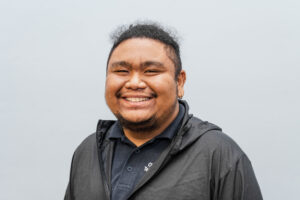
Xavier De Ramos

This year, Guam NSF EPSCoR welcomed six new members of its Graduate Research Assistantship program. Over the next three years, these graduate students will receive mentorship, training, and fieldwork experience as they pursue their master’s degree.   

Grace Jackson 

Having grown up in a small beach town in Southern California, Grace Jackson has lived her life surrounded by water.  

“This instilled in me the love for the ocean and later my scientific curiosity,” said Jackson. “I applied to this program to increase my scientific proficiency where I could learn about a different ecosystem and culture that I have not experienced before. I am so glad to be a part of this program.”  

Under the guidance of Tom Schils, Ph.D., Jackson will study crustose coralline red algae, specifically of the genus Lithophyllum.  

CCRA is a group of marine seaweeds that deposits limestone like stony corals. They serve several important ecological functions on reefs, such as building and cementing reefs together or serving as the preferred settlement substrates for coral larvae, which then further develop into adult colonies. 

Lauren Kallen  

Lauren Kallen applied to the Guam NSF EPSCoR GRA program due to the benefits and support that the program provides to its students. Kallen was born and raised in Illinois and earned her bachelor’s degree in marine biology at the University of California, Santa Cruz.  

Kallen’s advisor is Sarah Lemer, Ph.D., whose work focuses on the study of marine invertebrates. Over the course of the program, Kallen will conduct research on Drupella snails, carnivorous marine snails that feed on coral. Her research will focus on outbreaks of these snails on coral reefs because in high densities, these snails can quickly decimate a reef.  

I am very excited and grateful to be in this program, it is an amazing opportunity. I am very interested in outreach and giving back to the beautiful community in Guam,” said Kallen.   

Garret O’Donnell  

While looking for potential graduate programs, Garret O’Donnell found out about the Guam NSF EPSCoR program through his mentors from the University of Florida. 

Under the guidance of David Combosch, Ph.D., O’Donnell will study Leptoria, a genus of brain coral. O’Donnell said that he is interested in Leptoria’s population genetics, spawning behavior, and abiotic stress responses to factors such as heat and low oxygen.  

Since coming to Guam, O’Donnell said that he appreciates the UOG Marine Laboratory community.  

“I think everyone there has been super welcoming and super cohesive as a unit and that’s been really cool to see,” said O’Donnell. “Everyone seems to know what everybody else is doing and that’s not something you always see in science. A lot of the time, labs are kind of isolated from each other. I like to see that there’s a lot of camaraderie amongst the students and the faculty.”   

Andrew O’Neill  

Throughout his life, Andrew O’Neill found a love for the ocean. As he pursued his undergraduate degree at the University of California, Santa Cruz, he wanted to specialize in ecology and conservation. Once he learned about the Guam NSF EPSCoR GRA program, he saw it as a unique opportunity to do research and help the environment.  

During the program, O’Neill will be advised by Atsushi Fujimura, Ph.D., and plans to focus on research the effects of sedimentation on Guam’s reef fish assemblages.  

“In my first semester here, I did some instructing with some of the undergraduate biology sections and through that, I learned the Guam has a huge sedimentation problem,” said O’Neill. “Lots of silt gets washed away from all the rains and the rivers and flows down to the coastal waters. I want to figure out what would be the worst-case scenario if we don’t fix this problem.”  

Xavier De Ramos  

Knowing that he wanted to find ways to help the island, De Ramos earned a bachelor’s degree in marine biology at the University of Hawai’i, Manoa. 

“Towards the halfway point of my time in college, I started thinking about Guam – my home,” said De Ramos. “I remember having a lasting impression after I went snorkeling and I was just blown away about what I saw down there. That got me thinking about what kind of issues Guam is facing or if there was anything I could do to contribute to research regarding its coral reefs.”  

De Ramos will be advised by Ciemon Caballes, Ph.D., whose research focuses on ecophysiology as well as coral and echinoderm ecology.  

“I feel very excited about learning more through this program and my graduate courses because I want to give back to the island,” said De Ramos. “At the end of the day, giving back to the island is all that matters to me.”  

Laurie Raymundo signs on as director of the University of Guam Marine Laboratory  

DSC03835
DSC03835

History has been made with the creation of a permanent director’s position at the University of Guam Marine Laboratory. During its 52 years of existence, the facility has followed the tradition of having a three-year rotating directorship that the faculty took turns occupying. 

On August 2, 2022, UOG Professor of Marine Biology Laurie Raymundo signed her contract to fill the marine laboratory’s first permanent directorship position.  

“This is a huge change for the better. As we have grown, it has gotten harder and harder for everyone to deal with a position of leadership that is only for three years,” said Raymundo. “The continuity that the permanent position provides will enable long-term planning and implementation.” 

Raymundo’s qualifications for the job are stellar. As a coral scientist, she, her students, and colleagues have been in the forefront of coral restoration in Guam and the region. She has also held the director’s position from 2010 to 2013 and again in 2019 through August 2, 2022. 

She is happy to be able to continue her research and work with students on the university’s National Science Foundation EPSCoR grant as well as other grants she has for the next few years. Mentoring students is something she relishes, so she is not ready to relinquish that responsibility. 

When asked about her vision going forward, she gave a soft chuckle at the novelty of the question. In the past, the directorship involved putting out fires. With the new sense of stability of a permanent directorship, she wants to continue the partnerships that have been formed and wants to get faculty input as to needs going forward. Organizing a yearly faculty retreat to discuss what has been accomplished and how to propel future endeavors is on her list of priorities. 

“We work in 50-year-old buildings that have some issues, so I will be writing some grants to shore up infrastructure to meet the needs of all the new faculty we now have. There is a lot of talk about a Ph.D. program, and we have the talent, but that will need the support of the University.” 

Director Raymundo will bring some new and exciting changes to the middle-aged UOG Marine Laboratory while continuing its reputation for excellent scientific exploration and innovation. 

 2022 Student Research Experience: Meet our Student Participants!!  

Zaine Benavente 2022 SRE
Jackie Cabusi 2022 SRE
Jacquelyn Cabusi

This year, Guam NSF EPSCoR welcomed 10 undergraduate students from the University of Guam to its Student Research Experience. From coastal oceanography to red algae ecology and diadromous genomics, the internship offers mentorship and research training to increase the diversity of students who choose STEM careers and teach them skills such as DNA extraction and sequencing, experimental design, and more. In this article, we will introduce five out of the 10 students who have joined the program.  

Jacquelyn Cabusi, a pre-pharmacy and bio-medical track double major, joined the program to gain experience conducting research. Under the mentorship of Atsushi Fujimura, a UOG professor of oceanography, Cabusi will focus on analyzing concentrations of toxic chemicals in Guam’s marine environments during and after the SARS-CoV-2 pandemic and how they impact coral health. One of the chemicals that will be included in the study is oxybenzone, which can be found in products like sunscreen and certain cosmetics and can negatively affect coral health.  

“What I really enjoy about EPSCoR is that it’s allowing me to explore options and paths that I could possibly take,” said Cabusi. “Throughout my time here in EPSCoR, the primary thing I would like to learn is the reason why I applied – which is to learn more about the processes that surround conducting a research study. I’m excited to construct my own experimental design and carry it out, as well.”  

Anela Duenas 2022 SRE
Anela Duenas

This is not the first time that Anela Duenas, a biology major, has participated in a STEM research program. Her time as a 2021 NSF INCLUDES: SEAS Islands Alliance research fellow led her to become interested in the Guam NSF EPSCoR Student Research Experience as an opportunity to further enhance her research knowledge and build relationships with her mentor and peers.  

Under the mentorship of Tom Schils, a UOG professor of marine biology, she is working on the experimental design of her research project, which will focus on studying crustose calcifying red algae (CCRA). CCRA is a group of marine algae that deposit limestone like stony corals.  

After earning an undergraduate degree, Duenas plans to pursue higher education to eventually return to the Marianas and continue answering questions about the region’s marine ecosystems.  

“After graduate school, I plan to come back to the Marianas – more specifically Saipan because that’s where I’m from – and I want to conduct some research and hopefully help open the first marine lab there,” said Duenas. 


Hunter Sidell 2022 SRE
Hunter Sidell

Hunter Sidell got to know his mentor, Daniel Lindstrom, when he volunteered to help the UOG professor of biology collect specimens in 2021. Sidell has always been interested in the field of biology and finds his background as a philosophy major to be helpful when it comes to conducting research as it encourages him to be curious to find answers about the world around him.  

Under Lindstrom’s mentorship, Sidell’s research will involve learning more about the island’s native diadromous shrimp species. Diadromous animals are those that transition between freshwater and saltwater environments at different stages of their life cycles. Animals that are diadromous on Guam include certain species of fish, shrimp, and snails. 

“Dr. Lindstrom’s amazing. I knew that he would be a great mentor when he bought me pizza,” Sidell said. “I’d always ask a lot of questions and he never got impatient. In fact, it seemed like he was always happy to answer my questions and it created this sort of dialogue where he wanted to answer all of my questions and I wanted to keep on asking them so I could learn more. There’s nothing more I could ask for. I hope I can continue working with him.”  

__  

Antoni Badowski 2022 SRE scaled
Antoni Badowski

Antoni Badowski, a biology major, joined the SRE program to gain research experience and apply what he’s learned in his classes to conducting research. 

Badowski, who has always been fascinated with the natural world, says that being mentored by Daniel Lindstrom has been a great experience. Under the mentorship of Lindstrom, Badowski is excited to learn more about the diadromous animals that are native to Guam.  

“I am most excited to meet and work with other people who are passionate about the natural world,” Badowski said. “I’m also excited to explore and find out my areas of interest and career fields to get know more of what I can do in the future and what I can accomplish.” 

__  

Zaine Benavente 2022 SRE scaled
Zaine Benavente

Zaine Benavente, a biomedical track major, saw the SRE program as a way to gain experience and become more familiar with the lab procedures he would conduct in his classes.  

“I just finished my genetics class and I was thinking that I could get more experience here because we had been doing a lot of extractions and procedures in the lab and I wondered if it would be similar,” said Benavente. “And it is quite similar! Now, I’m applying what I’ve learned in the classroom to my internship.”  

During the program, Benavente has been performing DNA extractions of coral samples as part of his work with David Combosch, a UOG professor of population genetics. Combosch’s research explores evolutionary questions in island settings using genetic and genomic approaches to inform coral reef conservation, management, and restoration.  

“As one of my career goals, I always told myself that I wanted to be a medical lab technician,” said Benavente. “But now that I’m in a STEM program, I get to explore and pick the brain of my advisor about what it’s like to be a researcher.”  

Guam NSF EPSCoR welcomes new Education and Workforce Development Program Associate

Profile Story Emily Wendte
Guam NSF EPSCoR welcomes Emily Wendte as its new Education and Workforce Development Program Associate. As part of the education and workforce development division, Wendte will assist with the preparation and completion of grant reports to the National Science Foundation, keep track of project progress, and coordinate activities between students, faculty, and project partners.

Guam NSF EPSCoR welcomes Emily Wendte as its new Education and Workforce Development Program Associate. As part of the education and workforce development division, Wendte will assist with the preparation and completion of grant reports to the National Science Foundation, keep track of project progress, and coordinate activities between students, faculty, and project partners.  

Wendte grew up in Indiana where she earned her bachelor’s degree in sculpture and a minor in art history at the Herron School of Art and Design at Indiana University. She later received her master’s degree in sculpture from Arizona State University. She moved to Guam in April 2021.  

Prior to joining Guam NSF EPSCoR, Wendte taught sculpture classes at the University of Louisiana at Lafayette. Through her art, Wendte contemplates land use and the relationship people have with their environment.  

It was her interest in sustainability, the environment, and education that led her to want to join Guam NSF EPSCoR.   

“Pandemics have a funny way of making you realize what’s really important in life and I really loved being here, so I just decided that I was going to stop teaching and focus on working with my ideas within art and try to move my career into more of a sustainability-focused field,” said Wendte. 

Education has always been dear to Wendte and she looks forward to engaging with students and helping them achieve their academic goals.  

“Even though I’ve been here for a short time, everyone and how they interact with each other has been just wonderful,” said Wendte. “I’m most excited to work with the students and see their research come into fruition. I hope to contribute to and add to their growth.”  

UOG alumnus creates mural for professor

Constance Mural 1 2
Constance Mural 1 2
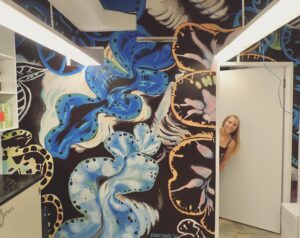
Constance Sartor, a UOG Master of Science in Biology, poses next to the giant clam mural she painted for UOG Assistant Professor Sarah Lemer.

The University of Guam Marine Laboratory has a new addition to its collection of murals — an assortment of giant clams (Tridacna maxima) in the office of UOG Assistant Professor Sarah Lemer.  

The mural was painted by Constance Sartor, a University of Guam Master of Science in Biology. Sartor has been under the mentorship of Lemer since 2018 as part of the university’s Guam NSF EPSCoR Graduate Research Assistantship.  

According to Sartor, Lemer wanted a mural in her new office that was related to the work being done in the Lemer Invertebrate Genomics Lab, which is studying various marine invertebrates to better understand how they response to climate change and reef degradation. 

“I chose giant clams because I find them so naturally beautiful with their vibrant colors and different patterns — there are so many different phenotypes within a single species — so I thought they’d be perfect for her new lab,” said Sartor.  

Sartor worked on the mural while Lemer was off-island, hoping to surprise her once she arrived back on Guam. The mural took 10 hours to complete.  

“When I came back and saw the extent of what she did, it was fantastic,” said Lemer. “I’m really happy that I’ll always have this. Wherever she goes, I’ll always have this from her.” 

Graduate student participates in artist-at-sea program 

Artist at Sea Photo 1

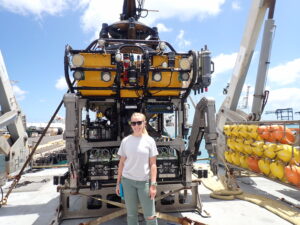
Constance Sartor, a University of Guam Master of Science in Biology and a Guam NSF EPSCoR Graduate Research Assistant, participated in the Schmidt Ocean Institute’s Artist-at-Sea program over the summer, which provides artists an opportunity to work side-by-side with marine scientists during a research expedition.  

From June 5 to July 9, Sartor spent 34 days onboard research vessel Falkor with 39 researchers and crew members as it traveled to the Phoenix Islands Archipelago, a group of coral atolls in Kiribati.  

During the expedition, the Remote Operated Vehicle (ROV) SuBastian descended as far as 2000 meters to collect deep-sea organisms within the Phoenix Islands Archipelago.  

“When you’re in a shallow reef, there’s so much diversity like fish and corals but when you get down where there’s no light, everything is kind of like a desert,” said Sartor. “It takes a while to find a tiny coral. There are not many fish so it’s like a treasure hunt. It’s surprising when you find something cool.”  

Sartor worked with the scientists to photograph and measure the samples collected by the ROV.  

In preparation for the voyage, Sartor brought more than 50 magazines with her to create upcycled collages based on the photos of the samples.  

“I advocate ‘upcycling’ because it helps keep some of the items out of landfills,” said Sartor. “Rather than using paint, which comes in disposable plastic or metal tubes, I like to give a ‘new life’ to magazines that would otherwise be thrown into landfills.”  

Out of the hundreds of samples collected over the course of the voyage, Sartor created 8 magazine collages of the unique starfish, crabs, corals and other deep-sea organisms collected by the ROV using magazine images of flowers, a sunset, and clothing.  

The body of works Sartor created are now a part of the Artist-at-Sea program’s traveling exhibit, which features art made and inspired by the work done on the Falkor. 


Meet the Team: Dirige does her part to keep the Guam NSF EPSCoR program moving forward

Janet pic

After spending her entire career working with and helping program leads and researchers as the Director for Contracts and Grants at the University of Guam (UOG) Office of Research and Sponsored Programs, Janet Dirige took a leap into the ocean known as EPSCoR and has been swimming since.  

Following her retirement from UOG in the summer of 2020, Dirige made her return to the workforce and is now the Associate Director/Project Administrator of Guam NSF-EPSCoR. 

According to Dirige, her main goal is to make sure that the program and all its components stay on track. 

“I work with project management,” explained Dirige. “I ensure that Guam EPSCoR stays within the rules and regulations of the National Science Foundation to ensure we are in compliance with expenditures and project scope of work.” 

When the mother of two is not spending time with her children or two grandchildren, you can find her listening to music, catching a movie or spending time outside gardening.  

Her strong connection to the environment and sense of family leaves her hopeful for the future and thankful for the work the EPSCoR research team is conducting.  

“I hope with all the research our research team is doing they find the solution to the coral bleaching problem,” said Dirige. “(They can) make it better for Guam and the region so we can have a better ecosystem and better environment for everyone.” 

Dirige says that she is excited to work with team members to accomplish tasks and make things happen as efficiently as possible.  

“I like to get things done,” said Dirige. “Tomorrow there is going to be another project or event that we need to take care of, so as long as it is within our budget and in compliance, let’s get it done.”  

Dirige can be found in the main EPSCoR house in Dean Circle alongside the administration team and can be reached via email at <jtdirige@uog.edu>. 

‘I think I’ve found my lifelong career’: Grad student publishes research as lead author

Coral Study Justin 1

Justin T. Berg, a graduate student in the Master of Science in Biology program, has achieved a personal first and, in the process, solidified the direction he wants to go with his career. As of February, he became a published lead author of scientific research. 

It was a study, which was funded by the university’s National Science Foundation EPSCoR grant, on the effects of shade on corals’ recovery time from heat stress, or coral bleaching, events. The researchers found that both light and temperature work together in coral bleaching events and that shading them greatly assists their recovery time. The paper is published in the peer-reviewed Marine Biology Research journal.

“I think I’ve found my lifelong career, which is extremely exciting,” Berg said. “I don’t think I’ll ever look back.”

This was the first time Berg had ever gone through the full process of writing a scientific paper to getting a project peer reviewed and published. He received support along the way and credits the Guam NSF EPSCoR program as well as Assistant Professor Bastian Bentlage, who supervised and also co-authored the study.

“Being first author is huge, especially when you’re looking into applying for a Ph.D. program,” Berg said. “I want to be able to be a professor one day and teach students and give them the opportunities I had.” 

Bentlage said a team of undergraduate and high school interns brought in by the Guam EPSCoR and NSF INCLUDES programs were also crucial in helping with the project’s experimental design and data collection. 

“It wouldn’t have been possible without all these students who were so keen on learning something new and helping my lab develop new approaches to study corals for us to use and add to our portfolio of tools,” Bentlage said. “We really went on this journey together.” 

Berg is expected to receive his master’s in biology at the end of this semester. He earned his bachelor’s from the University of Delaware, double majoring in biology and pre-veterinary medicine and animal biosciences with a minor in chemistry.

Link to original article.