
Category: All

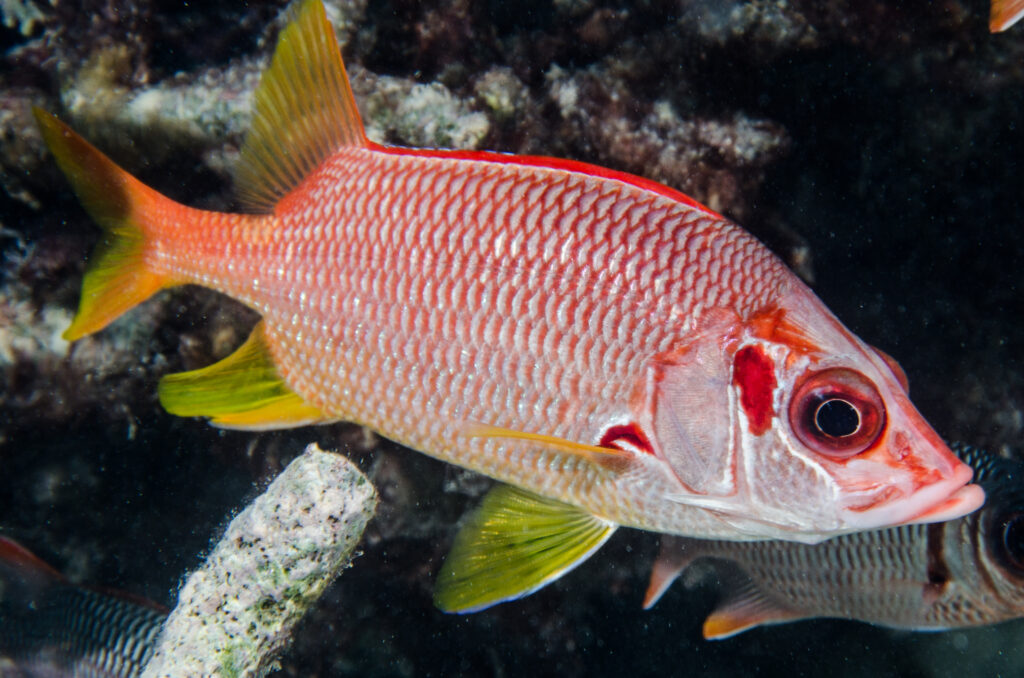
Sargocentron spiniferum or Sabre Squirrelfish, the largest member of the family Holocentridae (Squirrelfishes and Soldierfishes), are able to communicate with sound as detailed in a scientific paper recently published and co-authored by Guam NSF EPSCoR’s Terry Donaldson, Ph.D., at the University of Guam. Photo credit: Dave Burdick/Guam Reef Life
University of Guam Professor of Ichthyology Terry Donaldson recently co-authored a paper on bioacoustic communication within the family Holocentridae, a group of marine fishes commonly known as squirrelfishes and soldierfishes. These fishes are known to communicate by sound production. The paper, “Sounds as taxonomic indicators in holocentrid fishes,” was a
Peter Houk Ph.D., of the University of Guam Marine Laboratory presented at the 15th UOG Conference on Island Sustainabiliy in 2024. Researchers from all over the world are encouraged to submit an abstract for CIS2025 to be held in Tumon, Guam in April.
The University of Guam (UOG) is now accepting abstracts for the 16th annual Conference on Island Sustainability (CIS2025), a premier gathering for researchers, policymakers, and community members dedicated to building a more sustainable future for island communities.
meettheadminteam
Sitting right at the entrance of the Dean’s Circle is the Guam NSF EPSCoR Admin Office, where grant assistant Glenn Meno and financial analyst Annalyn Bansil claim to be their home away from home.
Grace McDermott displays coral samples at the Mote Marine Lab in Sarasota, Florida. Photo courtesy of Grace McDermott.

As the year 2024 reaches its end, four former Guam NSF EPSCoR Graduate Research Assistants (GRA) share where they are now, and how their time at the University of Guam helped them get there. The Guam NSF EPSCoR Graduate Research Assistantship (GRA) is a 3-year program that allows graduate students

P1330555

On November 16, the question “What are you good at?” was written at the top of the board at the Guam Green Growth Makerspace and Innovation Hub. The answers, given by kids between the ages of 6 to 13, ranged from “dancing” to “bowling” to “making smoothies”. This question is

Bastian Bentlage, associate professor of Bioinformatics at the UOG Marine Lab and one of the leads from UOG, speaks at the November town hall meeting, 'Ocean Energy Systems to Power Guam Aquaculture.' Bentlage states that UOG'd primary role in the project is to provide insights into site-specific considerations for evaluating the feasibility of deploying ocean energy systems.

Bastian Bentlage, associate professor of Bioinformatics at the UOG Marine Lab and one of the leads from UOG, speaks at the November town hall meeting, ‘Ocean Energy Systems to Power Guam Aquaculture.’ Bentlage states that UOG’d primary role in the project is to provide insights into site-specific considerations for evaluating